Two Houses and One Quiet Heart
A daughter learns to read between the lines of a life split in two
Read more →
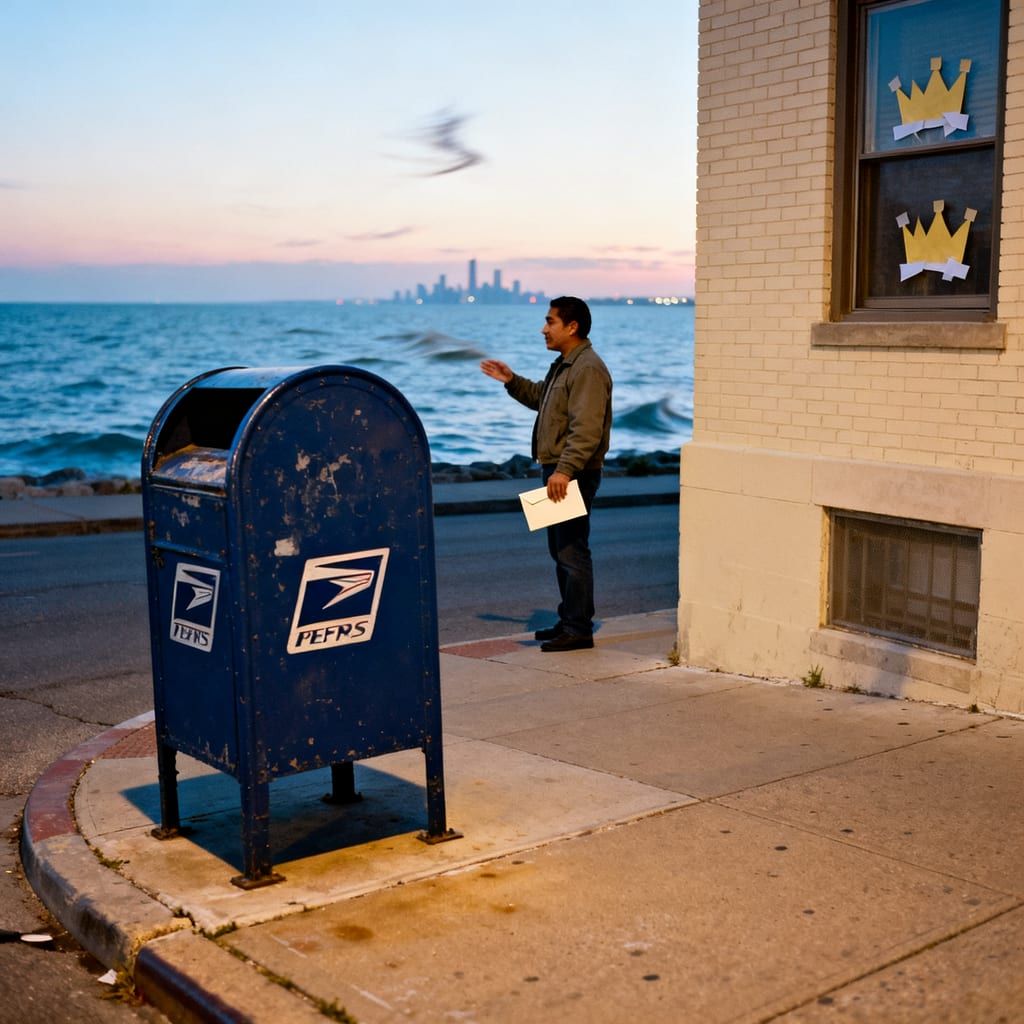
The card always finds him.
Cream stock, careful script, the kind of stationery that makes you sit up a little straighter. No return address, just the postmark marching along Chicago's North Side, a week early each June so it lands on his birthday like a train arriving on time. Inside: the same line, year after year. Another orbit. Keep going.
He runs his thumb over the words as if they were braille meant for a part of him he can't quite name. It is comfort. It is ache. It is proof that someone remembers and a reminder he doesn't know who.
By thirty-eight, Jonah Reyes has learned how to lift his life with the gentleness of a glass bowl and set it down in a new kitchen. Six rentals in ten years-walk-ups with humming radiators, a studio with a window the size of a laptop screen, a courtyard building where the vines treated the brick like scripture. He keeps the moving boxes flattened behind a closet door, just in case.
Since his mother's funeral last winter, since the relationship that was supposed to be adulthood finally unraveling, there has been no one to say You love cilantro, remember? when the grocery list stalls. The freelance calendar thins like hair. A late rent notice ends up face-down on the table. The birthday approaches with the mechanical grace of a ceiling fan.
The envelope sits by his keys. It has weight, somehow, beyond paper. This year it feels less like a blessing than a dare.
He lays out the cards from the last decade across his table, little bones of a ritual, the corners blunted by time. He's kept them all-rubber-banded, moved, re-rubber-banded, moved again. He leans over them the way his mother used to lean over recipes, palm pressed to the one that mattered.
Postmarks: Ravenswood, Andersonville, Edgewater, Rogers Park-drifting north in a lopsided migration. He maps them on his phone, watches the dots climb the shoreline like a cautious walker. The most recent is from a small station on Clark he's passed a hundred times without seeing.
Outside, the El clatters past like a drawer you forgot was full of silverware. He pockets the newest card and steps into the wind that always smells faintly of water and hot metal.
The stationer is narrow and bright, bells stitched to the door that call out like coins dropped into a song. Paper curls in stacks, inks displayed like small apothecary jars. A woman behind the counter looks up with the soft alertness of a librarian and the forearms of someone who moves boxes.
"You look like you could use something with good texture," she says, not unkindly.
"I think I've already got it," he says, sliding the cream card across. "Do you sell these?"
She lifts it with the tender severity of a midwife. "Once a year, to a woman with a little blue notebook. Spring, every time. She'd buy one, in cash. Ask to borrow a pen. Ask if she could drop it in the blue box out front instead of leaving it here."
"Did she give a name?"
"She left a note," the woman says, ducking under the counter. She returns with an envelope taped closed with washi printed with tiny moons. "Said if a certain person ever came asking, I should give him this. And the rest."
"The rest?" His mouth has gone dry. The bells on the door seem suddenly too loud for such a quiet place.
"Cards," she says. "A stack just like yours. She said to say she hoped they traveled well."
He doesn't open the envelope yet. He stares past the woman to the front window, where the blue mailbox stands squat and federal on the corner. "Did she ever wait?" he asks. "After she mailed it."
"Always," the woman says. "Wouldn't leave until the last pickup. Like she needed to see the hinge open and the arm take it away."
He knows the posture. His mother on their stoop with a college care package, arms folded, holding vigil until the carrier creaked the hinge and the box disappeared into the blue throat of the system. Each time, she'd wave-not at the mail truck, but at the idea of something she'd made going out into the world.
He takes the long way to the lake, cutting through streets that keep changing their minds about what they are-taquerias next to Pilates studios, a barber pole spinning outside a vegan bakery. The air is a humid page. By the time he reaches the path, evening has halved itself between gold and blue.
The bench is there, the one his mother favored, friendly to a view of small boats drifting back to harbor, oars clicking like knitting needles. He sits, the wood warming his palms, and thinks of all the small watchings that made his childhood: the way she'd check the stove twice, the way she'd stand under a streetlight after one of his games until he looked up from the field and knew where to wave.
A woman lowers herself to the far side of the bench with the care of someone who respects furniture. Silver hair pulled low, posture precise enough to make you want to stand up straighter. A canvas tote collapses against her shins. She looks at the water as if it has said something only she heard.
"Rosa?" he asks, surprising himself with the certainty of the name.
She smiles without turning. "I hoped you would be the kind to come sit first," she says. "Not the kind to call."
He laughs, because it feels true in a way that makes him want to deny it. "You knew my mother."
"I met her when her letter came back with a stamp that said no," Rosa says. "I was at the counter on Western. We remade the address together. She told me she hated the thought of a thing she sent not arriving."
He swallows. The lake is a patient machine turning light into movement. "The cards," he says.
"She asked me to send one every year until you stood in front of me and asked who it was," Rosa says. "Unsigned. From somewhere you could trace but not catch."
"Why unsigned?" He hears his voice come out smaller than he'd like.
"She said you were already good at gratitude," Rosa says. "She wanted to see if you could stand wonder without needing a place to put it down. He'll come when he's ready to be seen, she told me."
He wipes his mouth with the back of his hand as if to remove a taste. The cards had been a tether; now they are a bridge he's already crossing.
Rosa reaches into her tote and brings out a bundle wrapped in the kind of kraft paper he associates with honest things. Cream cards, familiar as light switches. On top, the envelope from the stationer.
"She left these," Rosa says. "Not a guarantee. A way through. When you were ready, you'd know what to do next."
He holds the weight of them like a bowl he's afraid to drop. There's grief here, and something stubborn stepping forward.
"Thank you," he says, and it is so much narrower than what he means that he has to look at the water to keep from trying to make it bigger.
Rosa stands with a patience that makes standing seem like art. "Say it to yourself, too," she says. "Sometimes that's the one that needs the stamp."
Night tilts. He walks home with the cards against his ribs, feels the edges through his shirt. He passes lit windows offering little domestic theaters: a man arguing with a blender, a cat titling its head at a moth, a kid falling asleep over a plate of spaghetti.
In his hallway, he hears singing. Off-key on purpose, the way you do to make a child laugh. His across-the-hall neighbor, the single dad with the running shoes by his door, is crouched with a guitar the color of honey. The girl-six? seven?-is holding a paper crown in both hands like a chalice. She mouths the words more than sings them, then darts an eye to Jonah as if caught stealing.
"Big night?" he asks, lowering his voice.
"Practice," the neighbor says. "Her mom's birthday's tomorrow. We're calling in the morning. Time zones." He trails off. The guitar gives a shy little chord.
The girl lifts the crown. "We're making a ceremony," she confides, serious as a newly minted judge. "You need decorations for phone birthdays."
Something eases at the edges of his chest. The perimeter he's drawn-work, microwave dinners, sleep like a sheet he pulls over his head-widens a fraction. He nods at the crown with gravity. "Looks official."
Inside his apartment, he lays a card on the table. The cream is familiar; the blank inside feels like clean snow. He thinks of ten-year-old him, making spaghetti with too little sauce, the silence of an apartment heavy enough to be a fourth roommate. What did he want to hear? What could have turned down the volume just a little on the ache?
He writes slowly, not trusting his hand at first. Today is proof you matter to someone you can't see. He leaves it unsigned. Underlines nothing. Seals with the press of a palm.
He opens his door, steps into the hall where the guitar has given up and the girl is fastening two streamers to an air vent. He slides the envelope under their door, then stands very still, because the gesture seems to make a sound only he can hear.
Over the next months, the habit changes its clothes. He buys stamps that look like tiny paintings and memorizes pickup times. He sends three more cards in the soft direction of people whose solitude shone a little too bright: to the woman in the coffee shop with a chemistry textbook and a face set like wet clay; to the older man in his building who folds his grocery bags into origami cranes in the lobby; to the barista with the chipped nail polish who still writes your name in a way that means she believes ink can pronounce you correctly.
None of them know it's him. He doesn't sign. He doesn't wait by the box-not always. Sometimes he watches from across the street as the hinge opens and the arm takes the small courage of it away. He thinks of Rosa at the window, of his mother with a package like a loaf of bread cooling in her hands.
In December, on a night that smells like iron and wool, he addresses a card to himself. Not the old line, not keep going, though he could. He writes his own name, then a sentence he is ready to read. You did not disappear when she did. He signs it. The pen hesitates, then moves. Jonah. The J looks like a hook he could grab in a storm.
On his next birthday, the cream card arrives again, as dependable as the sun finding its favorite part of the floor. He sits with it a while before opening, knowing what it will say and letting it say it. The handwriting feels like a hand on a shoulder-not his mother's, but near enough to warm him.
He carries the envelope down to the lake. On the bench, a teenager kisses his skateboard like a chalice, and a couple argues kindly about whether the sky is more violet or blue. He reads the line out loud because the air can hold it. Another orbit. Keep going.
He tucks the card back into its paper. There is room for new things beside old things-he can feel it like a new muscle waking.
On the walk home, he stops by the blue box and drops two envelopes in. One unsigned. One signed. Both true.
The hinge opens. The arm takes them. He waits, not because he doesn't trust the system, but because seeing the small door close is, somehow, part of the sending. It matters to him to witness the next thing beginning.
At his building, the neighbor's door is slightly ajar, a string of paper crowns taped above like flags from an invented country. The girl sees him and waves with the dignity of royalty. He bows back, absurd and ceremonious. The motion feels like a promise he has already started to keep.
In the months that follow, the city keeps making its quiet trades-light for shadow, snow for slush, strangers for neighbors for strangers again. The cards keep their patient orbit. He does not stop the ritual. He changes it.
Somewhere in the water's steady jawing at the shore, in the thud of catalogues through the mail slot, in the small honor of a stamp pressed straight, he finds that what surprised him was never who sent the first message.
It's what his hands know to do with the rest.
A daughter learns to read between the lines of a life split in two
Read more →
A fog-draped night, two souls found, and the quiet shape of a life
Read more →
Story audiobooks for children of all ages — a new one every day on Smarter Way Stories.