Two Houses and One Quiet Heart
A daughter learns to read between the lines of a life split in two
Read more →
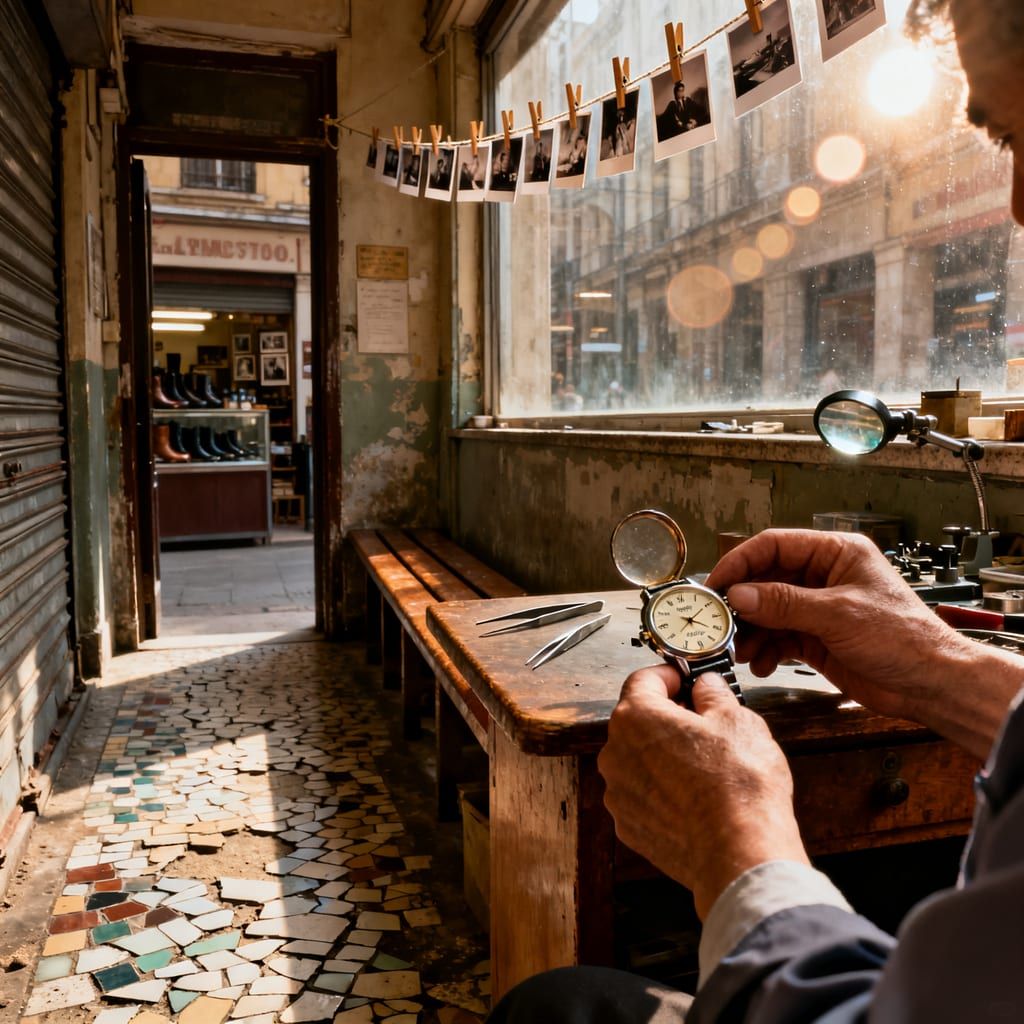
Daylight in the arcade fell the way dust does in an attic-soft, reluctant, familiar. The tile was a mosaic of missing teeth; somewhere a shutter rattled as if remembering wind. Luca Marín kept his door propped with a brick. In the window, brass faces watched the hallway go by.
On his bench: a loupe, tweezers that shivered at the thought of springs, a cloth the color of lake water. He fixed everything that arrived-battered pocket watches with panels that clicked like tiny doors, honeymoon chronographs thin as wedding vows, an old alarm clock whose bell sounded like laughter under a bowl.
He learned something he hadn't set out to learn: every timepiece came carrying. He saw it in the cursive initials running a curve like a shoreline, in the pattern of scratches that spelled out accidents, in the thumbnail faces curled under casebacks like pressed leaves.
The first time he slipped a note into a finished box, he didn't plan it. The watch was a petite Bulova with a hairline crack like a vein. Under the back: a photo of two girls in matching swimsuits, mouth-open joy. He wrote, in pencil: I liked the way they were laughing in the sun. You must have, too. If you ever want to tell me the rest-L.
People began to come back.
An exhausted chef with forearms mapped in small burns arrived in a smell of rosemary and steam. He slid across the glass his father's railroad watch, a thing of nickel and endless patience. "He timed trains," the chef said, voice hoarse from the hood fan. "Said time was a story we told to make sense of distance." Luca cleaned the grit out of the regulator, oiled the pallet stones until they winked. When the watch beat steady on the velvet pad, the chef folded into himself and cried into his apron, shoulders shaking like a man who'd gotten through dinner rush only to be ambushed by quiet.
A week later, a startup founder-edges, caffeine, two phones hissing-stood as if about to sprint. He handed over a modern piece, a honeymoon gift he'd chipped on a night he couldn't remember leaving the office. Luca replaced the crystal, polished the nick until it became a soft crescent the way the moon keeps its scars. When the founder slipped the watch back on, he let out a breath he didn't know he'd been holding. "Feels less like a countdown," he said, half a smile loosening his jaw.
Listening became part of the repair. Luca found he could take a watch apart with his hands and a person apart with his silence.
One morning, a cardboard box waited on his stool, taped with care and no return address. The arcade hadn't woken yet; the cobbler coughed behind his door. Luca slit the tape with a blade so sharp it made a sound like paper gulping.
Inside: nine watches wrapped in old handkerchiefs, each swaddled like something breakable that was never going to be whole again. Tied to every bundle was a paper tag with a year and an address in neat, deliberate print.
He pulled them free one by one. An enamel-dial ladies' watch from 1976, its cracked face clean as bone. A field watch with a ghosted dial and a hairline through the crystal like lightning remembered. A seventies Seiko with a black bezel so scuffed it looked like it had been in the pocket of a man who dug.
Luca felt the bench under his wrists-scarred, steady. He decided without deciding that he would fix them, one by one, and take them back along the thin red lines of the city after his day was over. It felt like a game children invent to make the walk home significant, or a penance you pay in small installments you can live with.
The 1976 piece had under its back a ring folded into the careful geography of the movement, wrapped in tissue someone had once kissed. A thin gold band with a nick you could lose a thought inside. He set the beat, replaced a spring that had tired, eased the ring back into the hidden hollow.
At the address on the tag, a narrow brick rowhouse sagged into itself. A woman opened the door with a cardigan tied tight; her hair was the color of morning steam. When he said why he'd come, she brought him to a table with a lace cloth turned coffee-brown at the edges. She lifted the watch as if it were an infant, then found the back with the practiced thumb of a person who'd worried something apart too many times.
She saw the ring and went perfectly still, like the room had clicked shut around her. "He asked," she said, voice like a path through leaves, "in the hallway of a hospital because he was afraid the elevator would swallow him. So I said yes before the doors opened." She looked at Luca the way you look at someone who has returned a thing you taught yourself not to need. "He died two years later. I wore the watch. I put the ring away where I couldn't look at it." She laughed, a sound that cracked and warmed all at once. "I never remarried. No one knew where that ring went. I didn't either."
He left her at the table with her hands cupping time like water.
The field watch was more stubborn. Its mainspring had not broken, only forgotten its job. Under the back, a dried clover, pressed nearly transparent-the green gone to memory. He wound it and listened until the tick returned, an animal coaxed back from brush.
At a porch with peeling turquoise paint, a woman in a University T-shirt and bare feet came out humming. When he held out the watch she blinked, then sat down hard as if a seat had been pulled out of the air for her. "Dad whistled in storms," she said before he asked anything. "Said it made thunder less sure of itself." She rolled the watch in her palm, light glancing off its glass. "He lost it in the flood when the creek thought it was a river. He told us he didn't care, but he kept going to the fence line to check if the water had spat it back." She pressed her thumb to the clover, reverent. "He'd stick these in our pockets before tests. Said luck is a thing you practice."
She didn't cry. She smiled like someone who had just remembered where she put her favorite knife and felt it slide in her hand.
Luca went on. A nurse with chipped nail polish who let him into a sixth-floor walk-up and told him about a woman who timed her prayers. A retired mailman who had a sunburned neck and spoke about a dog that waited at the fence line at three-oh-five. A man in a suit whose hands shook taking a watch that held a Polaroid of a baby in a blue knit cap. With each delivery, Luca played courier of time and testimony, catching what spilled in the handover, carrying it like an instrument that should not be dropped.
At the bottom: the Seiko, seventies, black face, the kind sold in catalogues next to charcoal suits and carhartt jackets. He knew it before he lifted it. The scuffs. The dent at ten where a father had bumped it against a child's head with careless gentleness and laughed-"Hard head like mine, Luca, see?"-and then they'd both laughed because they were boys that day, both of them.
His throat went tight. He loosened the caseback with a rubber ball because he could not bear to mark it with the tool. The second hand was frozen, but the mainspring was intact. Wedged under the balance: a sliver of paper, deliberate, with his name in the stilted, old-country script he had not seen in years.
He set the loupe and drew breath until his hands became the hands he trusted. He teased the paper out with tweezers, slid it onto the pad.
Luca.
If someone you do not know puts this in your hands, I am already gone. I did not know how to say things without breaking them. I think you might. There is a woman on Ward B who carries a tin of mints and listens like a mirror. She said to leave it to her.
I kept the time wrong on purpose, sometimes, to imagine I had more.
Your father, who tried to whistle in storms and only knew two notes.
There was a drawing in the margin-two lines that made a wave. It winded him more than any apology could have.
The hospice smelled like lemon and something careful. He walked there as the arcade dimmed into blue. A receptionist with hair the color of ripe wheat glanced at the Seiko on his palm and directed him down a hallway lined with framed watercolors of boats heading out and also in.
She was there-mid-fifties, sensible shoes, the tin of mints in her pocket making a small rectangle at her hip. Her name tag read AMINA in letters the color of cough drops. She watched his hands as you do when you recognize in someone a craft you don't do but respect.
"I kept them," she said, when he held up the box that had once been anonymous. "From people who spoke about what didn't get said in time. They asked for someone to carry the last inch." She lifted a shoulder. "Nurses have pockets. We use them."
He held out his father's note without speaking. She read, nodded, as if the contents were both fully unsurprising and entirely new. "He told me about a little boy who could sit quietly for longer than any man he knew," she said. "Said you listened like it was your way of keeping both of you from falling."
"I fix things," he said, and then understood the poverty of that sentence.
"I know," she said softly. "So did he. That's why I sent them to you."
He strung a line above his counter with the twine the cobbler used to lace boots. He clipped photographs to it with clothespins bought in a laundromat. A widow in a cardigan sent a picture of her husband young, teeth too big for his mouth, ring on a finger he hadn't noticed the first time. The porch daughter sent a photo of a fence line under a sky like a bruise. The chef taped up a Polaroid of a table after service-steel pans catching light, a watch face peeking from a pocket.
He put out a plate of sliced oranges and a carafe of coffee that tasted like the inside of old paper cups. He left the door propped with the brick.
They came. Slowly at first, then as if a bus had stopped out front, emptying its gentle migration. Shoulders brushed. Laughter arrived with tears, a braid that made the same rope. People set their stories down like offerings and then found they could breathe easier without carrying them that way.
The chef touched the ring photo with a forefinger. The startup founder stood under the line reading strangers' captions like instructions for a kinder device. The mailman leaned his forehead to the glass and watched the arcade like a route he'd forgotten he loved.
Amina arrived in her sensible shoes, tin evident. She pressed a mint into his palm the way you hand someone a coin for luck. "Ready?" she asked, but it wasn't a question.
Luca lifted his father's Seiko under the warm cone of the lamp. The crowd quieted into a pocket of held air. He had already cleaned the grit from the pivot, balanced the wheel, eased the impulse jewel back to a place where it could want again. He turned the crown and felt the coil grip and let go, grip and let go, the promise of work and rest.
He thought of a boy on a stoop counting trucks. He thought of a man at a kitchen table holding a fork like it had become an argument. He thought of a nurse with a tin of mints and a hallway of boats both leaving and returning. He thought, I have been repairing everyone else's time to avoid facing my own.
He did not look up. He watched the second hand-silver, dulled by years-quiver, consider. And then, almost shyly, it began to move. A circle is only a line that refuses to end.
Something in the room released. Not sound exactly-more like the feeling when a faucet that has been spitting air finally gives you water.
He read his father's note aloud. He did not say all of it, only the part about keeping the time wrong on purpose. People laughed that soft laugh you keep for grief when it tells a joke that is trying to be kind to you. He put the note back under the caseback where it could continue its small, deliberate haunting.
Amina lifted her chin toward the line of photos. "Now you," she said quietly. "Put one up."
He did not have a photograph that felt right. He took a business card, turned it over, and wrote in his careful, watchmaker's hand: My father could only whistle two notes, but he taught me to hear the rest. He clipped it next to the ring and the fence line.
He let the Seiko tick on the counter where anyone could lay a finger to the glass and feel it.
Later, after the oranges were gone and the coffee made a ring on the cloth like an eclipse, the arcade had gone from blue to black to the kind of gray that means a morning is considering you. The cobbler had slipped a pair of boots outside his door with a note that said Paid in advance. The shuttered photo studio's sign-the one no one noticed-had a small crack in the paint that looked like a smile if you knew how to look.
Luca locked the door and turned the sign, then stood a minute in the presence of his bench and the small machines breathing their regular breath.
His father's watch, newly alive, ticked loud enough to be company.
He reset the other clocks in the shop that had been a little wrong on purpose, the way people keep time when they are bargaining with it. He did it gently, as if apologizing to their faces.
In the window, brass faces kept watching the hallway go by.
Outside, rain began somewhere high, then remembered the ground. He stepped into it without lifting his collar. He found, to his surprise, that he could whistle two notes-badly-and that the sound, thin as it was, made the storm less sure of itself.
The arcade swallowed him and offered him back again, a loop not unlike a second hand-returning, always returning, with just enough difference to prove that it had moved.

A daughter learns to read between the lines of a life split in two
Read more →
A fog-draped night, two souls found, and the quiet shape of a life
Read more →
Story audiobooks for children of all ages — a new one every day on Smarter Way Stories.