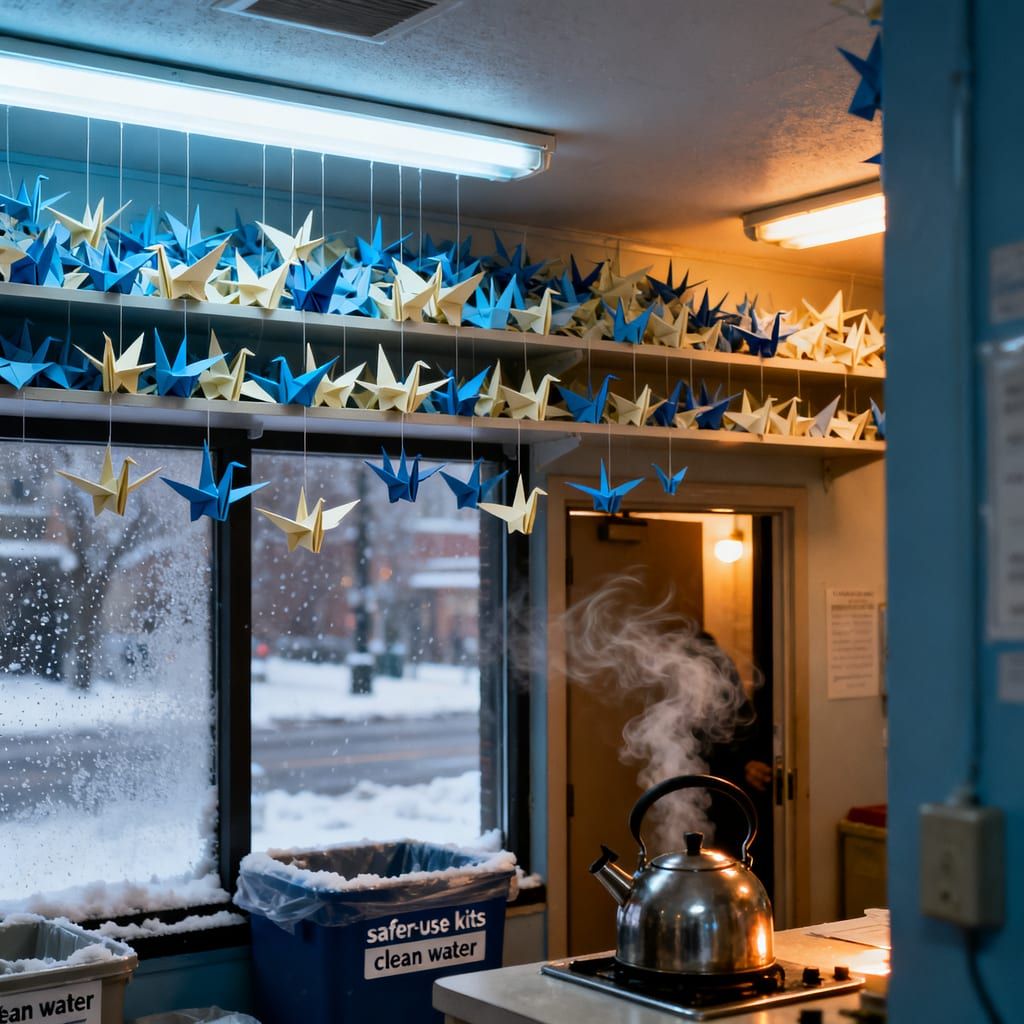
Paper Cranes at Shift Change
A winter of small mercies, folded and kept
Read more →

The rain starts in fits-first a whisper on the ambulance bay, then a steady drumming that slicks the city in neon. Ana Reyes tucks her hair into a bun and slips her pocket notebook into the scrub top that smells faintly of starch and coffee.
She moves like she has learned to move at night: soft-footed and certain. She warms blankets two at a time, folds them like promises, angles lamps so the light lands on linoleum instead of faces. She knows which floorboards will complain and which will keep a confidence. The hallway hums; the monitors keep their metallic vigil. Somewhere a vending machine clicks and settles. A mop dries in its yellow cradle like a drowned sunflower.
Ana takes a breath that reaches her toes and begins.
Three rooms tug at the hem of her attention.
In 8, a man in his fifties clings to control the way a drowning person clings to instruction. "If it's 98 I'm fine," he says, bargaining with his oxygen saturation like it's a bill he can negotiate. "If it's 98, if it's 98-" His fingers leave half-moons in the sheet.
"Let's not pick a number tonight," Ana murmurs, smoothing the pulse oximeter on his nailbed. "Let's pick your breath. In, slow as pouring tea. Out, like you're fogging a mirror."
He looks at her, doubtful. But he follows. The monitor agrees by a hair, takes the edge off its alarm.
In 9, a daughter sits straight-backed with an open Bible quivering in her hands. Her mother sleeps in the peculiar stillness morphine gives; the daughter's whisper is a river with rocks in it. "Yea, though I walk-" Her eyes lift to Ana, rimmed as if by sleep applied with a hard brush. "Do you think she hears?"
"Yes," Ana says, meaning it. "Sometimes they hear what we don't even say." She adjusts the thin blanket away from the IV line, angles the lamp to make a soft pool. The daughter nods and keeps reading, voice tripping, then catching itself.
And in 12, no visitors listed, an older woman lies with the quiet of someone who has been reducing her life to the essentials for a long time. Mrs. Park, the chart says. The name is plain and sturdy. A jar of petroleum jelly on the bedside table. Nails clipped short, hair a white cloud someone forgot to tame.
"Mrs. Park," Ana says, gentle. The woman's eyes do not open. Her breath is a ruffle on paper-there, and then not quite, and then again.
Ana warms a blanket anyway. She tucks it around shoulder and hip and sits. She thinks of the city rain pressing its forehead to the window.
Between blood draws and med passes, between the thousand small needles of duty, Ana returns to 12. She takes the woman's hand, thin as a bird's foot, and interlaces their fingers until the fit feels right.
"Who taught you to be brave?" she whispers-her question for the mostly-gone, the nearly-leaving. Not a quiz. A key.
She hums the tune her mother used to sing when a fever made the room a mirage. Not a lullaby exactly, but something low and old, a road you can walk in the dark.
Mrs. Park stirs. The eyelids flutter like a moth deciding on a porch light. Her lips form a shape without sound, then gather the strength for it. "Aniíta," she whispers.
The name hurts and soothes at the same time. No one at work calls her that. Only her mother, and a handful of voices from buried summers.
Ana leans in until her breath warms the air between them. "I'm here," she says, the hum forgotten. "It's Ana."
Mrs. Park's eyes find the place on the ceiling where memory is projected. "Storm," she says. "Hallway. Light-like-grocery store." She makes a small motion with her hand, a pushing of wheels.
A cart. A bitter fluorescent hum. The smell of clay and pencil shavings. The sound of a mop bucket's slosh and a radio tuned low to old ballads.
Ana is a girl again in a tiled bathroom at PS 117, knees pulled to her chest, the stall latch a rough edge against her forearm. Rain spat against the glass block windows. Her father had promised, again. The school emptied to echoes, and she counted shoe tiles to keep from crying until she didn't keep from it at all.
A knock. Not the brisk, impatient rattle of a teacher. A soft knuckle. Then a voice in Korean-lilted English. "Can I sit?"
The hinge sighed. The woman sat on the opposite tile, the mop leaning like a tall, quiet friend. "Some nights," she said, passing her a tissue she pulled from an overall pocket, "we borrow courage. We give it back later, stronger." She hummed while Ana breathed through hiccups. When the rain thinned and the fluorescent lights felt less cruel, the woman walked her to the front office and checked that the phone number worked, her hand a warm comma around Ana's shoulder.
Back in 12, the fluorescent light is kinder now, dampened by a shade Ana has half-closed. Outside, the rain fades to a mist that holds the streetlights like lanterns in its palm.
"Mrs. Park," Ana says. "From 117?"
The woman's mouth shapes a little yes.
Ana laughs once, soft as a cough. There is salt on her tongue she did not plan to swallow tonight. She presses her forehead to the back of Mrs. Park's hand. "You found me again," she says, and wishes, fiercely and briefly, that their hours were not so numbered.
The work does not pause for revelations. The hallway wants what it wants.
In 8, the man's bargaining becomes a bargain with himself. "In," he says. "Out." His shoulders loosen by increments, the way a stubborn jar lid gives. "Tell me a story," he says, the request almost sheepish.
Ana adjusts his pillow, the crispness of it a small mercy. "Once there was a man who thought the numbers were the world. And then he remembered he had lungs." He huffs a laugh that knocks his O2 up one notch. He closes his eyes, trusting something he cannot audit.
In 9, the daughter's whisper is raw but steady. "He leadeth me beside the still waters." She flinches at her own voice on waters and then steadies again.
"Here," Ana says, gently rearranging a word into a blanket. "Let me get you tea." She returns with heat in a paper cup that shows up as steam in the air-conditioned room. She wraps the daughter's cold fingers around it, adds, "When you're ready, I can answer questions about what the night might look like."
"What will it look like?" the daughter asks, not ready and ready at the same time.
"Like someone taking off tight shoes," Ana says. "Like a tide going out when the moon is still full." The daughter nods, eyes swimming but focused on a horizon inside them.
And every orbit, every round, draws Ana back to 12. Her shoes learn the distance by heart.
She wipes Mrs. Park's lips with a pink sponge dipped in water, threads the call bell cord so it won't tug. She tells her, in the tone of gossip, about the nurse in 6 whose acrylics are tiny masterpieces, about the security guard who pretends to hate the cat that lingers in the loading dock. She hums the rest of the tune the way she was meant to hum it-fully, without caution, the melody like a handrail in the dark.
Mrs. Park's breaths are paper now, skittering on a desk no one has sat at in years. The monitor registers each one as if it were a secret.
"Who taught you to be brave?" Ana asks again, though she knows the answer is in the room.
Mrs. Park turns her head the slightest fraction toward Ana, as if scenting a familiar kitchen. "You," she says, syllables like seeds. "You were brave before you knew."
The words are a coin placed in Ana's palm-a weight, and light.
When it happens, it happens the way a candle goes out in an open window: not dramatic, not theatrical, but sure. The breath that should come next doesn't. The air in the room deepens, somehow, like a lake accepting a stone.
Ana notes the time. She calls the resident, her voice the kind that ushers rather than alarms. They do what needs doing. The monitor sighs itself to blank. In the quiet after, the fluorescent ballast hums like a held note.
Ana sits back down. She fits her hand around Mrs. Park's again, the warmth in that skin borrowed, then gently given back. She hums the end of the tune and lets it trail into the kind of silence that is not empty at all.
At the desk, she takes out her notebook-the one with smudged corners and two bandage wrappers used as bookmarks. She writes in a looping hand that is steady with practice: Mrs. Park, Rm 12. "You were brave before you knew." She underlines nothing. She does not draw a heart. She closes the book and presses it to her chest like a benediction.
On her break, Ana sits in the staff lounge with the soda machine's blue glow scalloping the floor. Rain has backed down to a rumor. She pulls her phone, searches a memory she did not know she'd kept: PS 117 yearbook, 1991, staff. A PDF loads with a slowness that feels ceremonial.
There she is on a pixelated page: PARK, EUN-SOOK-Night Custodian. A photo where the smile is small but certain, eyes bright as a hallway just turned on.
Ana follows a breadcrumb trail to the custodial union website and an after-hours line. She leaves a message in the shape of a letter folded many times.
"My name is Ana Reyes. I wanted to say thank you for Mrs. Eun-sook Park. She worked nights at PS 117 in the early nineties. She sat with me once when my dad forgot to come. Tonight I sat with her. She told me I was brave before I knew. If there's family who'd like to know she wasn't alone-I was there. We borrowed courage together."
Her voice wobbles only once. She ends the call and stays seated until her pulse returns to its usual neighborhood.
By five, the hospital smells like the idea of toast. The automatic doors breathe in and out; the day shift arrives in bright sneakers and hot gossip. The rain gives up and leaves a clean windowed sky that looks like someone rinsed it twice.
Ana signs out of one chart, into another. She checks the man in 8, asleep with his mouth open and his bargain honored for the night. In 9, the daughter's Bible is closed, one hand resting on it as if on a sleeping animal.
She cleans a spill no one else noticed, tucks a corner, rights a picture frame that doesn't matter and therefore does. She collects her notebook from beneath a lab requisition and slides it into her chest pocket, over her heart.
Before she leaves, she stands one last time outside 12. The bed is empty, the sheet drawn neat, the room returned to a kind of zero. She places her palm flat on the doorframe, an old superstition no one taught her but her hands remember anyway. The air is the same and not.
On her next shift, a different rain will fall, or sun will pin itself brazenly to the windows. Another monitor will argue with another breath. Another hand will find hers in the dark.
When it does, her own pulse feels steadier-like a line drawn with a sure pencil-because she knows now what she is part of. The night workers, the sweepers and soothers, the ones who keep the lights kind and the world moving through its hardest passages. They enter and leave like tides. They carry courage back and forth until it belongs to everyone.
Ana warms a blanket. She lifts it like a sail. And the room, whatever room she's in, fills with the soft weather of care.
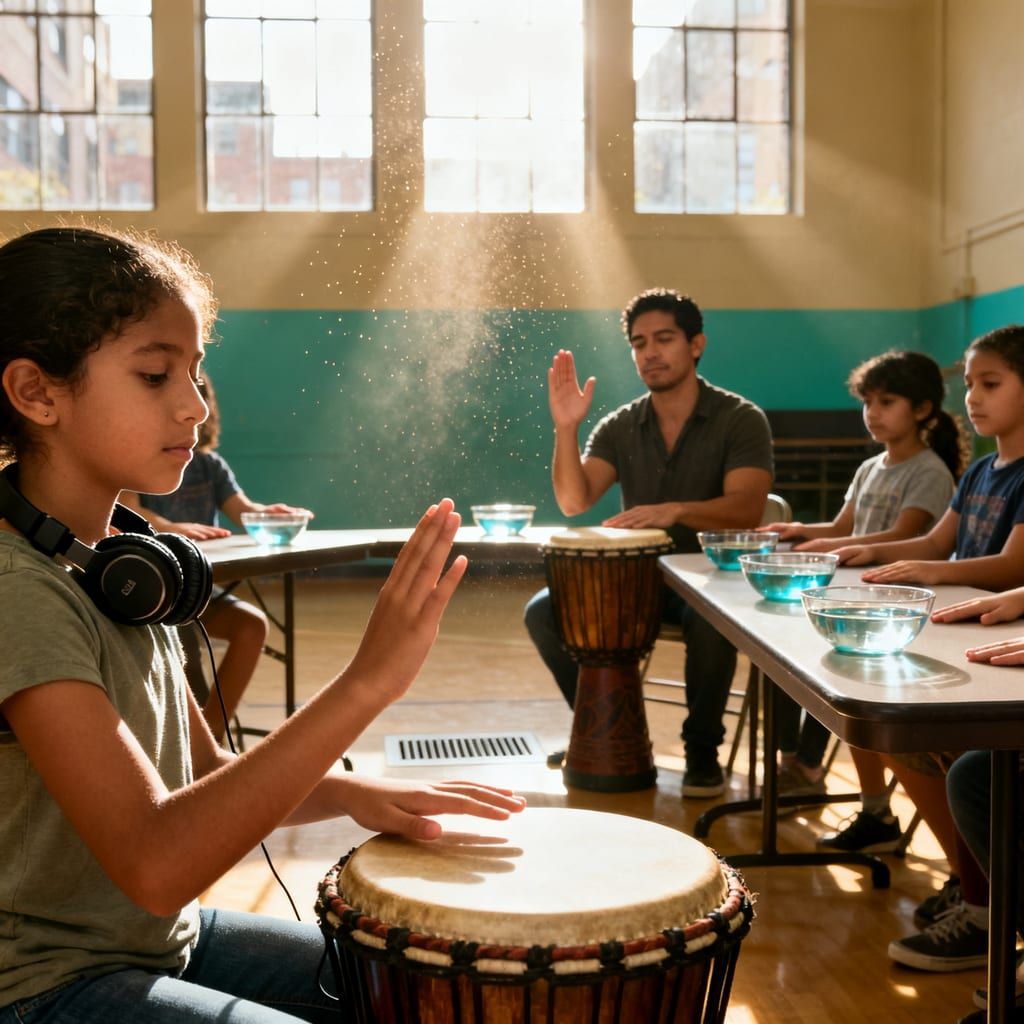
A drummer learns to listen for the rhythms you can't hear
Read more →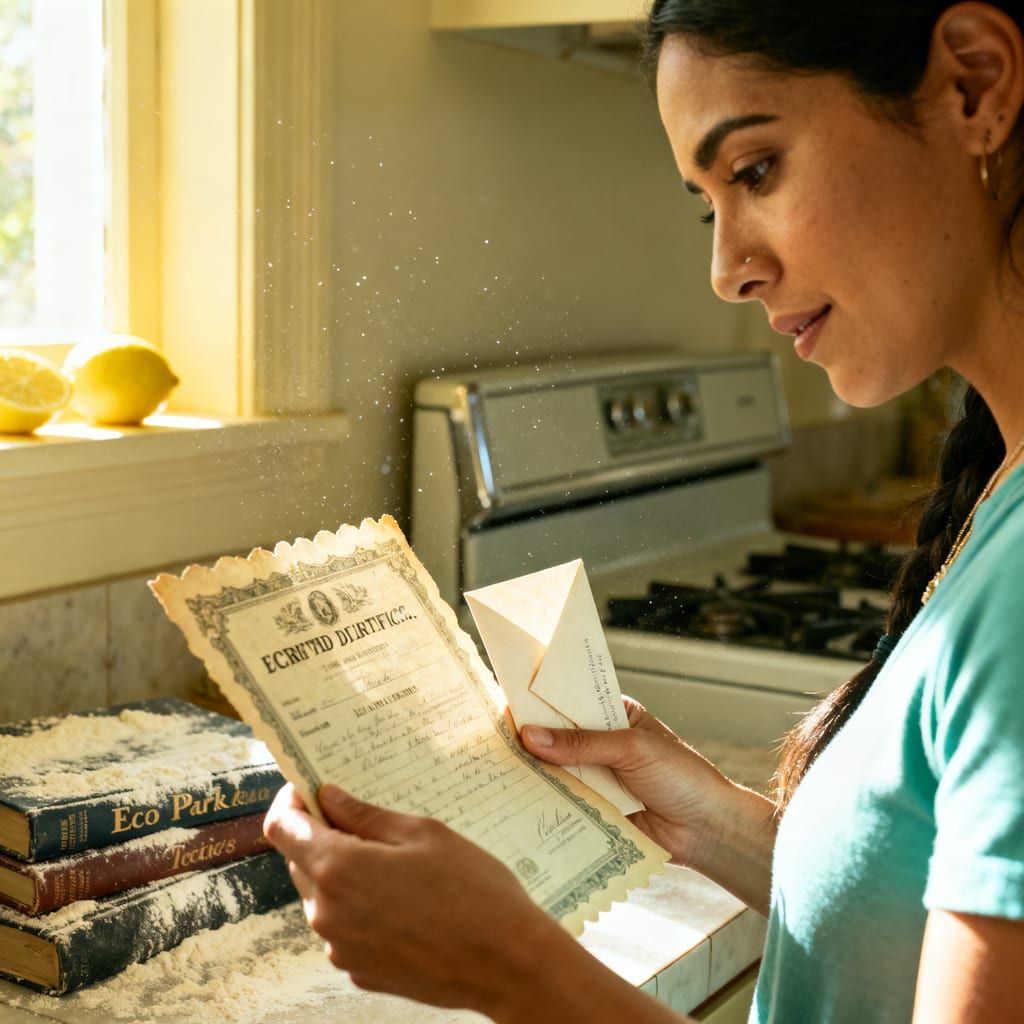
In Los Angeles, a daughter learns how to carry two lives forward
Read more →Story audiobooks for children of all ages — a new one every day on Smarter Way Stories.