Two Houses and One Quiet Heart
A daughter learns to read between the lines of a life split in two
Read more →
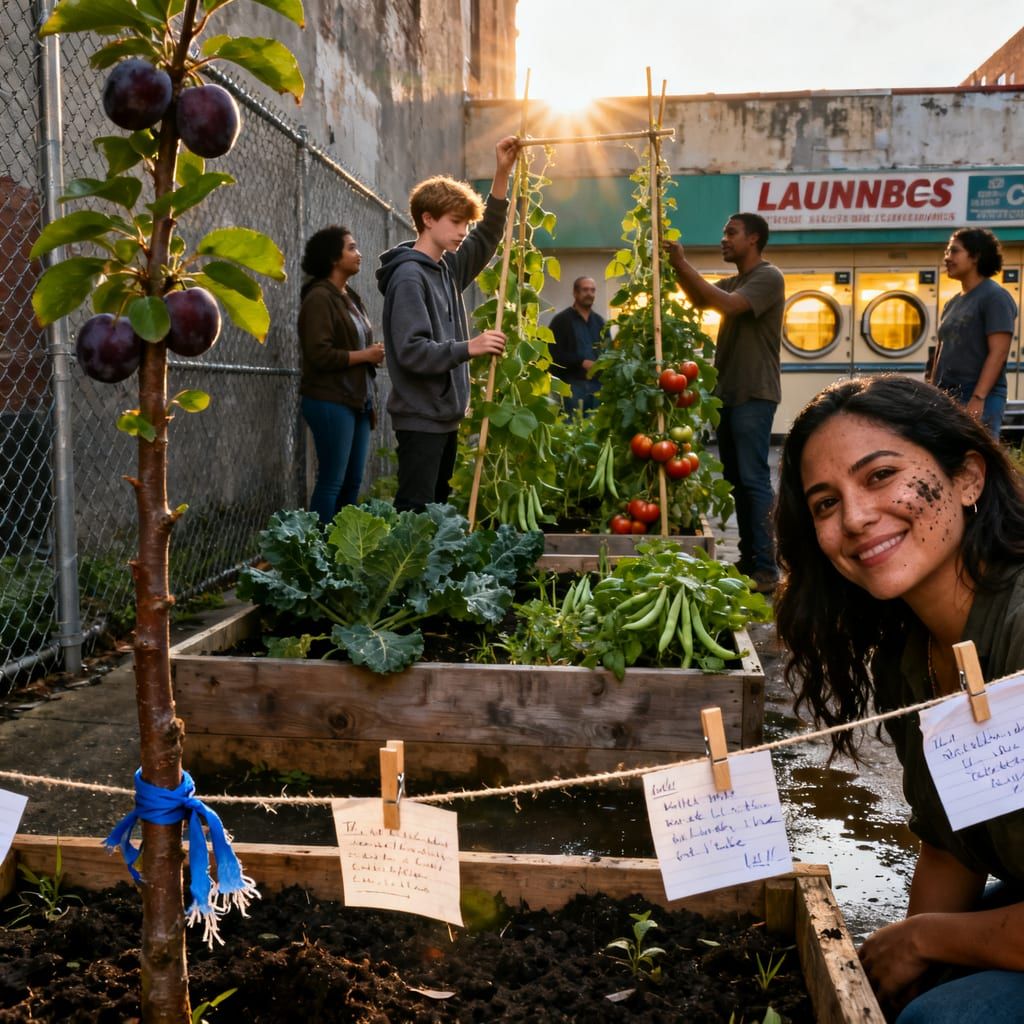
On the first Saturday of spring, the laundromat hummed like a beehive while Lina stapled a flyer to the light pole. Warm lint and jasmine detergent rode the air. Behind the building, a rectangle of busted bottles, dandelions, and a warped grocery cart waited like a dare.
She lifted the chain-link latch. A pigeon clapped off the fence, scattering ash-colored feathers. The lot looked like every plan she'd sketched and abandoned-edges undone, mess baked in. Lina rolled her shoulders, felt the low click where hunched hours at a screen had lived for years. Just start, she told herself. A hole. A flyer. A folding table.
By noon, she'd talked the bodega owner into lending two tables and a water cooler. She pushed a broom, made a pile of takeout lids, found a kid's sneaker missing its tongue. When she paused, the thrum from the washers behind her pulsed like a heartbeat.
They showed up in ones and twos: a woman with paint-splattered leggings carrying a plastic bin of seed packets; an older man wrestling a bale of straw like a dance partner; a teenager in a hoodie tugging his sleeves down to his knuckles. The lot's dirt tested too dirty-lead whispering no from the lab report-so they scrounged pallets, broke them down, sanded splinters. Sawdust clung to their eyelashes.
"Compost goes hot if you feed it right," said Rosa from 4B, slapping a hand on the new bin like it was a faithful mule. Her palms were maps of work. "And I have tomato seeds. Romita saved them every year. He swore they taste like July." Her mouth made a tender shape around her husband's name.
Hassan brought a pot of mint, the stems fuzzed silver. He held the soil like it had a pulse. "My mother tucked these into her coat when we left," he said, smiling without showing teeth. "They like to escape, so we tuck them tighter back."
An ICU nurse named Mina arrived with graveyard-shift eyes and a thermos that smelled like cardamom. She pressed labels into the corners of the beds: Amos. Sonya. Ruth L. "They liked okra," she said, and then glanced away as if the names had slipped out by themselves.
There were too many opinions about gravel bases and too few shovels. Someone insisted on permaculture theory. Someone else insisted that beans only climbed clockwise. Lina learned to nod, to say, "Let's try both," and to set a timer on her phone for debate breaks. Her hands learned a hammer. Her back learned to ask for ice. Inside, a small, quiet tightness finally loosened by degrees.
In April, kale leaves unfurled like a collection of tiny umbrellas. Sugar snap peas found the trellis string and braided themselves skyward. At dusk, with her jeans stained green-kneed, Lina tied her hair up and listened to the garden's gentle gossip-the click of beetles, the zip of sparrows, the way neighbors' voices softened when they bent to check a sprout.
The idea started with a recipe. Rosa clipped hers to a jute line Lina strung from post to post over the squash bed. The card read: Romita's Salsa Fresca (he didn't measure; good luck). Clothespins snapped little wooden mouths.
Soon the line sagged with declarations. A prayer for chemo to go easy. A recipe for mint tea, annotated in a child's hand with a cartoon lemon. A note from Mina: I watered Amos today. I told him the sun is back and I'm too. Sleep, love. A sketch of a bicycle with two stick figures, one taller, one with spoked curls.
The lot changed by touch. People lingered with their palms on the cedar of the beds. They squinted at the pea tendrils as if they were reading braille. They took turns refilling the cooler. A man from the barbershop came on his smoke breaks and crushed cigarette cravings between forefinger and thumb, pinching aphids into paste. "Oddly satisfying," he said, grinning.
Through it all, Lina kept moving. There was always one more thing-rebar caps, a sharps container, the volunteer pumpkin muscling where no pumpkin should. She slept the deep sleep of someone who had carried something heavy and put it down well.
One morning in June, Lina arrived early to find a bed trampled. Kale spines snapped white, radish leaves flattened as if a boot had pressed its heel with intent. A seedling lay yanked, roots exposed like a tiny hand.
Her cheeks heated. She tasted metal. She bent and righted what she could, sliding soil back over ragged roots like a blanket. Then, because rage had nowhere to go and she did not trust it to evaporate, she borrowed a wildlife camera and strapped it to the fence post, the lens a small black pupil watching.
Two nights later, the culprit floated in and out of the frame like a heron-lanky, hood drawn, sneakers flashing. He knelt, dug with his palms, and slid something into the earth with the care of someone putting a sleeping child to bed.
When she caught him in person-headphones around his neck, moon on his cheekbones-he bolted. She ran, surprised at her own speed, her breath ragged in her ears, the alley wall scraping her shoulder. "Hey!" she called. "Wait-I won't call anyone."
He stopped at the corner under a streetlight. He was all angles and elbows, maybe sixteen. He didn't look at her.
"What are you burying?" she asked, softer.
He held up a plastic bike bell so cracked it looked fossilized. "He-my dad-taught me here," he said, words tumbling. "We'd turn circles right there by the dumpster so I'd be ready for traffic. He died last year. Not like, here. But-here." He thumped his chest. The bell rattled. "They built the stupid garden, and I thought-if I put... pieces-" He swallowed what the pieces were of.
They stood with the streetlight puddling around their shoes. Lina's heart did something she'd been keeping it from doing. It moved.
"What's your name?" she asked.
"Marco." His voice made itself small.
"I'm Lina," she said. She thought of the rootbound plants at the nursery, how they softened when water found them. "Listen. We don't have to choose between your dad and the peas." She reached into her pocket and felt the cool shape of a key, spare to the tool shed, meant for no one yet. "Come in the mornings. Help me build. You can... we can find places for the things. Not under the stems, okay? But close."
He stared at the key like it might bite. Then he took it, and she saw how careful his fingers were: long, clean, nicked at the knuckles. He nodded once. The moon slipped behind a cloud like a coin behind a knuckle.
After that, Marco arrived at dawn, a shy nod and his headphones a soft halo around his neck. He squared trellis posts so straight it was as if the earth had a carpenter's level inside it. He taught the younger kids to tie tomato vines with figure-eights, fingers gentle. He tucked the bike bell in the crook of the gingko by the fence, the compass at the end of the bean tunnel, the festival badge under the bench seat. He labeled nothing, and yet somehow, everyone learned where the pieces were and left them.
Late summer settled like warm bread. Tomatoes the color of bruised sunsets pooled on a folding table. A toddler chomped a sugar snap and gasped at its sweetness as if it were a joke the universe had just told them.
Then a letter came. The envelope looked ordinary, the city seal a polite stamp. Lina slit it with a butter knife and read while her coffee went cold.
Permit misassigned. Parcel slated for temporary overflow parking. Self-storage facility. Null and void.
The words moved around on the page like fish. Lina set the letter down and felt her stomach lift and tilt, the way it had the morning she'd packed a single suitcase and left an apartment where nobody had fought and nobody had cried and nobody had touched the raw center of anything. She had built something, here, with hinges and twine and the slow lesson of roots. Now a diagram somewhere said it did not exist.
She almost didn't go to the meeting.
On the night before the vote, clouds snagged on the water tower and held. She walked to the lot to say good-bye to the shapes of things. But the fence gate was open. Light strings glowed. People had come with their notes taken down and doubled, new ones folded in their palms.
"We read," Rosa said, pressing a piece of lined paper into Lina's hand. "We bring the stories they can't measure." Hassan touched her shoulder. Mina leaned her head on Lina's for a second, then squared up again like a boxer.
At the council chambers, the microphone made a mean line of feedback and then settled. Papers shuffled like leaves. Suits had their own weather.
Rosa went first. She read a recipe like a hymn, her voice tipping into laughter on the part about too much onion and then thinning on the line about Romita tapping her wrist and saying, "Enough, mujer."
Hassan held up a Mason jar with mint inside and passed it down the row so the council could smell. "We brought the sweetness across an ocean," he said. "Please don't pave over our mouth." He didn't mean it as poetry. It was.
Mina's eyes were linen-soft. She read the names off the labels like they were there, then folded her note into a square and tucked it back into her pocket, as if she couldn't leave it behind.
Marco came up last, shoulders drawn up, the cracked bike bell in his palm. He didn't look at anyone, then he did. His voice shook and then found the center line. "Please don't pave over my dad," he said simply, and the room did a subtle, measurable thing-people leaned.
Bureaucracy is a language of commas. Questions were asked. A city planner cleared his throat too many times. A councilwoman with silver hair and fierce lipstick suggested a motion to amend. Maybe the storage facility could nudge its parcel lines; maybe the lot's new use could be recognized under a different code. It wasn't tidy. It never is.
But when the vote went up, hands raised. It was not unanimous, but it was enough. Papers thumped. Someone said, "Congratulations." Lina blinked hard and thought of how seed leaves are not the final shape of a plant, just the first brave guess.
They came home with pizza slices balanced on paper plates and scissors for ribbon. In the back corner where the soil stayed dark with a secret spring, they planted a young plum tree. Its leaves clicked in the night air. Lina held the sapling straight while Marco shoveled. Dirt filled around the ball like acceptance.
"Here," he said, and tied the first ribbon-blue, fraying-around the thin trunk. It slid and then caught. The knot was the kind you could undo with a single pull.
Someone started music low, just enough bass to feel the beat in the boards. A moth battered itself gently against the string lights and then found the dark it was seeking. Rosa tucked her recipe card back up on the new line; Hassan slid a sprig of mint behind his ear like a feather; Mina sat on the edge of a bed and touched the name on the label as if to show it the tree.
Lina felt the cry long before she made a sound, the way a storm starts miles off and rolls in as light. She shared pizza crust with a stray cat. She pressed her palm to the rough new bark. Then, finally, she let herself. The tears were not the hot, angry spill of a thing lost but the cool, grateful rain of a thing found and named and made true by the naming.
"I'm okay," she told the startled cat, laughing breath behind the words. I'm okay.
She looked up at the notes shivering in a small wind. She looked at the tomatoes sleeping in their oblongs. She looked at the gate and could picture, suddenly, winter-the beds tucked to sleep, the plum a dark etching against a pewter sky-and then spring again, the tight fists of buds easing. She could imagine it because it was theirs now, not just hers. Because the ground under her felt like a present tense.
The plum tree held its place in the corner, leaves glossy as if someone had licked their thumb and polished them. In the laundromat, a dryer door thudded shut and someone laughed. The hum pressed steady against the night the way a good heartbeat does, and in the lot, what took root between them kept on growing-quiet as breath, strong as ribbon, there enough to hold.
A daughter learns to read between the lines of a life split in two
Read more →
A fog-draped night, two souls found, and the quiet shape of a life
Read more →
Story audiobooks for children of all ages — a new one every day on Smarter Way Stories.