Two Houses and One Quiet Heart
A daughter learns to read between the lines of a life split in two
Read more →

The email lands at 9:12 p.m., bright as a siren in Jonah's inbox: a friendly note from a phone company explaining that their legacy voicemail system will be retired at the end of the month. For his convenience, they recommend downloading saved messages-"or risk permanent deletion."
His thumb hovers over the screen, that terrible softness swelling in his chest. Somewhere, half-buried under other apps and years, waits a message that begins in his own throat and never finishes, a cliff he stepped to and could not jump. Mateo's name fills the subject line of his body, even when it isn't printed there.
He locks the phone. The hall is dim. In the closet behind the extra set of sheets, a sealed tin sits, heavier than it looks.
He picks up his keys for group.
The clinic's conference room smells like brewed coffee and damp wool-the first cold front has people buttoning themselves higher. Folding chairs ring the space. The table holds a box of tissues, a chipped mug of pencils, a bowl of candies that always goes faster when someone speaks about fathers.
"Welcome," Jonah says, and it comes out more like breath than command. He keeps his tone loose, the line steady. "Same rhythm as before. We'll check in, we'll listen. If you want to record, the phones are yours. Remember-the messages are for you, not for sending."
Tonight a new woman sits at the far edge of the circle, wrapped in a navy cardigan too thin for the weather. Her hands cradle a little paper bag, the kind they give you with biscotti at a corner café. She watches the floor when everyone else looks up.
"I'm Jonah," he starts, though most of them know. "He, him. I'm here to hold the room."
Introductions orbit the circle-names, pronouns, losses like small boats moving through, bobbing, not capsizing. When it is her turn, the new woman's mouth opens and nothing comes for a heartbeat and then she says, "Talia. She, her," and the bag crinkles softly as if it has exhaled.
He nods. "We're glad you're here, Talia. Take your time."
She tries again. "My dad," she says, voice a thread. "It's just... you don't expect it even when they tell you."
Other heads bow. A man with river tattoos fingers the hem of his hoodie. The retired teacher who always wears pearl studs chews a mint like it will anchor her.
They speak in turns. Jonah guides the current. He is careful-an oak root under the riverbed-grounding, letting water move above him. He suggests prompts without making himself a prompt. When you're ready, consider what you never said. Or consider what you said and wish you could cradle softer. His examples, these days, wear Mateo's sweaters in his mind. But he doesn't bring Mateo into the room. He has made a vow to be a container, not a spill.
When they break for five minutes, Talia drifts up. "Do we bring... things?" she asks.
"You can," he says gently. "Sometimes it's helpful."
She nods and glances at the bag. "Next week."
She returns with a windburned face and the same paper bag. She waits until the others have gone and sits it on her knees.
"If it feels okay," Jonah says, "you can share what they are." He tilts the room in her direction. People lean, attentive but easy.
She pulls out a pocket notebook, its lines starred with grocery lists and reminders in a cramped, spiky hand. A transit card still sealed in plastic-"He said he'd try the train, finally," she murmurs, half-smiling like a private apology. And then a city map, creased and softened along the Blue Line, the paper thinned at the turns where fingers worried and folded again and again.
"Sometimes," Jonah says, slow, "we keep routes we never took because the idea of them holds us."
He hears Mateo laugh in his memory, that unspooling light. You and your lines, J. You and your maps.
Others share: a faded scarf that still smells like lilac. A recipe card with butter smears, annotated with "more salt" in an impatient hand. The room makes space for their objects and the unsent words that want to rise near them.
He invites recordings. The ritual is plain as bread. He asks them to hold their phone like a palm to a cheek and speak as if the loved one were standing at the sink, setting down a glass. Call the person by name. Call them back. Often, the first fifteen seconds is breath. Then air learns shape.
He does not say: There is a message I never finished. There is a night I do not let move.
A vote takes them out of the room. "Field exercise," they dub it, with a laugh that betrays relief. Union Park is close as anything-the trees with their thinning hair, the chess tables near the fence, the tracks that stalk its edge. Early dark has begun to throw its shawl over the city. Their mouths make ghosts when they talk.
Talia asks the question at the corner, where they're deciding if they should sit on the cold benches or keep moving. "Could I play mine... outside?" she says. "I recorded it last night."
Jonah's first thought is wind. He almost says, We'll lose half to weather. But her face tells him the location matters. "Yes," he says. "Let's listen as we are, not as we wish to be."
They stand near the fence. The tracks gleam. Someone's phone blinks up from her palm. Talia presses play. Her voice, private and unsteady, spills into air.
"Hey, Dad. It's me," she says on the clip, humor and terror braided tight. "I found your notebook-you did buy the stupid eggplant-"
Under her words, the city answers: a far-off metallic whine, the precise pitch that seems to peel at the inside of Jonah's ear. The L is dragging its voice over steel a few blocks away, and the sound slants into him like a blade and a hand.
And he's there again: a platform in February, breath knives, Mateo pale as snow and then blue, the wrong blue, the rails singing that thin song as help arrives too late to change the meaning of help. He had leaned to say, Mateo-, and the word had broken on the cold.
The group is quiet after the recording finishes. Leaves scratch their ankles, low complicated violins. Someone asks Talia if he ever used the card. She shakes her head.
When the others drift toward the bus stop, Talia stays with the fence.
"Can I tell you something weird?" she says.
Jonah nods, heart closing its eyes.
"When my dad was sick," she begins, feet braided at the ankle like she wants to keep herself from leaving, "I started going to stations. Not riding-just... being. It felt like a pulse I could borrow. One night this man crumpled right there as the train came in. People panicked. I held his hand and kept talking, because I thought maybe if someone told his body it was still wanted..."
Her face opens into the memory, wet at the edges but not drowning. "He never told me his name. He just said, 'Tell J I left the porch light on.'"
The words hit Jonah in two places at once-the joke they made when the bulb above their walkout died and they never replaced it because they liked the dark. "We're the porch light now," Mateo had grinned. We'll keep each other found.
Jonah looks at Talia's hands. They're small, chapped, certain. He has never told the group that his name begins with J. He never thought to guard it-he thought he had folded it away.
"You were there," he says, and his voice leaves him on a tide. He wants to ask what his face did. He wants to ask if Mateo knew the joke was reaching him. He wants to ask if the time between whisper and nothing was a door he could have held. But he does not ask her to drag her own grief back through him.
She nods, apologetic, then not. "I'm sorry," she says. "I just... have been holding that sentence. I couldn't find the right J."
"You did," he says. It is the first true thing he's said tonight that is just for him.
The voicemail email waits all week, a bright flag he refuses to lower. He carries the phrase like a talisman-porch light-as he moves through the clinic, the grocery store, the apartment, turning lights on and off with an ache he is learning how to call mercy.
At group, he tells them a sliver. "I realized," he says, looking at their shoes, at his own, "there's a message I've never finished. I'd like to try. Not here. But if you'd like to come, I'll be at the lake Saturday at dusk."
Talia brings him a cassette recorder from her father's box of things, a small brick with a clear lid and a hunger he recognizes.
"You don't have to-" he starts.
"I want to," she says. "Sometimes a thing needs weight."
Saturday arrives stark and glacial at the edges, the sky a cathedral of bruised glass. He gets there early, as promised, so that if his courage breaks he can stitch it privately. The breakwater is slick with lake breath. Somewhere across the city's ribcage, the L scrapes and sings. A gull caws like a joke that can't land.
He sits. The cassette's door clicks open, little mechanical mouth. He places in the tape-a new one-and labels it with a faded Sharpie he dug out of a drawer, his hand shaking just enough to make the letters look like a child's. The wind combs his hair the wrong way. He presses record.
He hasn't practiced. He doesn't want it to sound like a ceremony. He wants it to sound like Tuesday.
"Mateo," he says, and the way his own name for the man tastes on his tongue breaks him open like bread. "Hey. It's me."
His breath fogs the plastic and clears again. His voice shakes and then steadies. He speaks about small things-how the basil plant on the sill finally died, stubborn to the end; how the upstairs neighbor's kid learned to play a reluctant piano song that is getting less painful; how he found the sweater he thought they'd lost in the move and wore it all day like armor.
He says what he could not say in two years: "Thank you for making me less afraid."
He says: "I'm okay." The truth lands and wobbles, then holds.
He says: "Goodbye." The lake takes the word and sets it down among its stones.
The L hums as if approving. Distant, the city arranges itself again. He sits a moment longer, then presses stop. The tape, stunned and ordinary, captures it all in brown ribbon.
He holds it in his palm until his hand warms it. Then he tucks it into his coat like a heartbeat.
Behind him there is the shuffle and cough of people approaching. He does not turn. He doesn't need them to see him to know they came.
On Monday, he opens the hall closet. Sun reaches in as if it has been standing there all along. He takes down the tin and the extra sheets and the scent of cedar they've remembered for him. He says Mateo's name into the cotton, and then he carries the ashes to the passenger seat as if they're late for a matinee.
He doesn't tell the group that afternoon, not the whole of it. He tells them this: "Sometimes we speak to the dead to make room for the living who were there beside them." He watches their faces rearrange around this idea, recognizes the surprise of it before it turns into relief.
He sits differently in his chair. Not lower. Not higher. Softer at the edges, the way a stone is smoothed by water without losing itself.
On the wall, the clinic clock tick-ticks like a train farther than you think. Outside, a bus sighs. The room fills with bodies that still reach for one another.
He nods to Talia without naming it. She nods back. Somewhere a porch light he cannot see burns on for a stranger, for a city, for a man who finally finished a sentence and set it down.
When the check-ins end, he passes the bowl of candies. People take one, two. They keep what they can. They let the rest fall away.
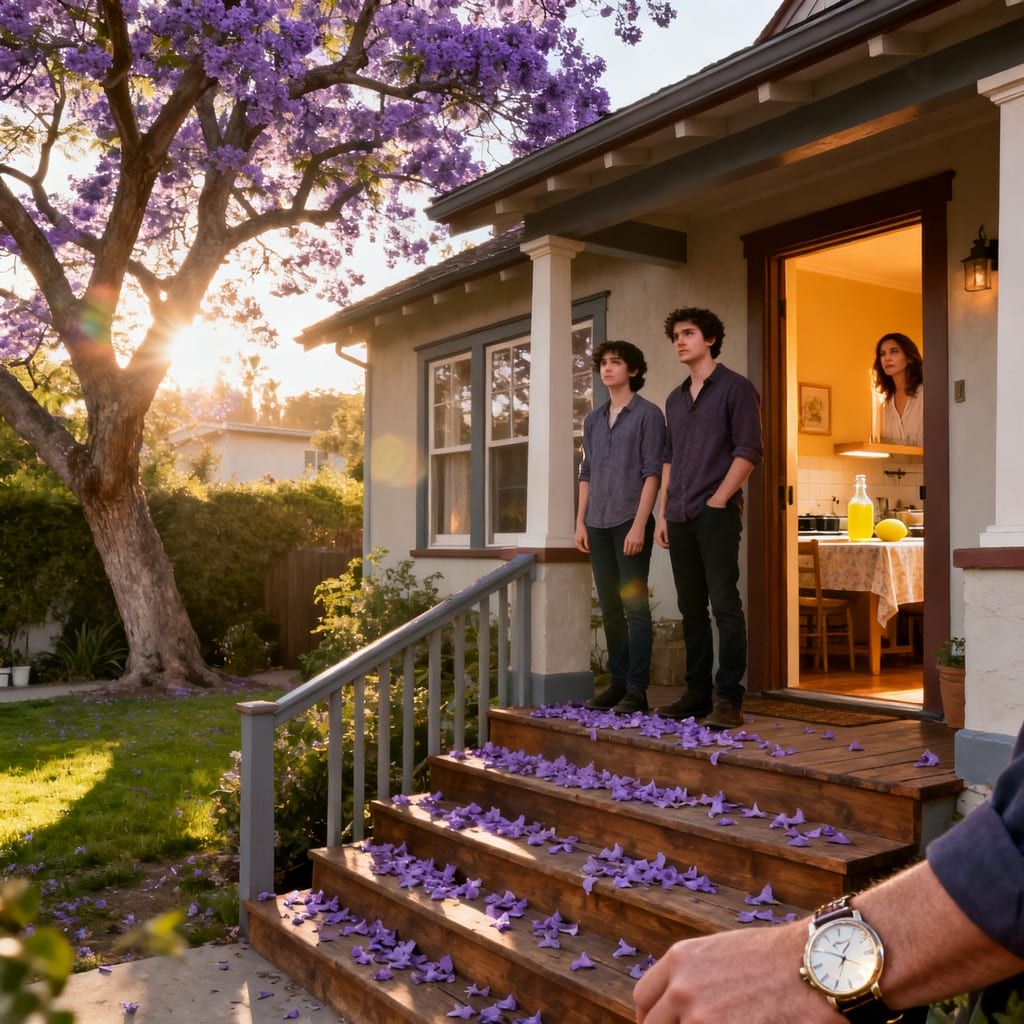
A daughter learns to read between the lines of a life split in two
Read more →
A fog-draped night, two souls found, and the quiet shape of a life
Read more →
Story audiobooks for children of all ages — a new one every day on Smarter Way Stories.