Two Houses and One Quiet Heart
A daughter learns to read between the lines of a life split in two
Read more →
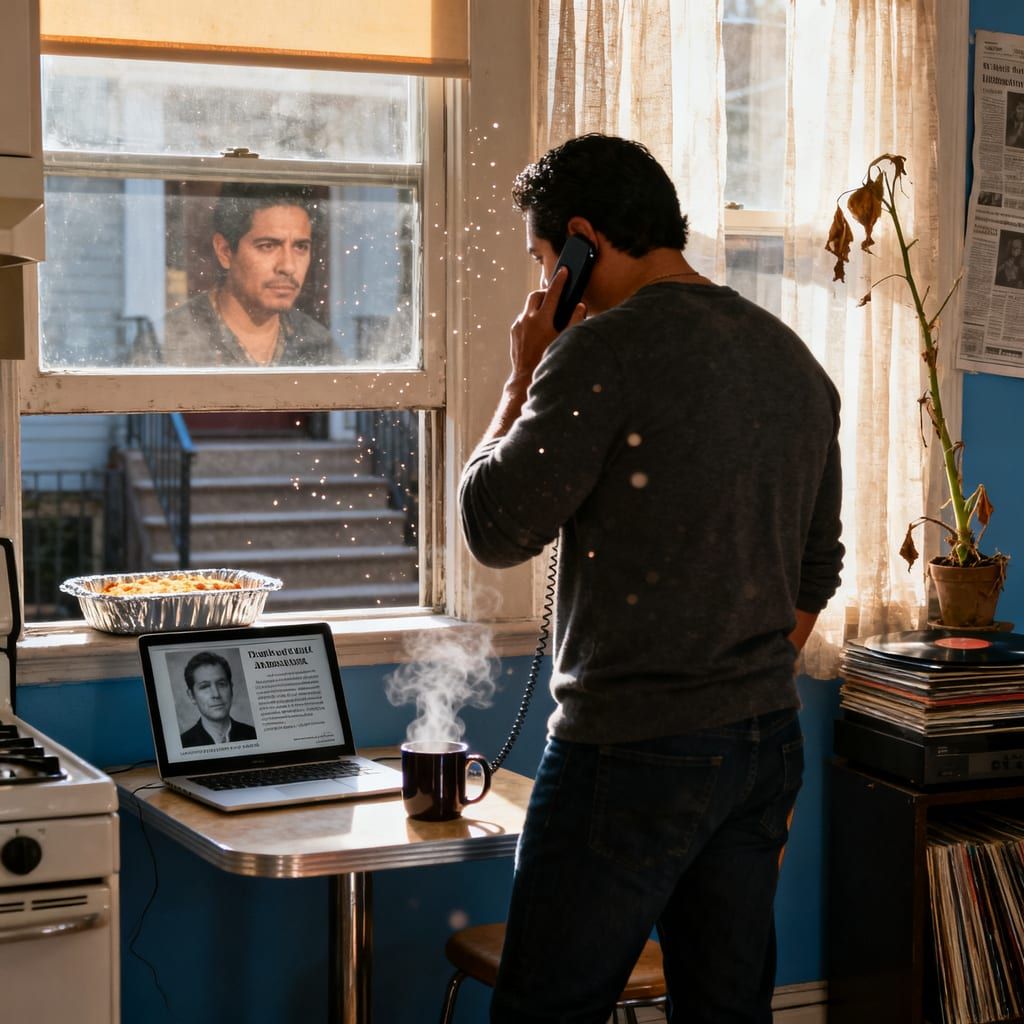
The morning my obituary ran, the kettle screamed at the same time my phone did. Steam fogged the kitchen window; outside, a bus sighed and swallowed a blue-capped boy with a trumpet case. I poured water over a tea bag and watched the color bloom.
My phone wouldn't stop buzzing. Group texts. Slack pings. An unknown number from the funeral home I'd recommended last week. A floral shop-twice.
I didn't check any of it. I took the first sip, winced, and reached for the pill organizer with Wednesday's square still full. The tea tasted like compost and orange peel. The day tasted ordinary-until it didn't.
I found myself on the homepage between a coupon for olive oil and an article about the county fair's butter sculpture.
"REYES, JONAH A., 39," the headline read. I recognized the cadence. I'd written it. I knew the weight of my initials and the downturn of the comma.
I had drafted it two nights ago on my divorce-sofa with my laptop balanced on my knees, a half-warm beer sweating onto the coffee table. A craft exercise, I told myself, as if rehearsal were insurance. As if keeping death in a private folder labeled "someday" could tame it.
The copy was detached, careful. A neat life in twelve sentences: born in El Paso, raised next to train tracks and a lemon tree that refused to fruit. Journalism degree. Ten years writing obituaries for the Sentinel. Married, then not. No children. A sister, Ana, not mentioned because I didn't know what to say.
It sounded like a man I knew but didn't love.
I stared at the website's bright white, at my own thumbnail headshot gone grayscale by the algorithm that did that when a person died. My throat went tight around the tea. The first comment blinked into place: a candle emoji and a cluster of blue hearts.
The second was a man named Rick who'd fixed our office HVAC a hundred times: "He always asked my name."
A hasty intern had pushed a draft live. The CMS had shrugged and said yes. And the world, or at least our corner of it, read the summary I'd written and decided it was true.
My phone vibrated again. My ex: "?" Then: "Jonah?? Call me." A minute later: a long paragraph I wasn't brave enough to open yet.
The elevator smelled like old coffee and floor cleaner. At the third-floor landing, the lobby TV still ran the morning show, a meteorologist gesturing at blobs of green. A reporter passed me with a bagel and a look of complicated sympathy.
"Hey," she said carefully, as if I might crack. "You... okay?"
"I'm not dead," I said, with a hand that wouldn't stop shaking. "I think that's... a fact."
In the bullpen, screens showed my name like an unfunny joke. The editor-in-chief, who wore her hair in a red scarf and kept a cactus alive in a coffee can, was already in the intern's cube, her voice pitched low. The intern, a kid named Mason with a soft mustache and a sweatshirt that said CODE LIKE A GIRL, looked like he might cry.
"Jonah." My editor turned. "Come here."
We hovered over the CMS, that temperamental machine that had made me a ghost. The cursor blinked like a pulse.
"How long has it been up?" I asked.
She glanced at the metrics. "Thirty-two minutes."
"Feels longer."
"I'm so sorry," Mason blurted. "I was building a demo page for the internship class and thought the 'private' tag carried over. I clicked publish. I- I didn't know."
I wanted to say something gracious. What came out was thinner. "People die all the time by mistake around here," I said. "Usually not on the home page.
"We'll run a correction," my editor said. "Right away. 'Due to a technical error, an unpublished draft was mistakenly posted. We regret the error.'"
She touched my elbow. It was the lightest kindness. "Do you want to go home?"
I looked at my desk-a mug with a chip on the lip, a stack of manila folders with women's names written in black marker, a bowl of paperclips that had turned a little heart-shaped from use. The screens around me filled with breaking news and soft news and news that never felt new, and for ten years, I'd put people in past tense.
"I have two submissions due," I said. "Mrs. Patel's daughter called in tears about the date of the rangoli festival. She wants it right."
My editor gave a short laugh that wasn't unkind. "Of course you do."
By lunch, the correction ran. It was clean and clinical, three sentences that lifted the gray from my headshot and slid me back into the alive column. The comments didn't stop. Now there were new ones: "So relieved!" "Thoughtful man." "Made my uncle sound like himself-thank you."
A neighbor I'd waved at for six years left a foil-wrapped casserole at my door. My landlord texted, offering to change the locks if I needed. A high school classmate I hadn't heard from since ninth grade wrote, "I remember your car smelled like mangoes and you let me cut in the caf line when my stomach hurt." Where had that lived in me all this time, this gentle, absurd detail?
When I went downstairs for coffee, the barista with the constellation of freckles across her nose-Jess-looked up and actually put her hand to her chest.
"Oh my God. Are you-" She caught herself, cheeks pink. "Of course you are. I, um, I saw the thing. I almost put your vanilla in free today without saying anything, and then I thought: if he's alive, that's weird. If he's dead, it's weirder."
"I'm sorry," I said, because sorry is how I know to move through the world. "I didn't mean to die before caffeine."
She laughed, grateful for the door I gave her. "You always do the llama joke," she said, sliding my cup without charge anyway.
"The llama joke?"
"You know. When the foam art looks like a blob and you say, 'Ah yes, the rare Andean sea llama.' It's dumb. I love it."
I had not known that my dumb thing had a life outside my own head.
At the building where I sometimes cut through the lobby to shave a minute off my walk, the security guard-Carl, whose name I knew because I asked-called me over.
"Don't go yet," he said, reaching under the desk. He handed me a thin cardboard sleeve with two records inside, old jazz albums with elegant women in gowns on the covers.
"I've been putting these aside for you," he said. "Saw them at the thrift. Thought, 'That guy who asks me about Coltrane would like these.' I was going to give them to you on Friday. Then I saw your name and... I figured I missed my shot."
I swallowed so I wouldn't cry at a desk where a sign said NO UNAUTHORIZED VISITORS.
"Thank you," I said, and the words scraped my throat from the inside. "Carl, man, this is- thank you."
Back at my desk, a message I'd avoided blinked unread. From Ana.
Subject: Can we talk.
Sent at 11:38 p.m. The night before the error. A small sentence done without punctuation, her old way when she was tired and hopeful, like we were still kids and words were easier without their fences.
We hadn't spoken since the day after our mother's funeral, when grief sorted us like laundry and I accused her of leaving early and she threw back that I had left years ago for bylines and deadlines and a city with winter only our parents would have tolerated.
I clicked the message. "When you have time. I want us to try. I think Mom would hate this. I do too." Then a single heart, the kind without shine.
I stood so quickly my chair rolled into the plant that had half-died and then decided against it. My fingers hovered over the keys and couldn't form a sentence that didn't sound like a eulogy.
At two, I taught a workshop at the library-the monthly one for teenagers who had lost grandparents and pets and, once, a brother. We don't say "died" in there until they do; we say "left" and "ended" and "no longer" until a kid drags us to the word.
A girl with chipped black polish and a Band-Aid on her knee stayed after everyone else herded toward the snack table.
"You helped me last month," she said without looking up. "My abuela. The part about her singing to the tomatoes. We put that in."
"She told them secrets," I said, remembering the grandmother's hands on the girl's phone screen, brown and veined like dried leaves.
"My mom said... she said the paper made it seem like she mattered." The girl looked at me. "That was you, right?"
"It was you," I said. "You gave me the tomato part."
She nodded, thinking it through. "Okay. But you wrote it."
After the workshop, I sat in the quiet for a long minute while the library settled into its afternoon hush. A dust mote drifted through the column of light on the table. I thought about the stories I'd placed between grocery ads and weather maps and how the space didn't cheapen them. If anything, it put them stubbornly where life lives.
By evening, the editor had pulled down the mistaken obituary and run a correction that made me sound like a typo. The calls slowed. The flowers at my stoop did not. The foil-wrapped casserole waited like a good dog.
I finally opened my ex's paragraph. It was a knot and a ribbon. "I didn't know how much I missed you until I thought I couldn't tell you. We were bad at the middle. I'm sorry for my part." There was more. A PS about the couch we fought about. A joke about splitting it in half and both losing.
On top of the casserole was a note in block letters: "We're glad you're still here. -2B." Apartment 2B had a new baby who cried in the exact key of a smoke alarm. I had not been generous about it, even to myself.
Inside, I put the records on the cabinet, set the casserole on the stove, and finally called Ana.
She picked up on the first ring and didn't speak. I could hear her breathe, the soft rush of an ocean inside a shell.
"I'm sorry," I said.
"For what?" She sounded wary and weary and so much like an echo of our mother that my throat tightened.
"For the way I left before I left. For the things I tucked into sentences with no room for you."
Ana let out a breath I could see with my eyes closed. "I'm sorry I made the funeral into a test you could only fail."
We were quiet. A siren threaded the air outside my window and unspooled into night.
"I saw the thing online," she said finally. A dry laugh. "You always did like deadlines."
"Too soon," I said, and she snorted, and it felt like a lifeline coiled between us.
We talked about the stupid lemon tree that never fruited and how Mom insisted it was teaching us patience. We talked about the box of recipes Ana had rescued, how the cards still smelled like cumin and dust. We didn't solve anything. We made room.
Before we hung up, she said, "Write me into your life, okay? Not just into your ending."
"I will," I said, and this time I knew it was a fact.
The next morning, I stood in my editor's doorway as the sun drew a rectangle on her floor. Mason hovered a polite distance away, a plant in his hands like an apology offering.
"I have a pitch," I said.
My editor raised an eyebrow and gestured at the chair. "If it's about better CMS permissions, you're late. IT is on it."
"Living obituaries," I said. "Not profiles. Not puff. The thing we do, but with the person there. While they can still pick up the phone. We'll sit beside them. We'll get the tomato song on record before the tomatoes stop listening."
She blinked. I watched the idea land on her like a bird that might startle. "People are allergic to earnest," she said. "They'll call it morbid."
"Maybe. But they came alive for me yesterday," I said. "They told me who I was. I want to give that back to them before the gray filter does."
Mason shifted, clutching the plant like a teddy bear. "I would read that," he said, eyes wet. "I would call my grandma because of that."
My editor looked past me, out at the city waking up again, the L looping like a slow bracelet around the skyline. She nodded. "Pilot it," she said. "First subject?"
I smiled. "Me," I said. "Revised."
In the draft that afternoon, I didn't start with where I was born. I started with the tea gone bitter on a morning the world thought I'd left it. I wrote about a barista who thought free vanilla wasn't quite the right response to mortality and about a security guard with a stack of jazz under his desk. I put in the way grief can make your voice smaller, even as you write other people big. I wrote about a sister who answered on the first ring.
I kept the mess in. I let the middle sprawl. I wrote: He began again.
When I turned it in, my editor read it twice. She didn't say good or bad. She said, "True." That was enough.
The piece ran the following Sunday in a sliver of the paper that smelled like ink and fresh morning. The comments were fewer this time. The texts were not. People sent me their beginnings without prologues. The llama joke made an appearance. The girl from the library emailed a photo of her abuela's tomatoes, glossy as plums.
On my walk home, I passed the bus stop where the boy with the trumpet had been. He was there again, tapping his case with a pencil. He looked up.
"Hey," he said. "You're the guy from the paper who makes people sound nice."
"I try," I said.
He considered this. "You should do one for my band director. He makes us sound bad and good at the same time."
"Deal," I said. "Tell him to answer the phone."
That night, I opened the private folder labeled "someday" and renamed it. "Now." Inside, the old obituary sat like a shed skin. I didn't delete it. I'm not naive. Endings come when they want.
I added a new document with the word "Again" at the top. I dated it. I wrote two lines and left room.
Outside, somewhere, a siren rose and fell. The kettle clicked off behind me. I set the table for one and then, for the first time in months, set out a second plate just to see how it felt.
When I finally ate the casserole, it was over-salted and perfect. I texted 2B: "Thank you. You're doing great." I meant the baby. I meant all of us.
And in the quiet after, with jazz humming and the night inching up the windows, I could hear it-a small chorus, the kind you only catch if you're paying attention. The living, clearing their throats, readying their lines.
A daughter learns to read between the lines of a life split in two
Read more →
A fog-draped night, two souls found, and the quiet shape of a life
Read more →
Story audiobooks for children of all ages — a new one every day on Smarter Way Stories.