Two Houses and One Quiet Heart
A daughter learns to read between the lines of a life split in two
Read more →
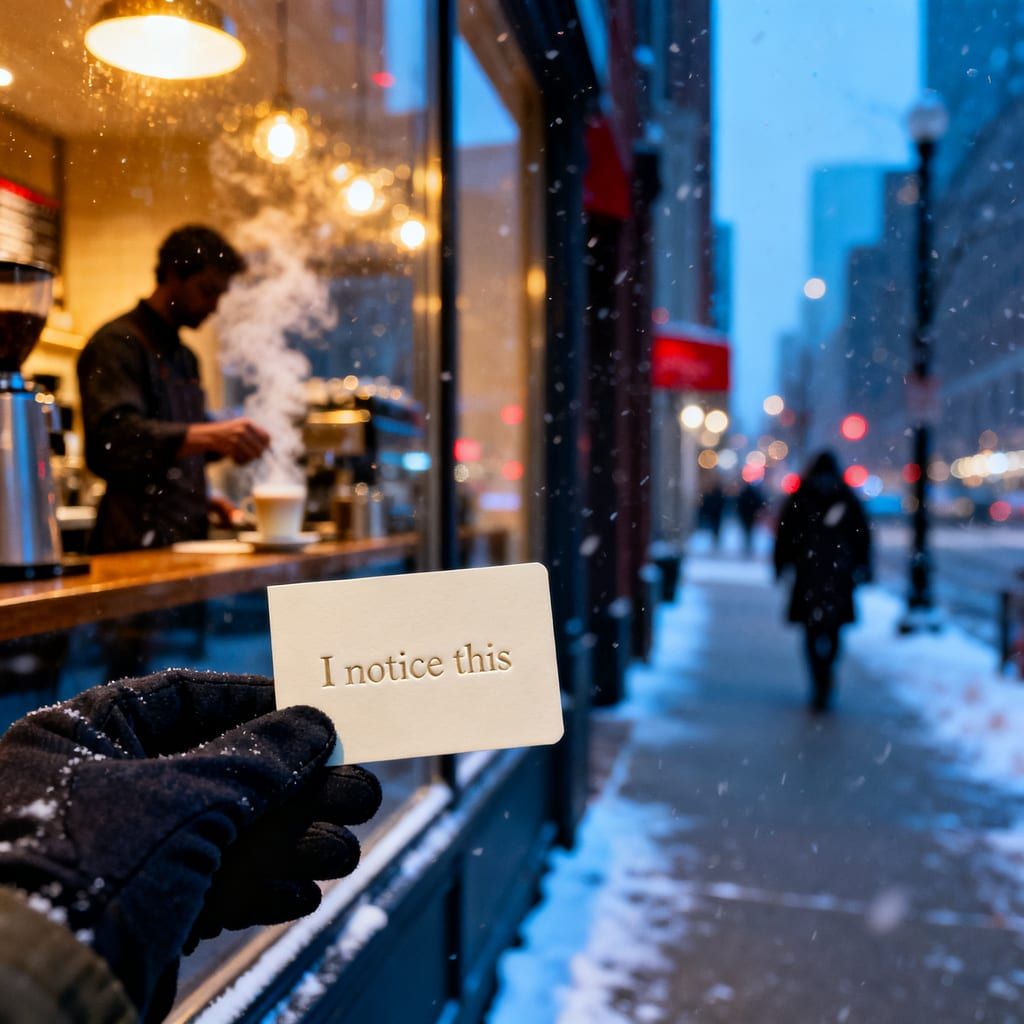
On New Year's Day, snow sifted over Chicago like someone shaking out a sheet. Noah stood by his drafty window with a stack of cream cards and a pen that bled a little when it paused. Three words were debossed at the top-I notice this-the phrase he'd tested under his breath the week before when the year felt vast and he did not.
He made tea he didn't finish. He made a rule he could hold: one compliment to a stranger, every day, and it had to be true; it had to be about something they could control; he could expect nothing back. He lined the cards like runway lights on his desk and picked one up.
On the corner of Damen and North, his first card found a home.
"You have very steady hands," he told the barista, watching the milk's white ribbon slip into espresso without a wobble. He slid the card across. His voice trembled, a half-degree. "That takes practice. It shows."
She glanced at the card, then back at him. A beat. "Oh. Thanks." The word came out surprised, like she'd tripped on it.
He left with foam he could taste all the way to the bus stop and wrote in his notes app: Day 1: Barista's pour didn't blink.
Awkward was the first weather system he moved through. The bus driver on the 146 had a voice like felt-soft, steady-when he announced the stops during sleet that blurred the windshield.
At the back door, Noah said, "Your voice makes this ride feel safe." He showed the card; the driver nodded once, eyes warm at the edges. "Be well," he said. Noah stepped onto slush that soaked his socks.
At a flower stand, a florist wrapped eucalyptus for a man who listed three allergies without looking up. "You remember people like it's a craft," Noah said. "That prevents headaches and worse. It matters."
The florist waved a hand, pink from the cold. "I try," she said, and tucked an extra sprig into the paper. He wrote later: Day 11: Florist holds details like water-carefully.
Some days, people deflected. A woman in a pea coat flinched when he admired her winter-bright scarf. "I didn't make it," she said. He slid the card back into his pocket and walked on, learning the terrain of No Thank You.
Still-he kept noticing. The old man at the bodega who counted change twice to be sure. The teenager backing up to let a stroller pass. The coat-check clerk who placed a lost mitten on top of the stand instead of stuffing it away. His compliments got smaller, which is to say they got truer.
His notes grew: Day 17: Bus 146 driver, calm in the rain. Day 29: Teen on blue bike, helmet every time. Day 33: Courthouse lobby man, shoulders squared.
By March, the cards felt less like tools and more like ritual. He wrote before he spoke. The writing slowed him, forced him to choose. He liked the scratch of the pen, the small bow of his hand.
One afternoon, at the courthouse where he filed paperwork he'd been avoiding, a middle-aged man sat on a bench with a folder pressed flat in his lap. His knee bounced, his jaw worked. Don't rescue, Noah told himself-this wasn't that. It was naming.
He wrote: I notice this: the courage it takes to show up. He read it aloud and watched the man's foot still. The man nodded twice, like resettling something inside.
"First time," the man said.
"Me too," Noah said. "Well. This part."
They did not trade names. They traded a small moment of air.
In April, on his way to work, Noah passed a violinist playing under the el tracks, resin floating faint as dust. The wind made a mockery of fingers, but she kept going, scarf stuffed into her collar, song like a gold thread.
"Your playing makes the cold kinder," he told her. She laughed, a little bark of disbelief, and looked back at her open case as if it might answer for him.
"Kinder?" she said.
He held out the card. "A little."
He put five dollars in the case, walked away before she could make it more or less than what it was. That night he wrote: Day 94: The D string like a light.
By June, work had gone gauzy. He stared more than he moved pixels. His product team spoke in acronyms he'd helped invent and now couldn't bear. He sat in meetings and noticed: a colleague's careful summaries, a QA engineer's patient bug reports. He wrote cards in the bathroom because it smelled faintly of lemon and privacy.
On an ordinary Wednesday, HR asked him to bring his laptop. The meeting took seven minutes. He walked out with a cardboard box and the kind of lightness that comes with a floor falling away.
He went home. He lay on the couch and watched the shadow of his plant move on the wall as the light shifted, like a slow wave. By evening he had not cried. By evening he had not spoken.
At nine, he put on his coat and went to the late bus because the day had to have its card. On the 151, a woman in scrubs stood up to offer her seat to an older man with a cane. She smiled in a way that made room for him to say no-and he did, and she sat again without making it a scene.
"You made that easy," Noah said, offering the card. "That's a skill."
She startled, then laughed. "I'm a nurse," she said. "Everything's a scene if you let it."
He wrote: Day 172: Laid off; strangers still generous.
The practice held. Even without a job, the day had a spine.
He did not expect the way the compliments would double back.
In October, a coworker he ran into at a farmer's market told him about a note that had started appearing on a bench in the courthouse lobby every Thursday. "Handwritten," she said, bag of apples swinging. "Says, 'If you're here, you're brave.' People take photos. It's become this-thing." She shrugged. "Chicago needs a weekly pep talk."
Noah stood very still among cabbages and doughnut samples, the sun making everybody's cheeks warm. He thought of the man on the bench, how his foot had stopped. He did not say, Maybe that was a seed I dropped. He said, "I love that."
One night in November, his neighbor across the hall knocked carrying a puffy coat in both hands like a baby. "See this?" she said, eyes bright. "Got it from a drive run by this violinist-The Cold-Kind Project. Found her streaming at night, the name got me. She's giving out coats at the encampment by the river."
The words hopped around the room before landing. The name. The coat. The winter he'd listened under the el.
Another time, he got on a bus and saw a slip of paper taped near the transfers: Your calm changes the route. The font was uneven; the tape bubbled. He heard the driver's voice, the day the rain beat flat. He sat down and put his hands in his pockets so he wouldn't touch it like proof.
He kept writing cards. He noticed shoelaces double-knotted and the way a shopkeeper's apology was actually accountability. He noticed a child who held the door open for four adults, each of whom said thank you like it had weight.
In December, he wondered if he'd done any of it right. Some days he forgot until eleven p.m., then went downstairs and complimented the building's night porter on the way he angled the lobby rug so nobody tripped. It felt perfunctory, a box ticked. Other days, the card burned in his pocket all morning, then found its person like a weather vane turning.
There were whispers now, online, about the cards. A thread in a neighborhood group: Has anyone else gotten one of those I notice this notes? People posted photos of their cards propped against salt shakers, stuck to fridge doors, tucked into wallets with cracked leather. The comments filled with specifics. I was told I have a clear way of asking questions. Someone noticed I always throw my trash away on the train. A stranger admired my yellow rain boots and now I wear them with shame-free joy.
He didn't comment. He didn't need to. The point was not to be known.
Still-on Day 360, he counted the remaining cards. There were five. He fanned them like a hand of something you were supposed to play well. The year had a cliff edge and he could feel his toes curling.
"I'll stop at 365," he told the plant, which had grown leggy and immodest. "That's round. Honest." His breath clouded the window. Outside, the city clicked its heels together without meaning to.
On the last night, the hospital lobby smelled like lemon and tiredness. Noah had brought a friend flowers after a minor surgery and gotten lost in a hallway with too many beige doors. He stood at a vending machine with an elderly man whose quarters kept slipping sideways and clanging like disappointment.
"Let me," Noah said, and he didn't rush. He lined the coins. He pressed the buttons slowly, narrating like it was a cooking show. The machine blinked, thought it over, then surrendered a bag of pretzels with a polite thud. The old man clapped once in delight, the sound small and pure.
"Thank you," he said. "You're patient."
"Sometimes," Noah said, smiling.
A woman in a navy cardigan watched them from a few paces away, slumped into herself the way the long day slumps the brave. She stepped closer, something resolute about the way her shoes clicked.
"Hey," she said. "I noticed the way you helped him without making him feel dumb." She held out a small cream card. On top: I notice this.
Noah laughed, a startled animal sound he did not recognize as his. He took the card like it might be hot.
"Where did you-" he began.
"They're everywhere," she said, tired mouth tipping up. "People leave them around. There's a hashtag on the back if you want to see. My daughter showed me. I've been carrying one in case I saw something I wanted to name." She angled her head, studying him. "Feels good, doesn't it?"
He turned the card over. There it was: a small stamp, a humble hashtag. Not an organization, not a brand. A trail of breadcrumbs.
"It does," he said softly.
"Keep going," she said. "Or don't. Others will." She lifted her coffee in a mock toast and moved toward the elevators, cardigan swaying like a curtain pulled closed.
Noah stood in the wash of vending-machine light and let the world rearrange him slightly.
He walked outside. Snow again-the confetti kind that sticks to eyelashes. A bus groaned past; a violin somewhere warmed up its first note.
In the days that followed, he found echoes with return addresses. A message landed in his DMs from a woman who said her brother had started leaving notes at the courthouse and gone with her to a mediation he'd sworn to skip. "He said some stranger told him showing up counted," she wrote. "So he did. We're... trying."
A clip of the violinist flickered across his feed: The Cold-Kind Project streaming in the blue dark, comments a waterfall, a pinned note about the heater they'd funded for the encampment by the river. People in coats inside a thin tent, steam of breath rising like prayers that didn't need a name.
He stopped into the coffee shop on Damen. The barista-same hands-was showing a new hire how to watch the milk, not the clock. "Name what they do well," she said, not noticing him at first. "Be specific. Like, your pour didn't blink. That kind of thing." When she saw him, her grin was the bright thing that happens when a circle closes.
"Still steady?" he asked.
"Steadier," she said, wrists loose. "I won a throwdown." She tugged at a paper taped to the espresso machine. It read: Notice, then name.
He bought a cappuccino and stood in the window light, watching his city move like an orchestra that didn't always know it was playing. People carried groceries, babies, grief, taxes, kindness. A dog tried to sit on two laps at once. A teenager practiced apologizing on the phone: "No, for real, I'm sorry. I hear you."
At home, he refilled the little brass holder on his desk with new cards. Not because the year wasn't over-it was, in the way calendars like endings-but because the practice had turned into a way of being, like brushing teeth, like locking doors, like looking up.
He wrote on the first new card slowly, letters careful as stitches: I notice this: the way you kept going. He didn't know yet who it would find. He liked that.
He slipped the card into his pocket, stepped into the hall, and listened. The world hummed-radiators, boots on salt, a neighbor's laugh splitting like kindling.
Outside, the snow fell in a new shape he did not have a name for. He would find one. Or he would let someone else.
He buttoned his coat and went looking for the next true thing.
A daughter learns to read between the lines of a life split in two
Read more →
A fog-draped night, two souls found, and the quiet shape of a life
Read more →
Story audiobooks for children of all ages — a new one every day on Smarter Way Stories.