The Porch Light Stays On
A bungalow where arrivals become landmarks
Read more →
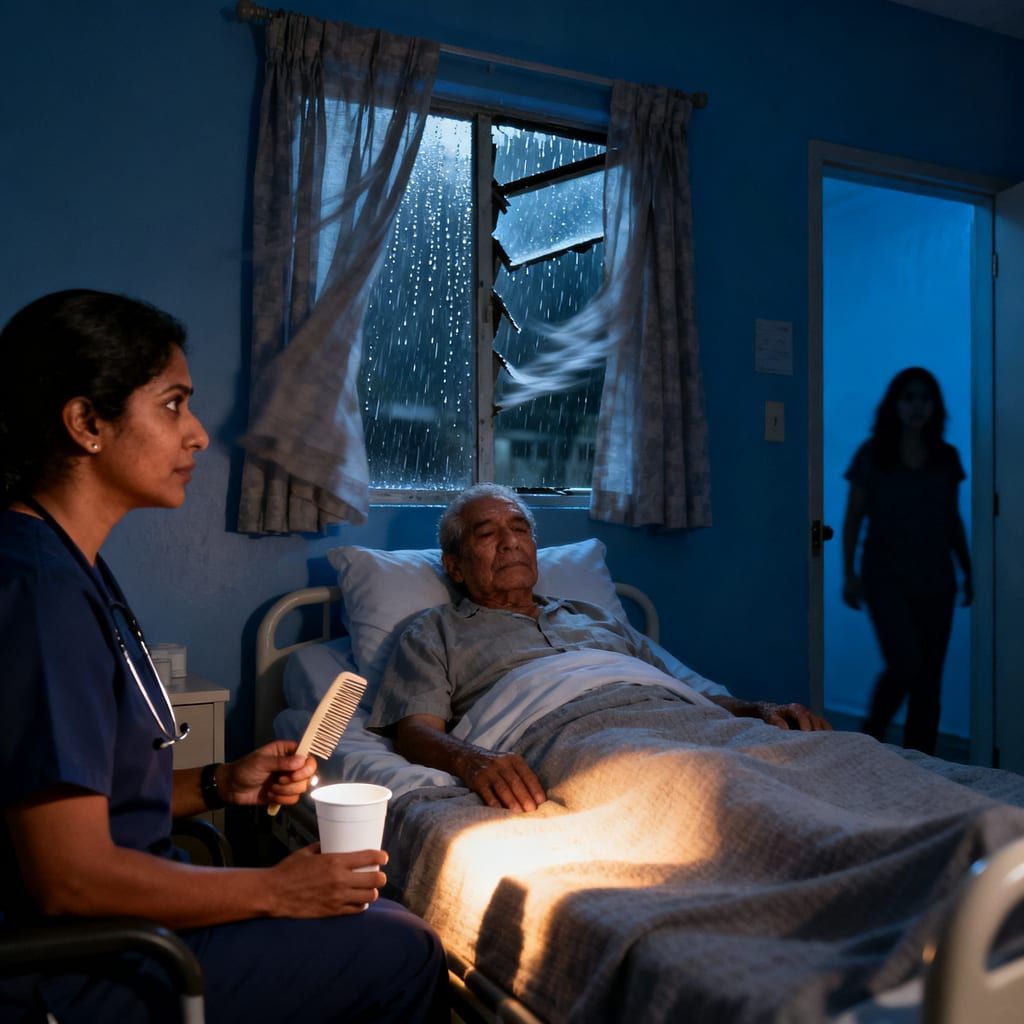
The storm took the building's breath first-the buzz of fluorescents faltered, monitors blinked a last green wink, and everything dropped into a held note of dark. Rain combed the city hard, thunder pacing the alley like a restless old dog.
Noor shifted her thermos of ginger tea under one arm and clicked on her pocket flashlight. Its circle found the corridors-scuffed baseboards, faded murals meant to be cheerful-then parted the hush at each door. She had learned the shapes of rooms by heart, the way you learn a lullaby before the meaning of the words.
She moved without hurry. Warm the hands. Smooth the linens. Name the fear if it helps; keep it company if it doesn't. She said the script under her breath like prayer.
At Room 5 a woman slept open-mouthed, slack with morphine. Noor tucked the call button closer to the bedsore pillow though it couldn't summon anyone now. In Room 9 she finished a crossword clue a retired teacher had started-seven letters for mercy-then tucked the pencil behind the woman's ear, a small, useless grace.
When power goes, so does pretense. Machinery can be loud with purpose; silence asks for a human voice.
She sipped ginger tea. It brought back kitchens scented with cardamom and rain that drummed so hard on the old apartment roof you could feel it in your chest. Monsoon, monsoon, her mother would sing, ladle clinking against steel, voice finding a melody that didn't mind the thunder.
By the time she reached Room 12, the storm had thinned to shivers. Wind pressed its palm to the window and released.
"Alvarez?" Noor said softly, beam low so it wouldn't startle. "It's Noor, night nurse. Lights are out for a bit. I've got extra blankets and a bad singing voice on request."
A rattle of breath answered, then a voice like a rusted hinge: "You got the ocean?"
Rafael Alvarez lay propped like a man who'd given up any relationship with comfort except the idea of it. He was mid-seventies, gruff the way men get when tenderness has cost them more than they could afford. His beard was salt and cigarette, his chest rose under the gown with effort the room could measure.
"The ocean," Noor repeated.
He turned his head toward the dark square of window. "The sound. I used to fix nets down in Ponce. Sleep on a bench since I couldn't pay for anything else. Wind in the palms, waves in pieces. Makes the hurting quiet."
Noor unlocked the window latch a cautious inch. Rain smell slid in-the hot, clean ache of it. Traffic far below hissed like a kettle. She opened a white paper cup from the shelf, held it sideways into the hush, and with the comb from her pocket she drew the teeth slow along the rim. A soft, rising hush answered-a small machine built of nothing but friction and air.
Rafael's eyebrows lifted. His breath snagged, then steadied a fraction. "What is that?"
"Best I can do for surf," Noor said. "A cup, a comb, and a wind that owes us a favor."
She tried a phone app first out of reflex-the ocean slider, the dunes option-but the battery wheezed and died between choppy seagulls. Technology had a way of choosing its moments to be mortal.
"No birds," Rafael said. "Just the push and pull."
"Just that, then." Noor kept her hand working the comb. Breath, wind, breath, wind.
He closed his eyes, cheeks hollowing as the room settled around the rhythm. The words came in the space between sounds. "My girl," he said. "She's not here."
Noor didn't make a shape of pity on her face. She had learned that expressions can be their own errors. "Do you want me to call her?"
"I don't want to make her come to watch a man do a thing he could've done better," he said. "I want a witness, maybe. Not a priest. Not a pardon."
"Okay," Noor said.
"Write some words?" he asked. "Plain. No sorry. She's had enough sorry she can drown in. Put this: I kept your letters under my socks so I could pretend I was brave. That's all. She'll know the rest."
Noor clicked the flashlight to her pocket, made a lap desk of her thigh with the chart. The pen scratched. I kept your letters under my socks so I could pretend I was brave. There was more air in that sentence than ink.
"Sign it?" she asked.
"Rafael," he said. "She calls me Papi, but you write Rafael. If she wants Papi later, she can choose it."
Noor folded the page carefully, slid it into a glove bag for want of an envelope, labeled it with a piece of tape and his name. In the dark, you invent ceremony from what you have.
"Now the wind again," he whispered. "And the song. You said you have a bad voice?"
"Terrible," Noor said, and smiled where he couldn't see it.
She hummed the tune her mother used to sing when the monsoon drummed: a lilting 6/8 that rocked even when your body wouldn't. It walked up three notes, back two, took its time sitting down. Words curled at the edge of her tongue-Gujarati syllables old as her grandmother's wedding anklets-and she let them stay unspoken for now, just the shape of the melody offering its patient palm.
Rafael's shoulders sank a centimeter into the pillow. In the beam of the flashlight, his hands loosened from fists he'd been holding for years.
When her father died last winter, Noor had tried to fix him. Charted his medications on a whiteboard, read journals past midnight, argued with physicians as if winning were the same as healing. A hospice nurse had put a hand on Noor's shoulder in a hallway that smelled like lemon cleaner and loss. "There's fixing," she'd said in a voice that didn't ask to be heard. "And there's holding."
Noor had nodded like she understood, and then spent the next days learning how to sit without plan. She had kept company with regret more than with him. The regret was noisier.
Now, in a room with no machines to pretend for them, she hummed and kept count not of minutes but of breaths. The long spaces were getting longer. The rain wandered off to find other roofs.
The cup-and-comb ocean kept its small coastline. Ginger and lemon murmured from the thermos cap. Noor's feet ached the low ache that follows you home and climbs into bed.
A door at the end of the hall thumped against a slow gust. Footsteps, the quickened kind. Then a figure filled the doorway-hair plastered to a brown face, jeans dark with rain, a canvas jacket shedding water in fat drops to the linoleum.
"Room twelve?" the woman asked, out of breath, not stepping in as much as being pulled.
"Alvarez," Noor said. "Yes. Come."
The woman crossed the threshold as if border guards might still stop her. She stopped at the foot of the bed, fingers white around a car key. Noor's humming wavered-then kept on, a small river refusing to be startled from its course.
The woman's face softened along a line that wasn't quite relief. She didn't speak. Instead, she stepped to the other side of the bed and-without preface-found the next verse. Spanish, same bones of melody, different skin of words. A lullaby that had lived in someone else's kitchen and another someone's tired throat.
Rafael's eyelids fluttered. He turned toward a sound he'd known before language. A tired smile cracked open. "María?" he breathed, and in the syllable was wife, was daughter, was shoreline.
"It's me," the woman said, and her voice became the song again because sometimes sentences fracture what singing can hold whole.
Noor didn't try to cover what didn't belong to her. She took the harmony below and let the woman's melody be wind, be water, be the quiet of hands finally not making fists. The paper cup whispered its surf. Their voices braided.
The breaths stretched wider-long meadows of quiet between them. Then one didn't end like a period but became a horizon.
They kept singing a moment longer because stopping felt like dropping a rope in the dark.
The room changed the way rooms do when a person leaves them. The bed was the same, the sheets the same, but the air had a notch taken out of it only certain lungs could feel.
The woman's hand was still on the blanket. She exhaled a sound that was not sobbing. Relief has its own key.
"I'm Noor," Noor said softly. "Night shift."
The woman wiped rain and sweat and something else off her cheek with the heel of her palm. "Ana," she said. "He called me. Two nights ago. I didn't pick up. I was mad at a ghost." Her mouth quirked into a grimace of honesty. "Then tonight I pulled into a gas station off 278, and I sang that song in my car to make my heart stop sounding like a siren. I've been singing it since I was little. My mother... she sang it for us when the wind got bad."
Noor nodded toward the glove bag she'd used as an envelope, the tape labeled RAFAEL in careful print. "He asked me to write something for you."
Ana took it delicately, like it might break. She read standing up, light from the hall finding her eyes. A breath changed her posture, a hinge eased somewhere no one could touch. She didn't cry. She folded the note and pressed it flat between her palms the way some people press a petition.
"There's tea," Noor offered, unscrewing the thermos. "Ginger. It forgives most things."
Ana let the steam touch her face before she drank. "How did you know that song?" she asked, not accusing, just curious in a room that had earned curiosity.
"My mother," Noor said. "When the monsoon drummed the roof. It was the only good wind I had left to make."
Ana smiled, small and wiped at the corners. "That's a good wind."
They stood a while longer with the hum of the emergency lights far down the hall like a city dreaming of itself. When Ana left, she pressed her fingers to the bed, to the space above where her father's chest had been, to Noor's forearm. Thank you didn't announce itself, but it lived there anyway.
By the time power returned, dawn had already started insisting at the edges of blinds. The fluorescents woke in a shiver of apology. Machines remembered their songs. The building found its old breath.
Noor finished her round in amber light. She reported to the day nurse what she could, what she couldn't, what didn't belong to words. She wrote Rafael's name into her ledger of small mercies, a notebook with a blue cloth cover that fit her hand like an old map. She didn't list the cause of death or time; she wrote: Wind. Cup. Comb. Two voices. Smile.
She tucked a spare comb into her pocket. You never know what you'll need until everything you thought you needed is gone.
On the sidewalk, the storm smell had washed the city no cleaner but differently. Pigeons strutted like damp old men in light jackets. The bus hissed open its doors. Noor adjusted her bag and felt last winter's emptiness shift in her chest like furniture moved to a better corner.
There are grand answers, she knew. There are cures and revelations and gestures you can frame. But at three in the morning in a dark room, sometimes all you have is a paper cup, a comb, and a tune your mother gave you for free. You put them in the air and trust they might be the bridge someone was already building from their side.
Noor took a breath that belonged completely to the morning and stepped into it, letting the city carry her with its old, working hum.
Story audiobooks for children of all ages — a new one every day on Smarter Way Stories.