What the Mirror Couldn't Hold
A frame, a note, and the rooms they make inside us
Read more →
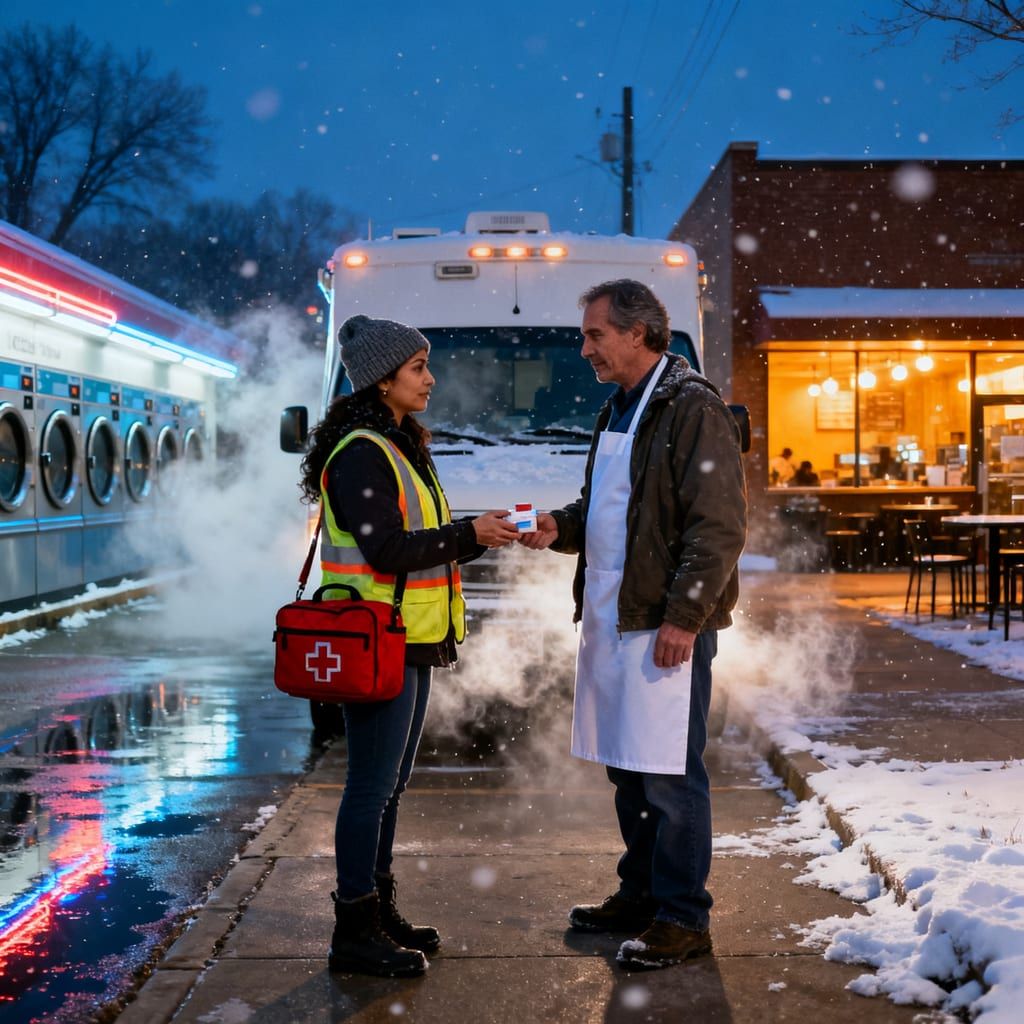
On winter nights the street is a thin jaw of breath and salt. The laundromat hums a lullaby-drums rolling, coins clinking-while the café leaks light along the sidewalk like honey. I park the mobile exchange in the seam between them, an old white van with a hot breath of its own. The heater coughs, the windows fog, and I flip the latch on the side door until it catches.
"Evening," I say to the first hunched shadow. "I'm glad you're here."
I keep a tally counter on my lanyard, a dumb silver bead for numbers I don't show anyone. Some nights it counts forward: clean kits out, wound care, a laugh. Some nights it counts back: prayers, seconds without air, the slow subtraction of grief.
They arrive in twos and lonesome ones, in quiet bursts and with the kind of noise that startles sparrows out of the hedges. I learn the names and the near-names: Teej, Mouse, Laree. I learn that Ben likes mint tea, that Nessa is saving for boots with fake fur, that Ray will look me straight in the eye and say, "These strips-do they turn darker if it's strong? Like, darker dark?"
"Dark is dark," I tell him, sliding the paper-wrapped tests across the folding table. "It's not a strength test. It's a presence test."
He nods like he'll carry the words in his pocket to turn over later. The air tastes like coins. Someone laughs at a joke no one told.
When I say, "I'm glad you're here," they nod or roll their eyes or say, "You and me both," but I mean it every time. It is the only true thing I know to start with.
Across the way, behind the café's soft glass and twined lights, a man polishes the same corner of counter until it gleams. He watches the van as if waiting for it to confess something. Two weeks ago he asked me, curt and careful, to keep the line tidy and out of the alley. He has called the city, I am told, most Tuesdays.
His name is Paul. He makes a cappuccino like a period at the end of a sentence-you can tell the thought is finished just by looking at it.
Between refills of cocoa packets and stamping dates on sharps containers, I listen to the radio ticking out school closures. The snow outside is the kind that makes no sound until it aggregates. The heater shifts into a chug-like it, too, is asking to make it to midnight.
A guy named Tomas appears for the third night in a row, palms open for naloxone. He jokes that he's become the neighborhood paramedic. "You know who you keep the kits for," he says, eyes flicking toward the café.
"I keep them for you," I say.
He grins at that like a child who just discovered his own reflection.
The back door of the café bangs once, twice, then hinges into silence. A beat. Then the sound flares up-the kind of frantic knock that lands deep in the throat. The van's heater rattles a warning. I'm already moving.
Paul's face appears at the side door, flushed and wolf-eyed. His breath turns to fog as he speaks. "Bathroom," he says. "She-please-she's-" He can't find the last word, and I don't need it.
"Grab that red bag," I tell him. "We're going."
The girl is crumpled on the bathroom tile, knees a letter bent the wrong way. She's wearing a sweatshirt with a middle school mascot peeling at the edges. Her breath is a coin flip that keeps landing on its rim.
I drop to my knees. Tilt. Sweep. Chin up, open. Cold tile against my jeans, the air sharp with citrus cleaner and something copper-sweet. "I'm Lina," I say, more for myself than for her. "I'm glad you're here."
I take out the naloxone. Paul hovers at the sink, hands shaking so hard a paper towel flutters to the floor. "I called 911," he says, as if that's a confession.
"Good," I tell him. "We're going to help her breathe until they get here. You're going to time the breaths with me."
He blinks like I've offered him a language he once knew.
"Nasal spray," I narrate. "Half in one nostril, half in the other. Okay. Now we count. In-" I press my palm over her sternum. "-and out."
Paul crouches. "What do I do?"
"Talk to her." I'm gloved and steady. That's the trick: let your hands learn the weather, not your mind.
"What do I say?" he asks, a child, an owner, a brother to someone I haven't met.
"Anything true."
He leans in close to her ear. "Hey," he says, voice raw. "You're in my place. You can have anything you want. Coffee on me. No questions." He swallows. "I know it's loud in there. But come back, yeah?"
We count breaths like rosary beads. Thirty, twenty-nine, twenty-eight-no, backwards makes my hands go slower, more careful. Twenty-one, twenty, nineteen. The body remembers math even when the brain is under snow.
There's a moment in every reversal where the room is a held note. And then there's the ragged symphony of return: a sputter, a cough that corkscrews, a smear of sound. She rolls a shoulder. The world rushes in.
Paul's hands won't stop shaking. He looks at me like I levered a star down.
"Okay," I say softly. "That's it. You did good."
His lip trembles. He laughs once, a bark he bites in half.
The paramedics bloom at the door in yellow and competence. I step back into the white noise of the hall. Paul locks the café early and returns with his jacket half on. He follows me out into the evening like someone leaving a movie without the end credits.
The snow turns from salt to lace. We sit on milk crates by the van, the laundromat's glow crawling over our boots. He keeps his hands tucked under his arms as if he could fold them into stillness.
"My brother," he says. The words come like a receipt printing-uneven, then an unspooling. "He died in a gas station bathroom. I was working a closing shift. He had my number in his pocket. I thought I could fix everything by keeping it clean. If the block looks safe, it stays safe, right? That's the math I could live with."
I listen. The heater cedes a softer hum, as if warming to the idea of mercy.
"I called every week," he admits. "About your van." He rocks his heel on the ice. "I didn't tell them about him. Felt like-if I said it out loud I'd be asking you to pity me, and then I'd owe you something I couldn't pay."
"You don't owe me," I say. "You didn't owe him either."
He looks at the café's dark windows like they're a ship he once sailed. "Those ten minutes," he says, staring at the strip of snow along the curb, "the ones where they told me, and I was still holding his name in my mouth-those minutes have been ten years long."
The bottle of mint tea I keep for Ben fogs my gloved palm. Across the street, someone hoots triumph at a washing machine that finally unlocked.
"Sometimes," I say, "we count wrong on purpose. To slow it down enough to care."
He nods, a motion that seems to set his ribs free.
In the weeks after, the city line goes silent. Paul stops dialing and starts bringing a kettle, the kind with a lovely throat, and three orange extension cords that he snakes across the threshold like tame eels. "For phones," he says, shrug-awkward, eyes on the ground. "People should be able to call their people."
He lets me stock an amnesty tin behind his counter-stickered, modest-with a small sign that says, in his neat capitals: "Take one. No questions." He slides kits into open palms. He learns to say, "I'm glad you're here," and he says it to everyone, even the man who once urinated behind his dumpster, even the woman who coughed so hard she knocked over a stack of napkins.
The regulars notice. Tomas leaves a dollar in the tip jar with a conspiratorial glance, as if generosity were a prank. A woman named Rhea returns for more fentanyl strips-"For my mom," she says-her hand trembling like a leaf cupping rain. We show her how to wait for the line to darken, not as judgment, but as a map.
Not everyone makes it. The sirens still curl through the night like a bad rumor. The tally counter on my lanyard still clicks in both directions, arithmetic with no mercy for wishes. But sometimes people come back-wet-eyed, sheepish, alive.
One night the girl from the restroom reappears at the edge of our circle of light. Her hands are clean in the way you notice only if you know what grime loves to cling to. She tucks hair behind her ear, looks at Paul and then me.
"Hey," she says. "Thanks."
"Anytime," I say.
She inhales like surfacing. "I'm going to try detox," she says, testing the sentence like a step onto ice. "I'm scared."
"Okay," I say. "We can be scared and still walk."
Paul sets a paper cup in front of her. He has written her name on it even though she didn't give it. He nods at me like I handed him a new way to hold his brother in his chest-less blade, more bowl.
The snow lifts. The laundromat doors yaw open like lungs. The café's bell rings with the same little brass note it always had, but the sound lands differently now-less like a boundary, more like a hand on a shoulder.
I learn new names. I keep mint tea for Ben, ginger for Rhea's mom, cocoa with extra packets for Tomas's paramedic nights. I jot a reminder to get boot socks for Nessa when she finally buys the boots. The van goes on being a little ugly and entirely useful.
On quiet stretches I find myself glancing at the tally counter, thinking of the bathroom's echo and the way Paul's voice bent toward hope like a reed to wind. We counted backwards that night, not as surrender, but as a way to hold time in our hands without breaking it. Back from the edge, back into breath, back to the small, practical acts that make a life spacious enough for trying.
I still begin the same way, palm open over boxes and bandages, voice even in the bite of weather. "I'm glad you're here," I say, to the man limping, to the woman with eyes like flint, to the kid who doesn't know he's a kid. Across the street, Paul looks up from the espresso machine as the door bell tings, his hand already reaching for a cup.
Light pushes under the corners of the day. The room has shifted, just enough. The numbers do what they do. We breathe. We count, sometimes forward, sometimes back, until the rhythm becomes something like music.
A daughter learns to read between the lines of a life split in two
Read more →Story audiobooks for children of all ages — a new one every day on Smarter Way Stories.