Clean Needles, Quiet Acts of Grace
Winter light, a humming sign, and the breath between
Read more →
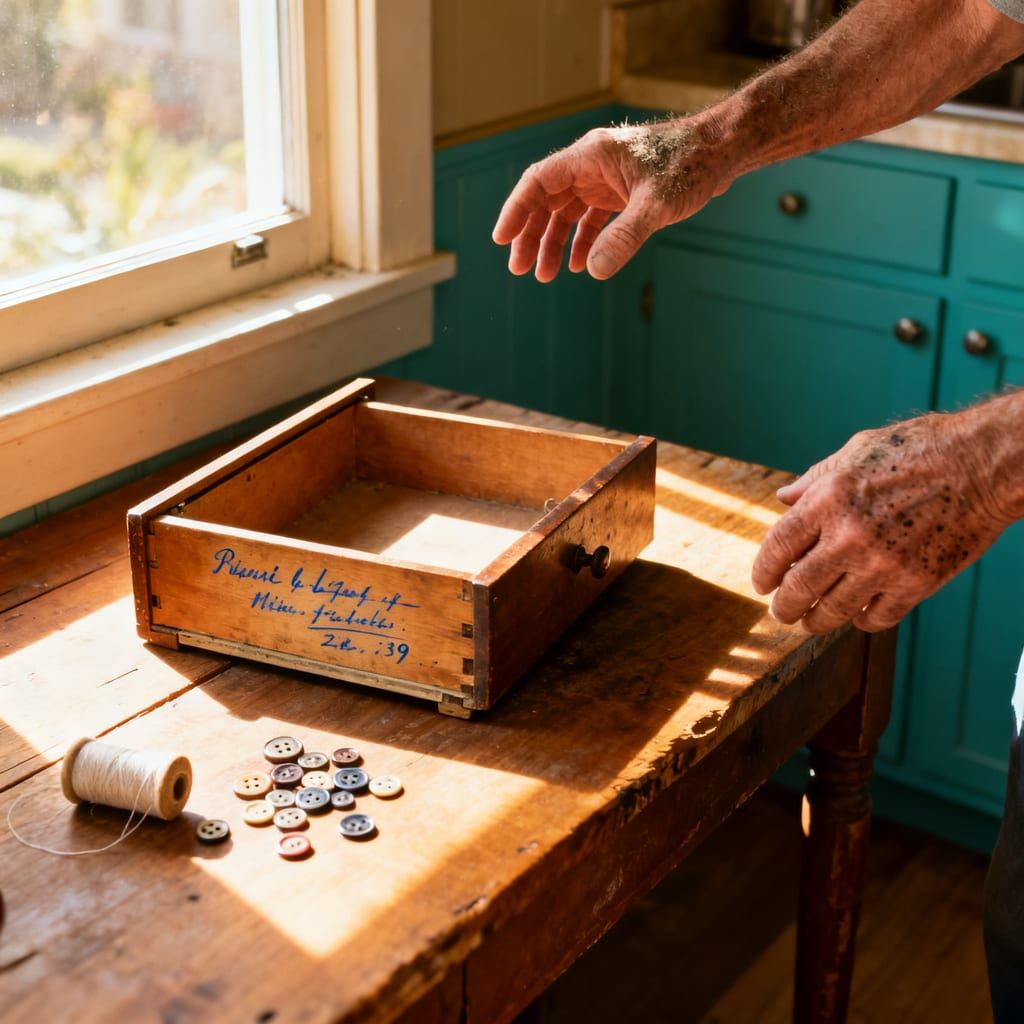
The shallow drawer slides free with a little gasp, as if the desk exhales when it finally lets go. It clatters onto the carpet and scatters buttons like moons across a dark sky. Jonah stares down, heart thudding harder than it should for a piece of furniture misbehaving.
On the raw underside, in looping blue ink, someone has written: "Jonah-if you find this, I forgive you. -Lola, 2004."
He sits back on his heels, palms gritty with dust. The year is wrong. Lola died in 2003, in this sunlit rent-controlled apartment that still smells faintly of fabric softener and eucalyptus. He feels the message land inside him like a stone in a pond-ripples he can't see but knows will touch everything.
He wasn't the one who needed forgiving. That's the defensive thought that arrives too quickly, like a child shoving to the front. He hears his own voice answer it, quiet: Or maybe you were.
Across the room, light slants in dusty ladders over the faded couch where he took naps after school while Lola-never Grandma, always Lola-hemmed someone's church dress or barong. The apartment hums with the refrigerator and the faded chatter of a neighbor's radio. Outside, a leaf blower complains.
He flips the drawer in his hands, tracing the steady loops of her handwriting, the way she always made her J's a little fancy, like a hook that had just caught something.
Jonah Reyes is thirty-eight, a freelance IT contractor with a divorce decree folded too neatly at the back of his filing cabinet. He has come back to this apartment to pack what can be packed and fold what can be folded. The rest-like the thin line of grief dust along the windowsill-resists.
On the dining table, a handful of roped thread sits beside a chipped cup of coffee gone cold. He sets the drawer gently beside them and wipes his palms on his jeans. His mouth tastes like old pennies.
Juan. His father's name, in Spanish, is his in English. Jonah and Juan. Two halves of the same sound, two men with the same first letter of absence.
He breathes out and does the thing he always does when something confuses him: he starts making a list. On an old receipt book from the desk-Lola's handwriting again, tidy, tight-he writes: 1) Ask neighbors. 2) Check desk for clues. 3) Call Dad.
A laugh bubbles up and breaks quickly. Look at him, reverse-engineering love like a printer driver.
He begins with the drawers. He empties them into careful piles-zippers, needles, measuring tapes curled like sleeping snakes. In the bottom drawer, under a square of floral contact paper, he finds a phone number scribbled on the inside of a pattern envelope. No name. The numbers look like they were written quickly, ink pressing through like a shout.
In a shallow side cubby, he discovers a faded receipt from a repair shop: RIVERA WOODWORKS, Eagle Rock. The date is smudged, but he can make out the summer before she died. "Desk drawer runner replacement," it says in block letters. He turns it over. On the back, in Lola's loops: "Gracias, Juan."
He presses his thumb against the name until the skin ghosts pale around it.
He knocks on the apartment next door. Mrs. Cruz opens in her socks and rollers, her mouth forming the little O it always has when she sees him. "Ay, Jonah. Your Lola used to throw her chappal at me from the balcony when I left laundry too long in the machine," she says, smiling and already crying.
He asks his careful questions. Did Lola have the desk repaired? Yes, she did, the summer it squeaked every time she opened that one drawer, drove her crazy. Who fixed it? "A nice man with rough hands," Mrs. Cruz says. "Juan, like your father. He and your Lola... they talked long that day."
He nods like he expected it. Inside he feels something tipping, a long shelf finally giving way.
Back inside, he dials the number from the pattern envelope. It rings to a dead line. He tries Rivera Woodworks. A young voice answers-new owner, same sign. "My tito says the old Rivera retired years ago," the voice tells him. "But he kept some of the old job sheets. If you can come by, maybe we find it."
Eagle Rock is ten freeway exits and a lifetime from Lola's apartment. The shop smells like lemon oil and cigarettes long quit but still haunting. On a corkboard, Polaroids of legs of tables and half-finished credenzas curl at the edges.
An older man with a pencil behind his ear flips through a milk crate and pulls the sheet free. "Look at that," he says, tapping the paper. "Barajas Desk, repair: drawer runner. Note: 'client will pay with pandesal.' Your Lola, she used to bring bread. I remember her."
He tilts the paper for Jonah. A name is scrawled at the bottom. Juan Reyes. Carpenter.
He stands there with the name between them, its letters doing a strange thing in his chest, like an elevator passing floors slowly.
"Good carpenter," the man says. "Quiet. Sad."
"Yeah," Jonah says. "That sounds right."
He leaves with a photocopy of the job sheet in his pocket and the sudden, sharp certainty that the desk never belonged to him alone. He drives east, past streets named for fruits and saints, to a modest bungalow with a chain-link fence and bougainvillea making its small riot over the gate.
His father's rental smells like boiled coffee and the lemon dish soap every Filipino kitchen seems to know. The table near the window wobbles when you brush against it, a rhythm of its own.
Juan answers the knock with a wariness Jonah recognizes-like when you turn on a light after years of telling yourself you don't need to. His hair has retreated, his shoulders hunched into the shape of an apology he never learned the words for.
"Anak," he says, surprised into intimacy. "Jonah." He says the name twice like checking a bridge.
"I brought something," Jonah says, and the desk arrives between them like a third person.
They unload it together, a graceless dance on the narrow walkway. "Careful," his father says, "this leg is loose," and Jonah almost laughs because-of course.
Inside, he sets the shallow drawer on the table, flips it over, and watches his father's face watch the ink. For a breath nothing happens. Then the older man laughs once, helpless, and his mouth folds around the sound like it doesn't fit.
"I told her the runner was cheap," his father says finally, voice breaking gently. "I told her the drawer will come out again one day. She said, 'Good.'" He presses two fingers to the blue loops. "Her pen. Always that blue. Like the Bic she kept behind her ear."
"You fixed it," Jonah says quietly.
His father nods. The quiet lasts-this one a good quiet-and then it breaks the way clouds do when a plane comes through. "I was the one she forgave," he says. "I came to fix this, and she fed me bread until my mouth was too busy to say I was sorry." He shakes his head. "I was a coward."
Jonah looks at the man's hands, the way the tendons rise when he grips the drawer. He thinks of all the times he has told people his father "left" like a package left on a stoop-neutral, passive-when what he wanted to say was that he was the boy on the other side of the door, listening for footsteps that never turned back.
"So," Jonah says, and the single soft syllable opens a space. They fill it.
They talk in slow pieces at first. About how the Dodgers had looked on TV through cheap antennas, how morning bread is best when it's still warm in the bag and leaves crumbs on your palm like a small blessing. His father says the thing that takes effort to say: "Leaving felt like love that day, because I thought I would not break you if I went before I did the breaking piece by piece." He looks down at his hands. "I was wrong."
Jonah swallows, the old salt and new water mixing. "I blamed you," he says. "And also I used you to make decisions easier. 'My dad wasn't around'-you know, like a coupon for getting out of trying." He laughs, a sorry sound that lands and stays. "I was wrong too."
Outside, a dog barks. The kettle clicks itself off. The house breathes around them.
When there is a natural lull-a place to fold the conversation like fabric waiting its turn-Jonah runs a fingernail under the bottom-most drawer's panel. It resists, then yields with a papery sigh. On the raw wood there, fainter, a different hand has written in pencil: "For the one who is tired: eat, then rest. The world can wait."
He closes his eyes and sees the shape of Lola's mouth when she said his name in the mornings like a soft instruction: Jo-nah. He realizes that the second message is not to a man who left but to the boy who learned to carry.
His father touches the words like they might rub away. "You were always tired, anak," he murmurs. "Helping. Being good."
Jonah feels suddenly, stupidly hungry. "Do you-do you have coffee?" he asks, and the answer is of course, yes, it's already there on the counter in a chipped mug, black as Friday church.
They sit at the wobbly table. His father tears open a paper bag of pan de sal, still warm. The bread steams when split-hearts opening. They eat with their fingers, butter smudging the corners of their mouths. They do not say the world can wait, but it does.
They decide to mend the desk. They don't plan this; their hands just rise to the same idea. His father brings out sandpaper and a small tin of oil that smells like clean wood inside a church. They unclog the runners, smooth the snag of a splinter, coax a stubborn screw into cooperation.
As they work, their sentences lengthen. Jonah tells a story about fixing a server at three a.m. in a room so cold the machine hummed like a distant ocean. His father tells one about making cabinets for a woman who cried when she could finally reach her plates without a stool.
"People think wood is unforgiving," his father says, "but it's only stubborn because it remembers the tree. You have to offer heat and time." He runs the oiled cloth in long, sure strokes. "Then it says okay."
Jonah smiles. "Computers are worse," he says. "They forgive until they don't. Then you unplug and count to ten and pretend you had something to do with the miracle."
They laugh, there in the lemon-light kitchen, and it doesn't feel like borrowing.
By late afternoon the desk has the soft sheen of something that has always known work. The drawers slide without complaint. The blue ink holds.
At the door, Jonah lingers with the weight of the day in his throat. He wants to leave and he doesn't. He wants to forgive and he does, a little, in the shape of his palm on the doorjamb the way a hand once steadied him when he was small.
"You can borrow the desk," he says, trying the word borrow on his tongue. "Keep it awhile. Use it."
His father nods like he has been offered a country. "I will write something," he says. "Bills. A letter. Maybe a list to help me remember the good groceries."
Jonah steps onto the porch and blinks in the late sunlight. The bougainvillea flickers like someone shaking a handful of magenta scarves. He thinks about doors-how forgiveness turned out not to be a single address but a room with two doors you could open from either side.
He goes home through the evening traffic, the city's arteries bright and stubborn. In his small kitchen, he pulls out the second drawer from the bottom. The screws are cheap; it gives easily when he urges it. The wood underneath is clean, a pale tongue waiting for words.
He finds a pen. He thinks about what would have helped him the night he left his marriage with two duffel bags and a borrowed dolly. What he needed that time he lay awake in Lola's apartment after the funeral, breathing carefully so the grief didn't hear.
He writes, in his plain print: "If your hands are here, they are doing enough. Drink water. Call someone who laughs like you do."
He slides the drawer back. The house is quiet in the good way. On the counter, a half bag of pan de sal waits for morning.
When he turns off the kitchen light, the dark holds him lightly. The city can wait. The messages can rest where wood remembers touch, where ink dries into a kind of shelter. Somewhere, a drawer will fall open again. Somewhere, hands will find what they didn't know they needed.
And Jonah-Jonah breathes like someone forgiven on both sides of a door.

Story audiobooks for children of all ages — a new one every day on Smarter Way Stories.