The Note Beneath the Drawer
Forgiveness hidden where hands must hold
Read more →
Lina Alvarez presses a strip of blue tape against the coffee shop corkboard until her thumb warms the pin through. The flyer shivers under the door's draft: For those who carry unsent goodbyes.
Outside, Minneapolis is a palette of salt and tire slush. Her gloves are damp at the fingertips. At the bus shelter on Hennepin, she smooths another sheet against the glass while a woman in a red hat reads over her shoulder and murmurs, "Huh," like a prayer she isn't sure belongs to her.
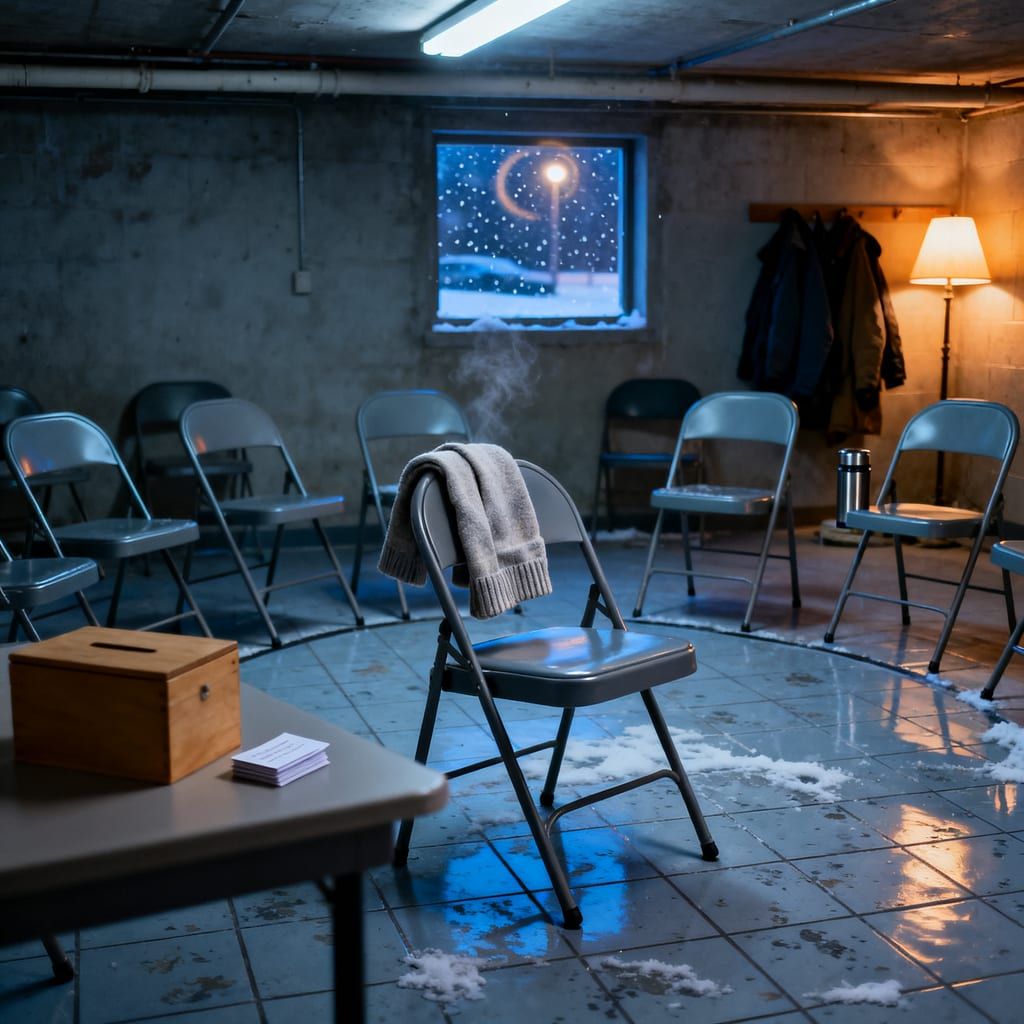
On Tuesday, Lina unlocks the church basement that smells faintly of lemon cleaner and wet wool. Fluorescents buzz like bees waking too early. She sets out twelve chairs-metal, cold at first touch-then places a folded scarf on one: the empty chair, the place they've all been trying not to talk to aloud.
Three arrive the first night, their sentences careful as those first steps onto late ice.
Raj comes in from the snow with a driver's cap damp around the brim. He holds his phone like a talisman. "Sometimes," he says, once they're seated, "I play it on mute. Just to see the little bar move. Just to know it's there."
Evie is all sleeves and chipped nail polish, her apron strings peeking from her coat. "My sister's birthday still pops up on my calendar," she offers, eyes on the floor. "I swipe it away and it just-reschedules."
Margo, retired from teaching clarinet to middle schoolers, knits without looking. The yarn whispers across her needles. When she speaks, it's like someone opening a window an inch. "I have carried silence for so long I forgot it had weight."
Lina clears her throat, feels her voice knock against her ribs. "Soft rules," she says, palms up. "We don't fix. We don't rank pain. We don't turn anyone into a lesson."
They nod. No one writes that down.
They talk in pieces. What they do for work. The way winter slides into the bones. How hospitals smell like cucumber soap and overheated plastic. The words are slow and cracking, thaw from the edges. When Raj says, "His last voicemail is just him asking if I need eggs," no one tells him eggs are just eggs. They sit with the weight of breakfast.
They keep coming. Tuesday becomes a promise that tastes like stale coffee and something warm trying to get through.
They leave the empty chair with something wearable on it-a fuchsia beanie, a gray cuffed hat, a scarf that smells faintly of eucalyptus. Each person brings a small object and the story inside it: Evie lays a concert stub face down like it's been looking at her for too long; Raj brings a parking receipt from the Trader Joe's ramp, wrinkled and almost transparent at the creases; Margo sets a chipped mug on the floor, its handle mended with a line of gold like some private kintsugi.
They pass a stack of index cards, cheap and stiff. You write what you wish you'd said. You read it if you can. You fold it once, then again, until it is a small white animal in your palm. Lina bought a plain wooden box from the craft store and sanded the lid herself. It makes a soft sound when it closes - a domestic sound, a drawer, a lullaby.
Sometimes new faces slip in, red-cheeked from the cold, and leave before the end. Sometimes they stay. Names don't stick right away; it doesn't matter. What matters is the circle, the chairs rubbing the tile in a chorus of small scuffs, the way everyone looks at the person speaking like they are learning a language together.
Once, a woman arrives in a parka still dusted with snow. She doesn't sit. She stands by the door, shoulders up by her ears, and says, "He was my boss. He's not supposed to be in this circle, but there he is," and then she is gone, her breath fog on the glass leaving a wet crescent that lasts longer than she does.
The storm hits on a Tuesday like it waited on purpose. The door opens to a man shaking snow from his collar hard enough to look like anger. Theo. He chooses a chair and drags it with the squeal of metal on tile that makes everyone wince.
"They said early intervention," he says, jaw working. "They said watch for signs. What signs? He ate cereal. He went to work. The healthcare system is a joke. I'm a joke. God is-" He stops himself, breath ragged. His words are all edges, sharp enough to draw.
No one reaches across the circle to file them down. That's the rule. Lina can feel the electricity of fixing-its itch-move through the room like static. She keeps her hands open in her lap.
Theo comes back the next week, and the next. He blames the weather, the doctor, himself, the time change, an April newsletter from his kid's school. The room wobbles around his jagged grief. Evie stops sharing her smaller stories. Raj leaves early with a nod that doesn't mean anything. Margo's knitting grows louder in the quiet.
Then, one Tuesday, no one comes. Twelve empty chairs. The scarf like a throat closed around a word.
Lina sits anyway. The buzzing light has a stutter tonight, an arrhythmic blink. She opens her laptop and types an email that starts, "I wanted this to help and I think I made it worse," and ends, "I'm sorry." She can't send it. Her finger hovers, and the basement hums, and upstairs a pipe knocks like someone insisting.
The next week, the janitor has turned the heat up early. "Figured you'd want it warm," he says, shrugging like it's nothing, the key ring on his belt a constellation.
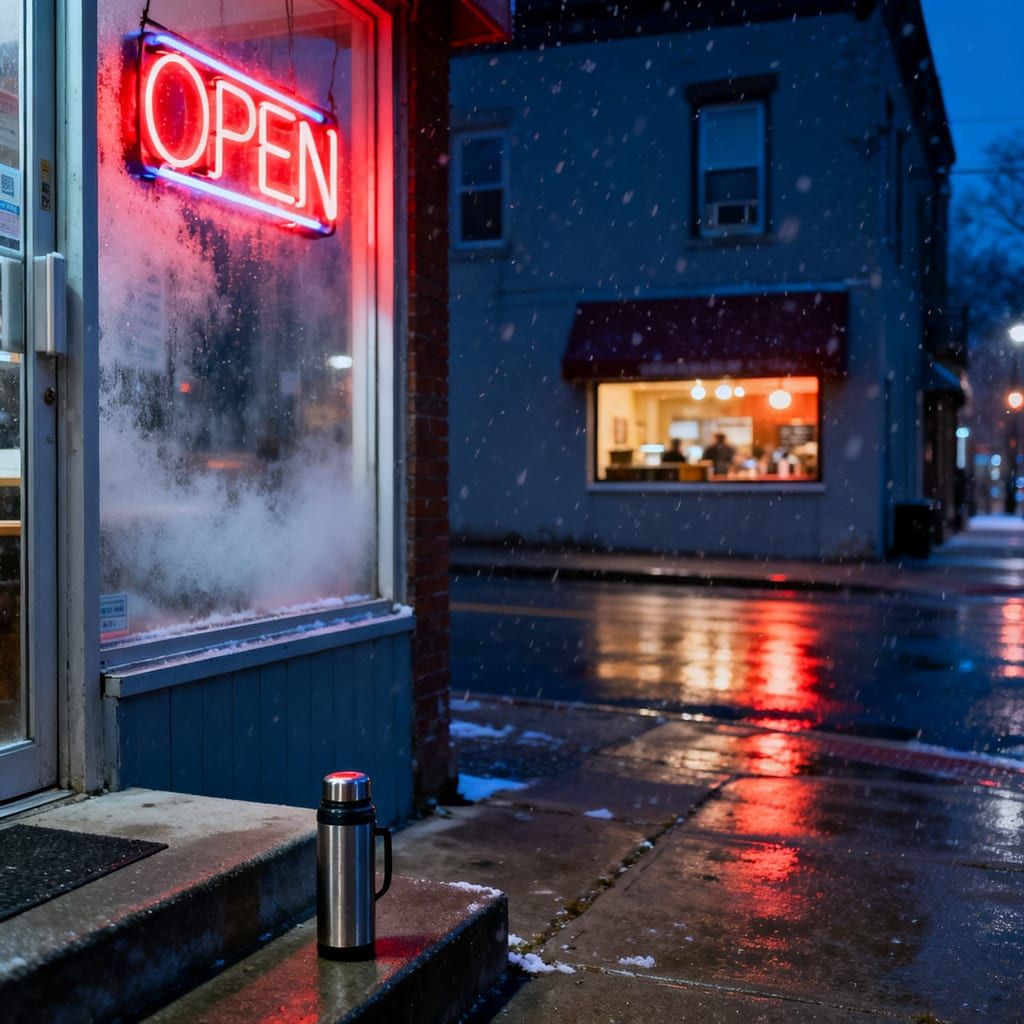
A thermos sits on the table with a Post-it stuck crookedly to the lid: For Tuesdays. It's chicken wild rice, thick and peppery, steam rising like a small mercy. No name.
An envelope waits under the door. Inside, a handful of twenties, and on the flap, in a tight, left-leaning hand: This place keeps me breathing.
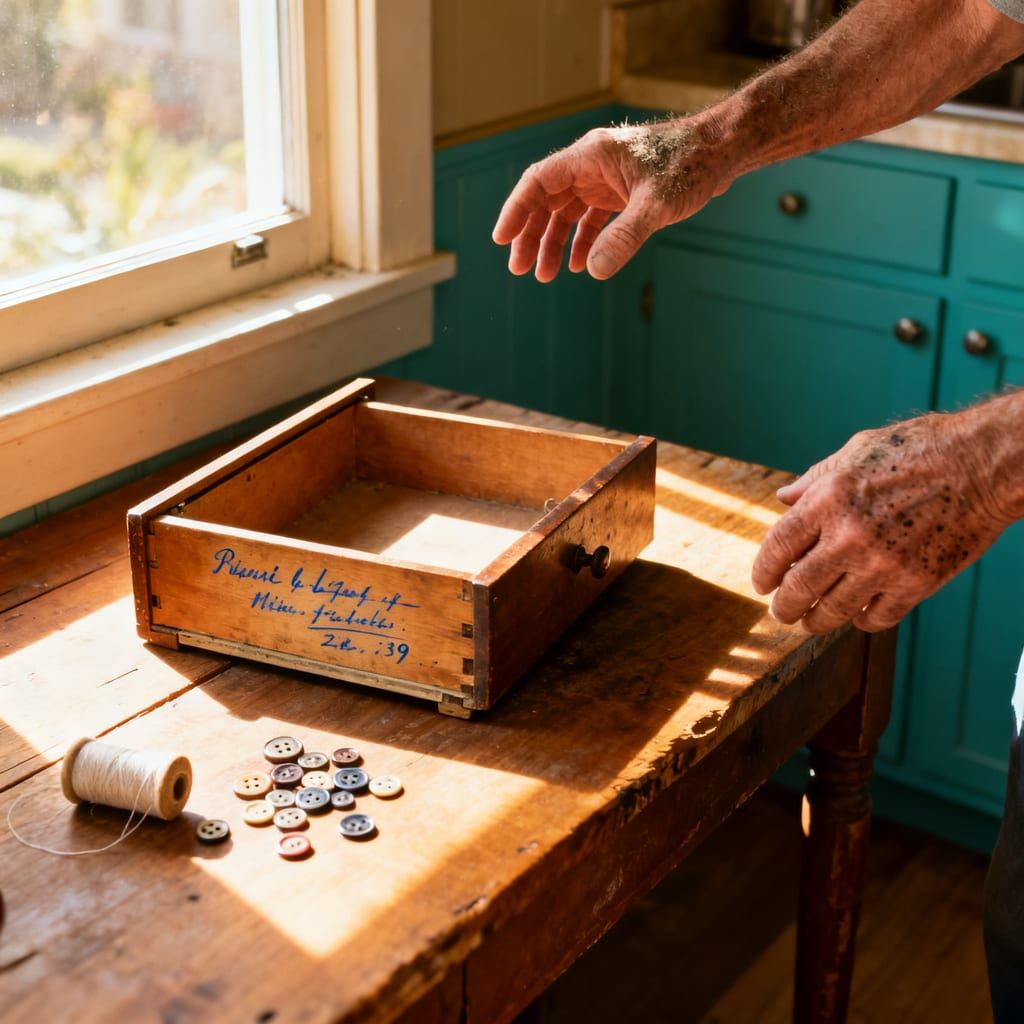
Lina holds the note like it is someone's wrist. She puts the money in an old shoebox and the note in the wooden one. It doesn't fix the wobble. It steadies her anyway.
That night, after dishes and the mindless rhythm of wiping counters, she opens Mateo's old laptop. It is stubborn, the hinge a little bent. She doesn't remember the password. The computer does.
In Documents, a folder named Tuesday.
Her lungs go thin. She clicks. Inside is a single draft-no date, just a title she knows by heart now: For those who carry unsent goodbyes. Below it, bullet points, Mateo's tidy lowercase letters lined up like chairs:
She presses her thumb to the trackpad and holds it there until the screen dims and returns, like a heartbeat seen through skin. "You were going to make it," she whispers, not sure if she is asking. The revelation doesn't close anything. It pours cool water over a place that has been on fire.
The next Tuesday she arrives early and sets an extra chair, not the empty one, but one for herself in a way she has been avoiding.
When the group gathers-some familiar faces, some new-Lina doesn't stand outside the circle counting paper cups or aligning pens. She sits.
"My husband," she says. She swallows, tasting lemon cleaner in the back of her throat. "Mateo. He died last spring. I thought if I made a room for other people's words, maybe mine would arrive without me noticing. They haven't. Not really. But I found something he wrote." She tells them about the folder, his bullet points, how the phrase she thought she'd plucked from the air was already living on his hard drive.
Silence, but not empty. Warm silence, blanket-thick.
Raj tips his head. "Maybe that's how things circle back," he says softly. "You throw a stone, you think it's gone, and then the ripples find your ankles."
Evie reaches into her bag and pulls out a photo booth strip. Two girls pressed together, skewed crowns on their heads, tongues out. "I've been waiting for a perfect time to read mine," she says, picking up an index card. "There isn't one."
Theo stares at the floor, his boots leaving wet half-moons. "I don't know how to stop being mad," he says to his laces.
"You don't have to," Margo replies, her knitting sleeping in her lap. "You just have to let the anger have a chair and not the whole room."
They write. They read. Some words come out like rust finally breaking loose. Some stay on paper and go into the box. Lina writes, Dear Mateo, and then nothing for a long time. The empty chair wears a beanie tonight, navy with a pom-pom-ridiculous and perfect. She writes, I wanted to fix you, and I am learning the difference between fixing and loving.
When she folds the card, her hands stop shaking.
Winter loosens. The city traded its ice for puddles that trick your shoes. Backyards return in patches. On a Tuesday that smells almost like rain, they carry the wooden box outside, the group blinking against the wide evening like emerging from a matinee.
They walk to the river. The path is still edged with snow like frosting someone missed. The water is the color of slate and moving like a decision already made.
They stand in a circle not made by chairs. Birds argue in a tree above them. A runner passes, their breath a cloud.
"We don't have to let go," Lina says, more to the river than to the people. "We can just-hold differently."
They unfold their cards. Paper flutters. Some read aloud, voices barely higher than the water. Evie's laugh breaks in the middle of her sentence and repairs itself. Raj presses his card to his chest when he's done like it might keep warmth in. Theo's jaw unclenches on a single word: Sorry.
Margo clears her throat, and the sound is bright as a bell. "I carried your silence so long I made a house from it," she reads, breath catching. "I'm leaving the lights on in case you can finally find your way."
When it's Lina's turn, she holds the paper that is softer now from her palm. "Mateo," she says, tasting his name like a winter orange. "You wanted this room before I did. You built it in a file and I walked into it. I don't forgive you. I don't forgive myself. Not yet. I will make soup on Tuesdays. I will put out chairs. I will come sit in one of them."
She doesn't throw the card. None of them do. They slip them into the wooden box and close the lid and listen to the latch catch. The water takes their words anyway, thieving and generous, mixing them into its own long sentence.
A breeze lifts the edge of the scarf draped over Lina's arm, the one that lived on the empty chair all winter. She wraps it once around her neck against the cold that still waits in the shadows. They turn toward the church, their boots making a new map from old salt.
Behind them, the river keeps moving-unfixed, unranked, unwilling to make a lesson of anything-and in its sound, something like breathing.
Story audiobooks for children of all ages — a new one every day on Smarter Way Stories.