Circles We Draw in Winter
A Tuesday night for unsent goodbyes
Read more →
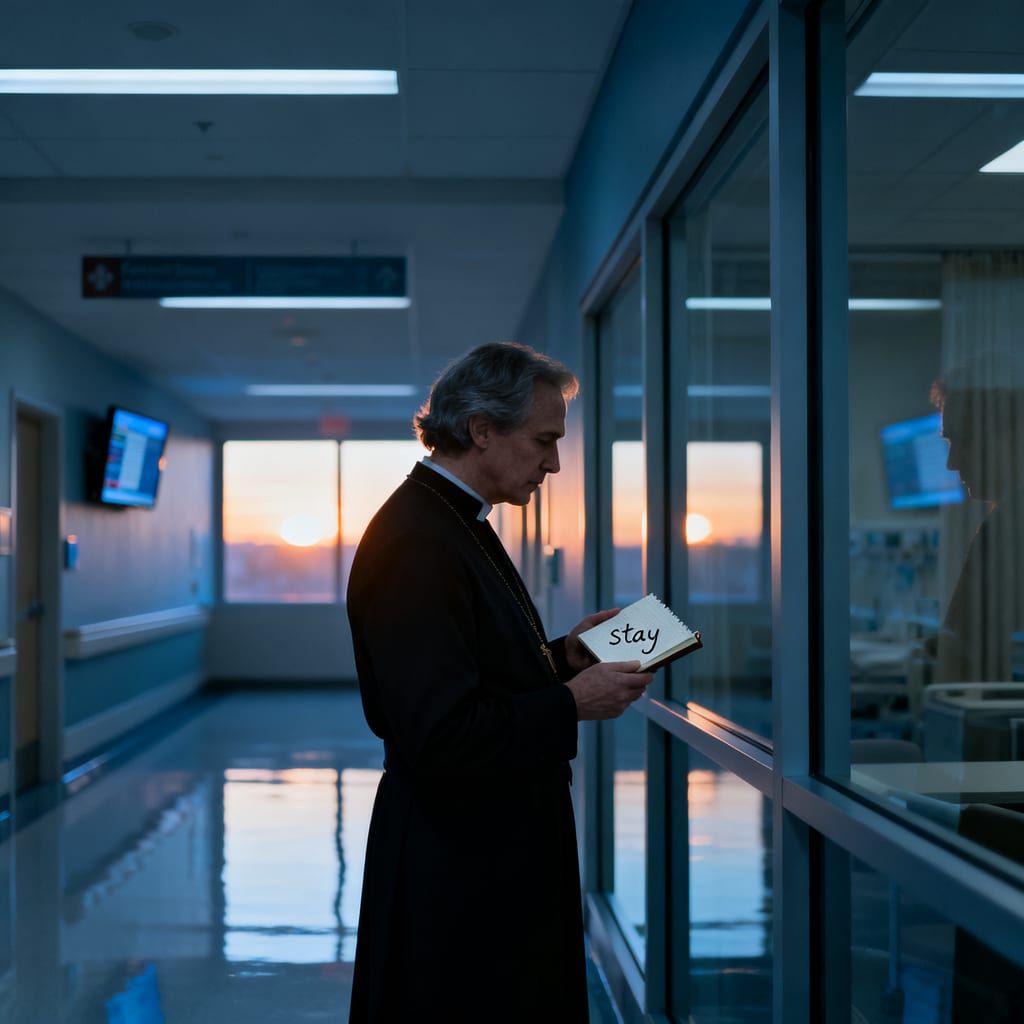
The badge says Spiritual Care, but most days it means knowing where the clean tissues live and which elevators skip the cafeteria smell.
By noon, Jonah Reyes has memorized the rhythms of this building-the ding of 6 West, the rattle of the linen cart, the way grief flattens voices against tile. He moves through it like a quiet metronome, clicking time for other people's lives.
On 7, a Muslim father crouches beside a hospital bed with a roll of tape and a paper arrow torn from a menu. He asks Jonah if he might help him find east. The vinyl floor is the plainest compass Jonah has ever seen.
"Here," Jonah says, kneeling, the cold seeping through his slacks. He opens a map app, lines up the world, presses the arrow firm. The father closes his eyes. "Thank you," he whispers, as if everything fragile depends on angles.
Down the hall, a nurse waves him into a room that smells like antiseptic and oranges. A Jewish grandmother, hairnet slipping, clutches a phone. The video call stutters. "My sister," she says, breathless. "She wants to sing. Will you hold it?"
He does. He lifts the rectangle to her face and the thin music of Shalom Aleichem fills the space between the IV pole and the morphine button. The connection fuzzes, returns, falters. The grandmother's eyes pool. "It's enough," she says, when the song wobbles out, "it's enough to try."
Down in Respiratory, a man in a faded software company T-shirt sits upright, chest hitching in short, fierce jerks. "No prayers," he says as Jonah enters, voice buzzing like a blown fuse. "Just-will you count? It's stupid but-just count with me."
Jonah sets a chair. He doesn't carry scriptures anymore-only a pocket notebook, pages blank as a winter field. He opens it, writes a word he offers like a lozenge. Breathe.
"In-two-three," Jonah says softly. "Out-two-three."
They anchor to the numbers together until the man's hands loosen. The monitor's green line stops shouting and goes back to singing its small, sullen song.
By late afternoon the fluorescent hum has threaded itself through Jonah's temples. He tends to tiny mercies, useless-seeming gifts that somehow are not: a phone charger unearthed from the Lost and Found; a cup of ice that remembers cold in a heat-woozy room; a question to a harried nurse-"Can we please dim the lights?"-that tilts the whole tone of a place.
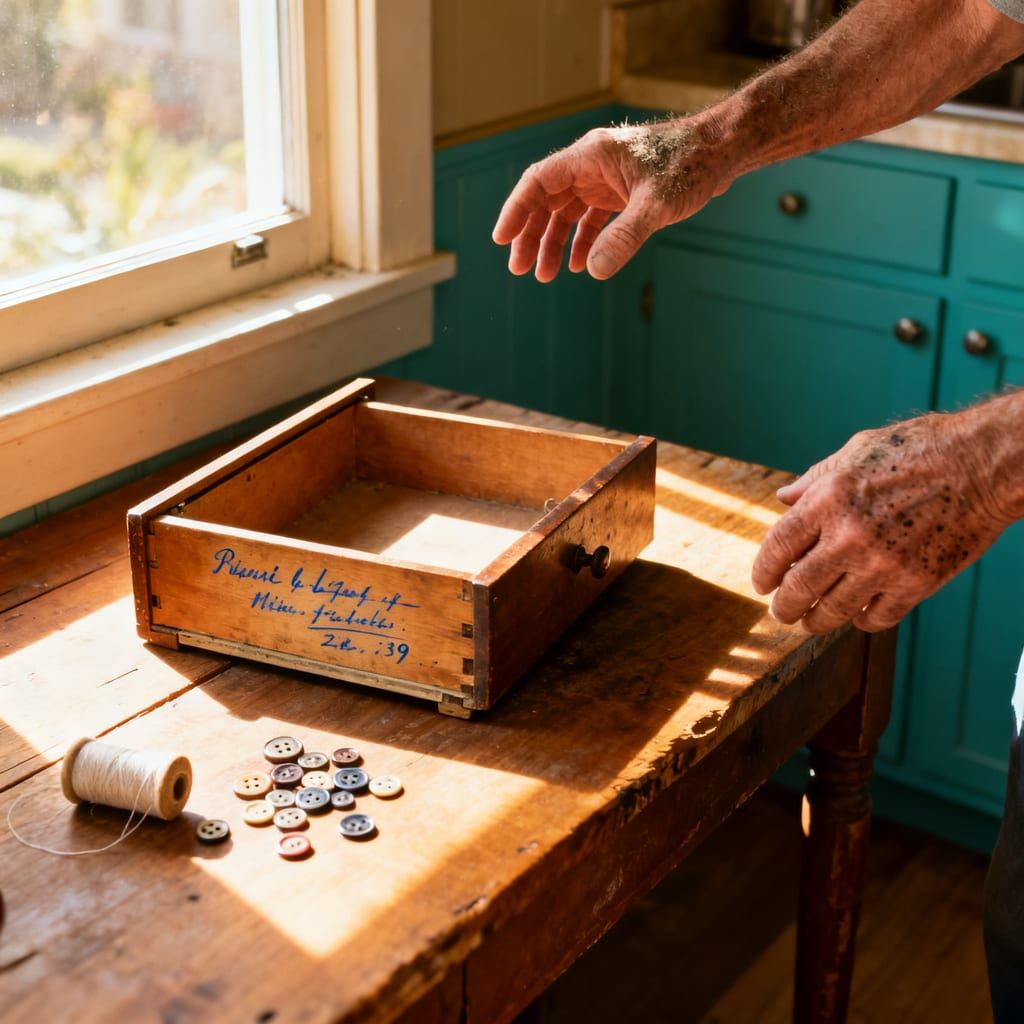
He reads aloud to Mr. Adler, who is mostly bones and cleverness now, his carpenter's hands cupping nothing but air. Mr. Adler closes his eyes and requests a strange litany. "Start on page forty-seven," he says, pointing with two fingers to a dog-eared hardware catalog. "Tell me the old names."
Jonah begins. "Duplex nails. Cut tacks. Brads. Finishing nails. Robertson screws, slotted, Phillips, Torx-"
"Ah," Mr. Adler exhales, smile like a half-set joint. "Music."
He lingers on the vowels, gives each metal letter a weight. The page smells like dust and ink, and for a while the room is full of a workshop's ghost-pine shavings, coffee cooling on a bench, a radio low.
In Pediatrics, fluorescent fish swim on a painted wall and a teenage girl kneels to light a battery candle at the foot of a window. "For my abuela," she says, flicking the tiny switch with her nail. On the sill, her marker squeaks as she draws a heart that looks like a house.
"Pretty," Jonah says.
"It's dumb," she says, not looking at him. But she shades the roof and adds a crooked chimney. Smoke lifts like a question mark.
A door opens and a sleep-starved mother appears, purple crescents under her eyes. "Can you-" she starts, then stops. "I don't know. Anything. He won't-He just-" She gestures to the bundle whining against her chest.
"I can try to find someone," Jonah says. He hasn't sung in years. Since his sister, Mara, went out for a swim and the ocean kept her, the thread of sound in him has been a tangle he can't tease apart. He smiles, makes a joke about his terrible pitch, and escapes.
The ER is white-bright, a test he didn't study for. A code unfurls-shout, sprint, swing the curtain. A young delivery driver lies still as a package on a gurney, plastic badge flipped backward. No next of kin. Someone calls, "Chaplain?" as if the word could absorb impact.
Jonah stands, hands useless at his sides, and the fluorescent lights insist on everything he cannot do. He hates those lights. He hates their certainty.
He ends up at the vending machines, the glass reflecting his own tired face back at him in candy-colored squares. A coil of powdered donuts hangs like a white crown above the slot.
"I haven't been able to pray to anyone in a year," he says to the sugar behind the glass. His voice startles him-a small confession slipping out of a mouth he can't control. It sounds like Mara's kitchen radio, turned low, wheezing out a morning show in a language neither of them spoke. He misses her so much the missing flakes off him like paint.
He waits for thunder. For a reprimand. For a sign. The machines whir patiently, holding their lit goods. Down the hall, a monitor alarms. Someone laughs too loudly. The hospital keeps being a hospital.
Back upstairs, Jonah flips his notebook and finds a new page folded into a crooked tent. A sticky note hugs the crease. The handwriting is cramped, the ink grey.
If you can't pray, count with me: in-two-three, out-two-three.
The atheist's hand. He can see it trembling, then steadying.
In the family room, the Muslim father presses something into Jonah's palm-sweet, dense, old as any vow. "For Iftar," the man says, half-smiling, half-sad. A date. "I saw you earlier," he adds softly. "You looked like you needed to break something." He glances at the date and laughs at himself. "Fast. I meant fast."
The nurse from Pediatrics hums as she hustles by, an armful of warm blankets rising like bread. It's a lullaby Jonah knows without knowing-he hears his mother's voice drift across years of kitchens, a tune as practical as boiling water. He touches the sticky note in his pocket and feels its low-tech mercy.
When he rounds the corner, the sleep-starved mother is there again. This time she doesn't ask. She steps forward and places the colicky newborn in his arms, her hands shaking. The baby is a tight button of fury.
Jonah's arms remember how to be furniture. He doesn't think. He just breathes.
"In-two-three," he whispers. "Out-two-three."
He matches himself to the small animal rhythm of the child's chest. The room narrows-the fish mural, the hum, the flicker of an exit sign all recede until there is only the urgent, high-pitched engine of a baby's need and the soft, stubborn tick of counting.
The numbers turn, almost without permission, into a melody with no words and no owner. It is not a hymn he's ever learned. It's a neutral sky you can lie under without being seen. He doesn't push it. It arrives and he allows it.
The baby's cry hitches, falters, folds. Breath finds its groove. The mother doesn't applaud; she closes her eyes and leans her forehead to a wall as if it could take some weight from her. Jonah feels something in his ribs unclench-like the first click when a zipper finally catches.
The building quiets in the stubborn way cities do-never whole, only in patches. He fetches ice. He finds a charger. He sits with a woman who says she doesn't want to be touched but won't send him away. He holds his silence the way nurses hold sharp things, carefully, with practice.
He returns to Mr. Adler, who asks for names again. "Just a few," he mumbles, eyes like woodgrain.
"Lag bolts," Jonah reads. "Eye hooks. Cabinet hinge. Dovetail."
"Stay for the dovetail," Mr. Adler says, words catching. "The best ones stay."
Jonah waits for the gentle rattle to smooth, but it doesn't. He sits a while longer, the catalog open to a page about sanding belts, and when the nurse comes in at dawn she looks once and nods, her mouth a thin line of respect. They turn the monitor off. The room exhales.
He steps into the corridor. The windows are a long patient aquamarine, dawn arriving like a decision made elsewhere.
He finds an empty family room-the one with the lamp that leans a fraction to the left and the couch that squeaks if you look at it. He closes the door. He doesn't lock it; there's no lock. The sign on the wall says Quiet Room, but the door is mostly glass and the hum still seeps in.
He sits and opens the notebook. The pages are a geography of other people's hours-TRY in all caps, breathe in someone's shaky cursive, STAY written once and then traced over again, as if pressing harder can make a word last.
He thinks of the arrow taped to vinyl, pointing to a city his feet aren't in. He thinks of a grandmother's brave, wobbly song, a programmer's lungs finally less greedy. He thinks of the date in his pocket, sweet like a joke you share with a stranger. He thinks of Mara's palm pressing his shoulder blade through a winter coat-Go on. You can do this-when he'd first worn this badge.
He writes a word. His hand is steady.
Stay.
The room has no door, not really. Anyone can push it open. Anyone can slip inside and sit and be quiet and be not-quiet and breathe or sing or count or just look at the scuffed floor.
He closes the notebook. He doesn't pray. He doesn't not pray. He listens to the building wake, and for once that feels like enough.
Somewhere, a baby rests its soft face in a small nest of cotton and sleeps. Somewhere, a sister's laughter moves through a kitchen in another year. Somewhere, a wooden joint holds without fuss because two pieces were cut to fit and were asked, gently, to stay.
In-two-three. Out-two-three.
The light along the far window brightens, a slow spill. Jonah stands, straightens the tilted lamp with two fingers, and goes to find more tissues.
Story audiobooks for children of all ages — a new one every day on Smarter Way Stories.