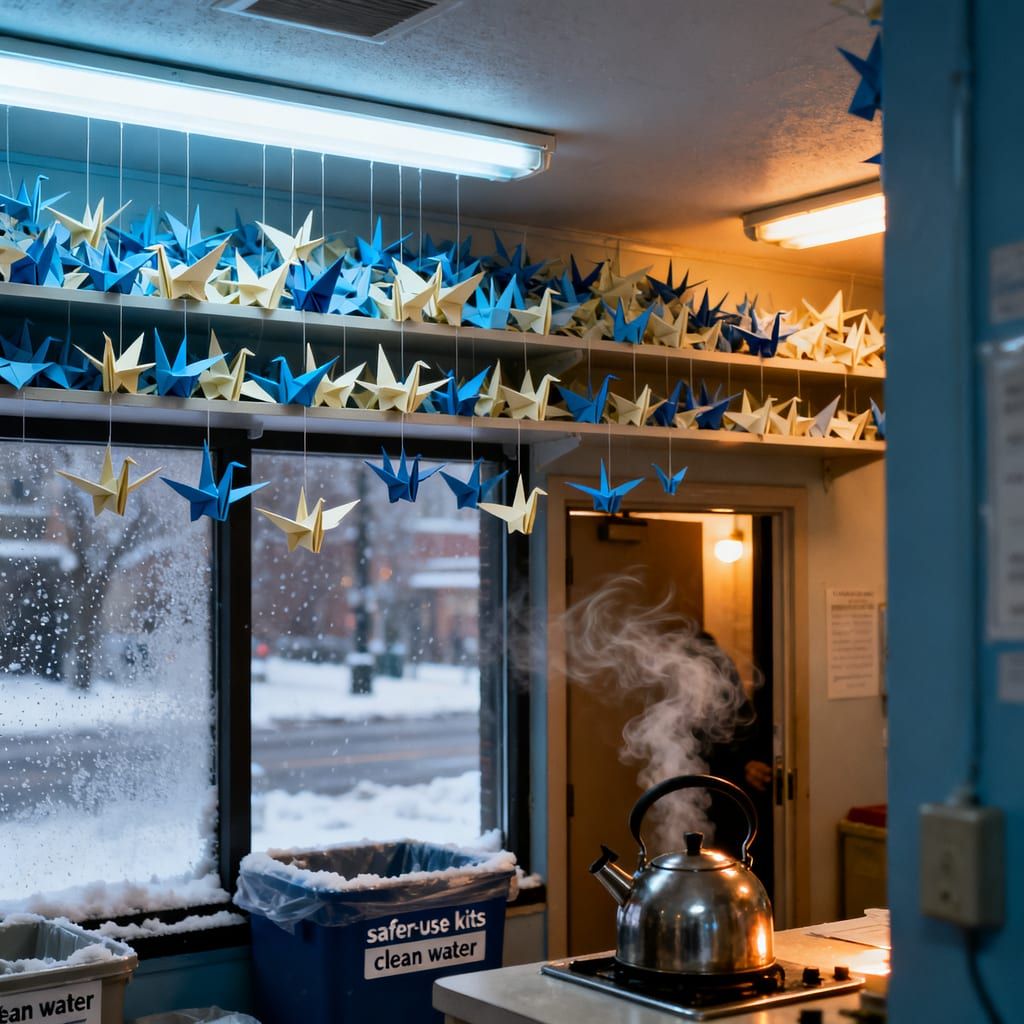
Paper Cranes at Shift Change
A winter of small mercies, folded and kept
Read more →
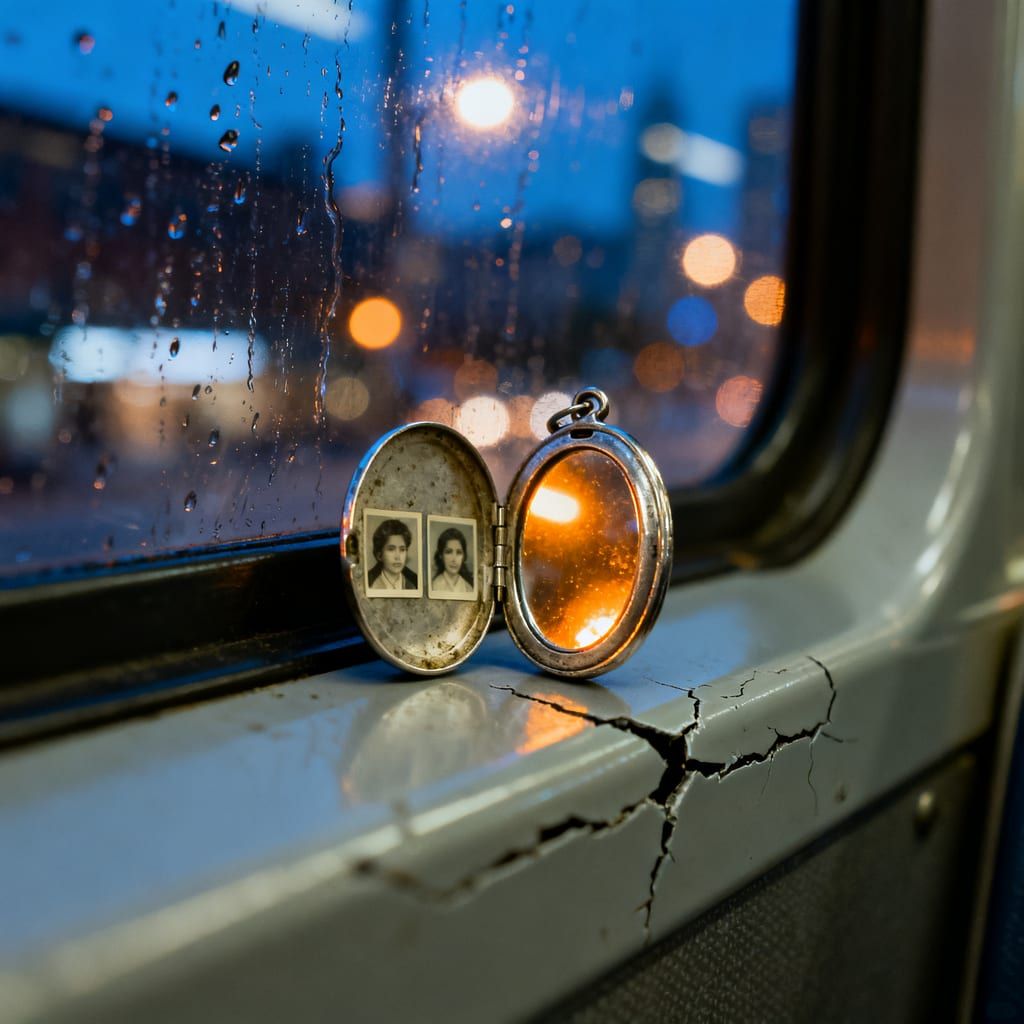
The locket winked at Alex from the cracked plastic bus seat as if it had been waiting. A thumbprint of light clung to it each time the bus jolted over a pothole, then slipped away, like a breath on a mirror.
Alex lifted it, surprised by its honest weight. Silver, oval, a little scuffed-some jewelry pretends at age; this one had earned it. The bus droned south, heaters hissing, windows filmed in winter grit. Outside, Chicago was a grayscale flipbook: slush-curbed corners, salt-bloomed boots, kids breathing dragons into their scarves.
At the back, a woman in a yellow beanie argued gently with a toddler about mittens. The driver's radio whispered a ballgame. Alex thumbed the clasp and the locket clicked open.
Two faces peered from its tiny frames.
On the left, a sepia woman with a stern mouth and soft eyes, the late 19th century rinsing her features the way old sunlight does. On the right, a glossy print that could have been taken ten years ago-color true, edges unfrayed. Different centuries, same chin, same widow's peak. Same, Alex realized with a faint jolt, as the face reflected dimly in the bus window.
You've got to be kidding.
"Lost anything?" the driver asked when Alex called up before getting off.
"A locket," Alex said, which was not a lie. "Silver. Found it on the seat. Anyone leave a message?"
The driver shook his head and waved a hand. "Leave a note with dispatch. But folks don't call for small things. They call for wallets."
Alex walked home along the lake, snow pocked by last night's rain, the wind gnawing through coat seams. Apartment radiators groaned awake as Alex stripped off layers and set the locket on the coffee table, where it sat like a dare.
Unemployment left hours unstacked, glossy on both sides. Alex filled them the way people fill drawers-hastily, defensively. Job boards. Cover letters. Stir-fry. A video of a dog who knew the names for twenty toys. But the locket shouldered its way into the pile.
Alex posted on neighborhood forums. "Found: silver locket on the 147 southbound. Two photos inside. Describe to claim." Wrote the CTA lost-and-found. Walked to the Ashland station bulletin board and pinned an index card between a guitar lesson flyer and a missing orange cat named Clementine.
And then the part Alex never would have admitted: a face search app, the kind they warn you about. Grainy screenshots of the sepia woman. The glossy one. Alex took a selfie in the white kitchen light and ran that, too, because who was a real person if not someone tethered online?
Nothing matched. The algorithm shrugged.
In the evenings, the apartment dimmed into a box of shadows. Alex angled the locket under a floor lamp, looking for a clue the way people look for constellations. That was when, under the skimming wash of light, a hairline seam winked along the locket's rim.
"Hello," Alex said to the room, breath fogging the metal.
A patient fingernail. A breath held. A hidden hinge gave with a sticky little sigh, revealing a third, thinner frame tucked behind the others. No photograph-only a polished oval, mirror-bright. Alex's right eye swam in it, then steadied. Along the silver lip of the frame, letters rose from the metal only when the light hit slantwise.
If this face finds you, come Wednesdays, 7 pm, Room B.
The mirror held Alex's reflection between the two women like a mediator. The lake-wind flush still in the cheeks. The stubborn jaw. Who do you look like? the world has asked since childhood. My mother when she laughs. My father when he's concentrating. A stranger who once stopped me in line and said, God, you look just like-. Who? They never remember who.
On Wednesday, Alex went.
The church on Damen was the brick kind the city knows by heart-stoic on the outside; downstairs, a basement that smelled faintly of coffee and old books. Paper snowflakes from December still dangled from a corkboard announcing AA, ESL, choir sign-ups. A piece of copier paper, crookedly scissored, bore two words in a tidy hand: Room B.
Alex paused at the door, the locket heavy in a coat pocket. A hum of voices seeped through, the way heat seeps under a door.
Inside: a circle of metal folding chairs and the sort of styrofoam cups that make everything taste like church. Eight people, give or take. A beanbag that had given up pretending to be a piece of furniture. Someone had taped a big paper flower to the far wall; its petals were pages torn from a magazine, headlines still peeking through. A woman with silver hair and dark, capable eyes reached up to pin one petal that had fallen.
"New face," she said, voice like a wool sweater-soft but it holds its shape. "Come in. Coffee or tea?"
"Coffee," Alex said, because hands needed something to do.
"We're the Family Resemblance Club," the silver-haired woman continued, and her smile didn't blink as everyone turned. "I'm Alma. Don't be spooked. We don't collect noses or anything. We collect stories."
A laugh rippled around the chairs. Alex exhaled.
Introductions spun like a lazy carousel. Warren, who looked like a Civil War general in a daguerreotype his grandmother carried until it wore through at the fold. Nia, whose neighbor's toddler called her Auntie Hair because their curls matched. Mrs. Delgado, who came each week and wept in a gentle, unscary way over her sister's face appearing to her in strangers during the produce aisle.
"And you?" Alma asked finally, gently particular.
Alex reached into the coat, placed the locket in Alma's open palm. It looked at home there, like a coin returned to its purse.
"I found it," Alex said. "On the bus. It tried to return itself to the world and failed. The mirror told me to come."
Alma's thumb stroked the seam. The faintest shift crossed her face-the kind you see only if you know a person, or if you've trained to see the beginnings of grief.
"I know it," she said. "I know it very well."
They listened as Alma spoke, the way people listen to a lullaby out of season. Her mother had survived a war by tucking herself into plainness and pretending to be unremarkable. After, she decided plainness was a suit she could shrug from her shoulders.
"She used to say, 'The dead make us lonely. The living make us brave,'" Alma said, setting the locket at the circle's center like a candle you couldn't blow out. "After the war she wanted to make a small engine for living. Something you could carry. A talisman that said: You belong to the living."
Her mother started with her own two photos-one from before everything cracked, one after-and pressed them into silver frames. She gifted the locket to anyone who confessed to feeling unmoored. Young mothers with newborns who cried in matches to their breath. Soldiers missing faces that would not walk back through doorways. Girls told they looked like actresses no one would ever hire. When the locket-bearer's feet remembered the ground, the tradition asked one thing: leave it somewhere conspicuous for the next familiar stranger.
"I've kept it going," Alma said, simple as that.
"And the mirror?" Alex asked.
A smile tilted the edge of Alma's mouth. "The mirror is how you find yourself finding it. My mother believed the invitation had to be in your face for you to trust it."
The circle held its quiet. People sipped coffee. Snowmelt ticked in the radiators. Outside, a bus exhaled as it knelt at a stop.
Alex went back the next week, and the next. Brought a portable recorder and asked if people would mind. The stories gave off a small heat. Warren told how a barber paused halfway through a fade because he suddenly realized he knew Warren's ears-they were his father's ears, the father who left when he was six. Nia showed the group a photo of her neighbor's kid, both of them grinning, the understructure of their smiles like scaffolding on the same building.
Alex rebuilt the club's ghosted website with care, replacing broken links with better ones, writing a page called How to Come In. The page was short. It said: "You already have."
Between Wednesdays, life uncreased itself by degrees. The grocery clerk stopped carding Alex for wine-the kind of progress no one tells you feels like an award. A recruiter finally replied with an interview slot, and Alex wore a shirt that didn't gape at the collar. On the bus, the locket rode in a pocket, cool against skin, a coin pressed between worlds.
February became March by dragging its boots through slush. The club gathered and parted. Someone always put the chairs away. Someone always ran the dishwasher. Alma noticed everything and made it smaller. She'd fix a collar or pass a tissue just as the sob was rising, lay a hand flat on someone's knee when they drifted off into memory so they could steer back.
And then one Wednesday, Alma did not come.
Room B felt larger with the empty chair. Coffee tasted like it was straining toward a flavor and failing. The group waited until the coats on their laps grew warm and had to be pushed onto chair backs. Eventually Warren said he'd call, and then he didn't have to-because a woman from upstairs, from choir, poked her head in and said, "I'm so sorry," like she'd brought soup and spilled it on the stairs.
Alma had died in her sleep, the woman said. No fuss. No warning. The choir would sing at her service. If anyone here wanted to say a few words, they should call.
The group moved like people learning a new dance they hadn't agreed to. Someone put both hands flat on the table so the room would stop spinning.
They cleaned up Alma's corner-a bag with tissues and peppermints, a notebook with a pen tucked at a confident angle, a box that rattled like the past when Alex lifted it. Inside: little tools, the ones for coaxing tears back into old photographs. Brushes thin as eyelashes. Blades like commas. And a folded note, addressed to The Next Face.
Alex held it. The group waited without asking.
The paper rasped. The handwriting was blood-warm and steady.
The mirror isn't vanity. It's an open seat.
Keep the circle even when it's odd. Give the locket to the right stranger-someone who looks one breath short of belonging. You'll know them the way you know where your pockets are. Leave it where it can be found when you no longer need it.
With love through time, A.
The room's quiet had a pulse. The heater clicked, as if agreeing.
"Who are the women?" Nia asked at last, eyes on the locket as if it might answer itself.
Alma had told that, too, in other words on other nights. But the group said it again aloud, plaiting their voices together: The two photos were Alma at twenty and Alma's mother at twenty. Not an inheritance that traced blood, but a draft you could walk in front of and see if your face moved the air.
The mirror, Alex thought, and understood suddenly that the invitation was not a password. It was a promise.
Spring came like a mistake the city kept making and then apologizing for with more snow. Crocuses nosed up between cigarette butts. Pigeons bowed like business associates. The bus windows lost their smoker's cough of condensation and showed faces again.
Alex carried the locket not the way you carry a secret, but the way you carry exact change. You don't reach for it until the hand is there.
When the HR receptionist in a glossy Loop tower whispered to the security guard, "He looks just like my cousin who moved to Denver," Alex unlatched the locket and let her hold it. Her mouth rounded into a soft O at the mirror, at her face framed by other faces. She laughed, then did that small, embarrassing, necessary cry people do when something slots back into them. "I'm fine," she said, dabbing her eyes. "I don't know why I'm crying."
"Sure you do," Alex said, and she nodded, because she did.
At Mariano's, a man in a Cubs hoodie handled the tomatoes like they were old friends he'd lost touch with. He didn't notice Alex at first. When he did, his mouth wrenched before his smile made it, grief and recognition arm-wrestling. "You look like-" he began, and laid the word down, gentle. "My brother."
"Want to see something?" Alex asked.
Sometimes it was a seat on a bus given without a story attached. Sometimes it was only the mirror, flashed like a beacon. Sometimes the locket stayed in the pocket all day, warm from body heat and ready.
The website added a page called How to Keep Going. The answer was as short as the first page. "Practice," it said. "Practice looking. Practice opening. Practice leaving room."
On a rainy Wednesday in April, Room B was crowded. Alma's chair held her cardigan, clean and folded over the back like a blessing. Mrs. Delgado brought pan dulce. Warren brought a photo of the barber, the two of them in the mirror together.
"Does anyone know where it is now?" Nia asked, eyeing the center of the circle where the locket had so often sat.
Alex patted the coat pocket and met everyone's eyes, the way Alma had once met theirs. "For now," Alex said. "Until the right hands. Then it won't be mine anymore."
They nodded, like a tide coming in at the right moon.
On a bus again, late, lights smearing across the wet, Alex sat with the locket cradled in a palm. The driver hummed under his breath. At the front, a teenage boy argued softly with nobody in particular about whether he was going to make it. The city had its winter smell still-metal and damp wool and something like pennies. Alex's face, in the window, hovered between the sepia woman and the glossy one as if the bus had become a reliquary.
A stop before home, a young woman climbed on, breathless, no gloves. She clutched a folder against her chest the way people clutch sheepish bouquets. She scanned the bus, recalibrating fast, looking for a place that was not a mistake.
Her eyes caught Alex's and did a small startle-recognition, fear, relief, all the tiny animals that live under the heart.
Alex stood and offered the seat, then, after a beat, offered the locket.
"If this face finds you," Alex said, smiling so it would not sound like an instruction, "there's a room on Wednesdays."
The woman opened it. In the mirror her face steadied, then lit. "Huh," she said, because the honest words are small. She traced the engraved letters with a fingernail and nodded as if learning a new address.
Alex watched the carriage of her shoulders lower by a half-inch. Like a weight set down. Like a chair pulled out at the right moment.
Two stops later, Alex rose. The locket slept in the woman's lap, silver warm under bus lights, as if it had always been there.
At the back door, Alex paused, hand on the pole, and looked at the snow-streaked floor, the people's shoes, the way strangers arrange themselves when they are all headed somewhere at once. The bus hissed and the city opened, familiar and newly so.
Outside, April rain ticked on Alex's hood. The streetlamp made a small, faithful territory of light.
Alex walked home with both hands empty and did not feel alone.
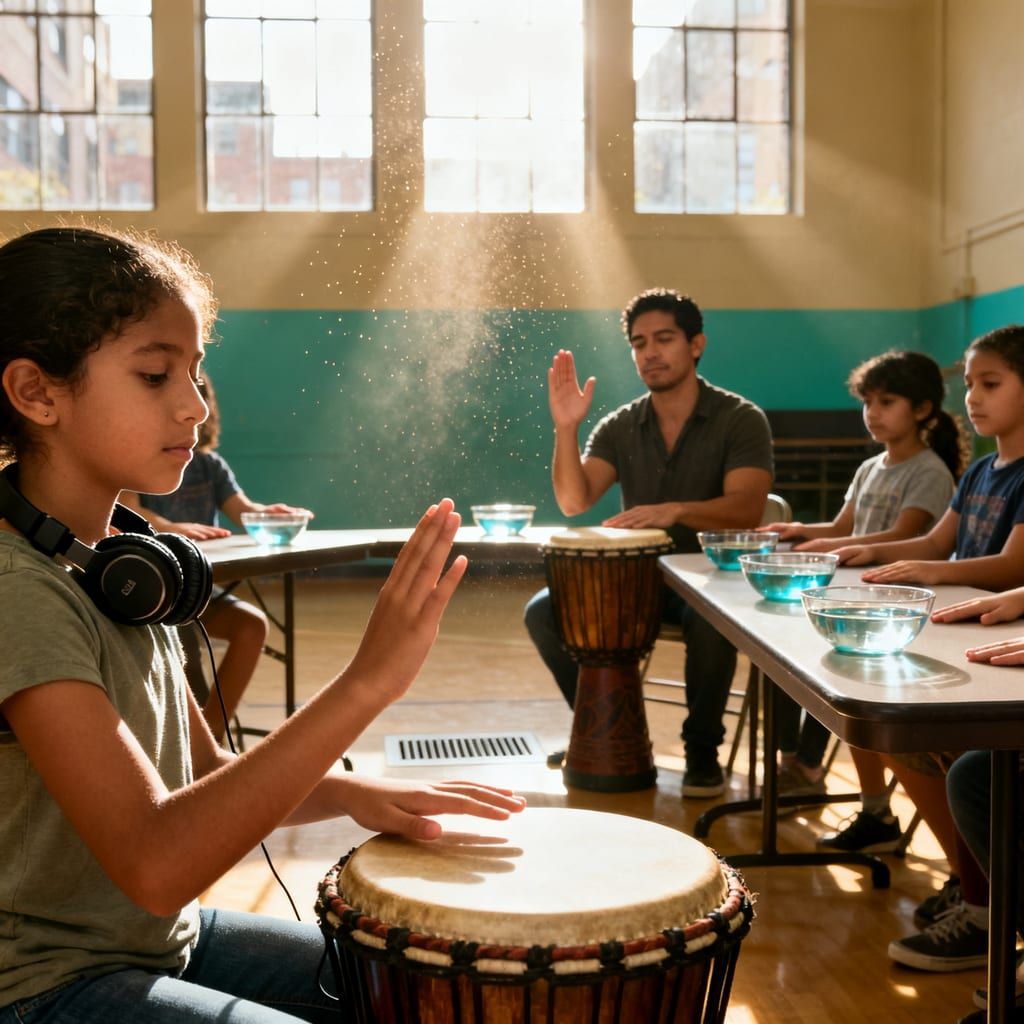
A drummer learns to listen for the rhythms you can't hear
Read more →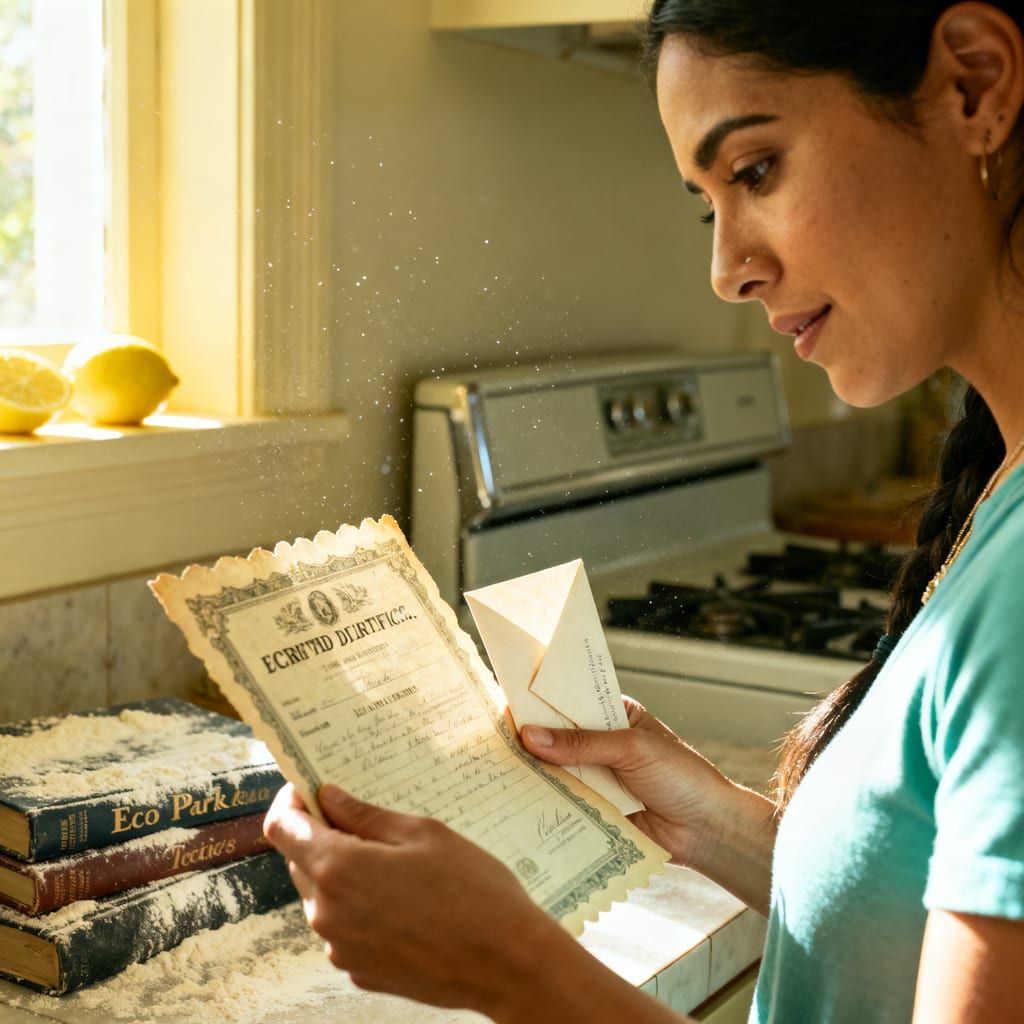
In Los Angeles, a daughter learns how to carry two lives forward
Read more →Story audiobooks for children of all ages — a new one every day on Smarter Way Stories.