The Night We Counted Backwards
Between a laundromat's hum and a café's light, a van keeps score another way
Read more →
The estate sale smelled like old lemon oil and the patience of people who kept receipts in folded envelopes. Theo drifted through the rooms with a paper cup of weak coffee, pretending the objects wanted him.
He didn't need anything. He told himself that as he touched a butter-soft leather glove with no mate, ran a finger along a teacup's hairline crack. Then, in the back bedroom, a mirror leaned against the wall-oval, bevel soft as breath, its frame a browned ribbon of wood.
It caught him. Or maybe the way it threw his face back, stretched with the new hollowness the breakup had left. He looked wider in it, as if grief had put air between his bones.
"Forty," the woman said, catching his glance. "Came from the owner's first apartment. Been with her forever."
Forever. He bought it because the word thudded in his chest and he was tired of rooms that looked like he was just passing through.
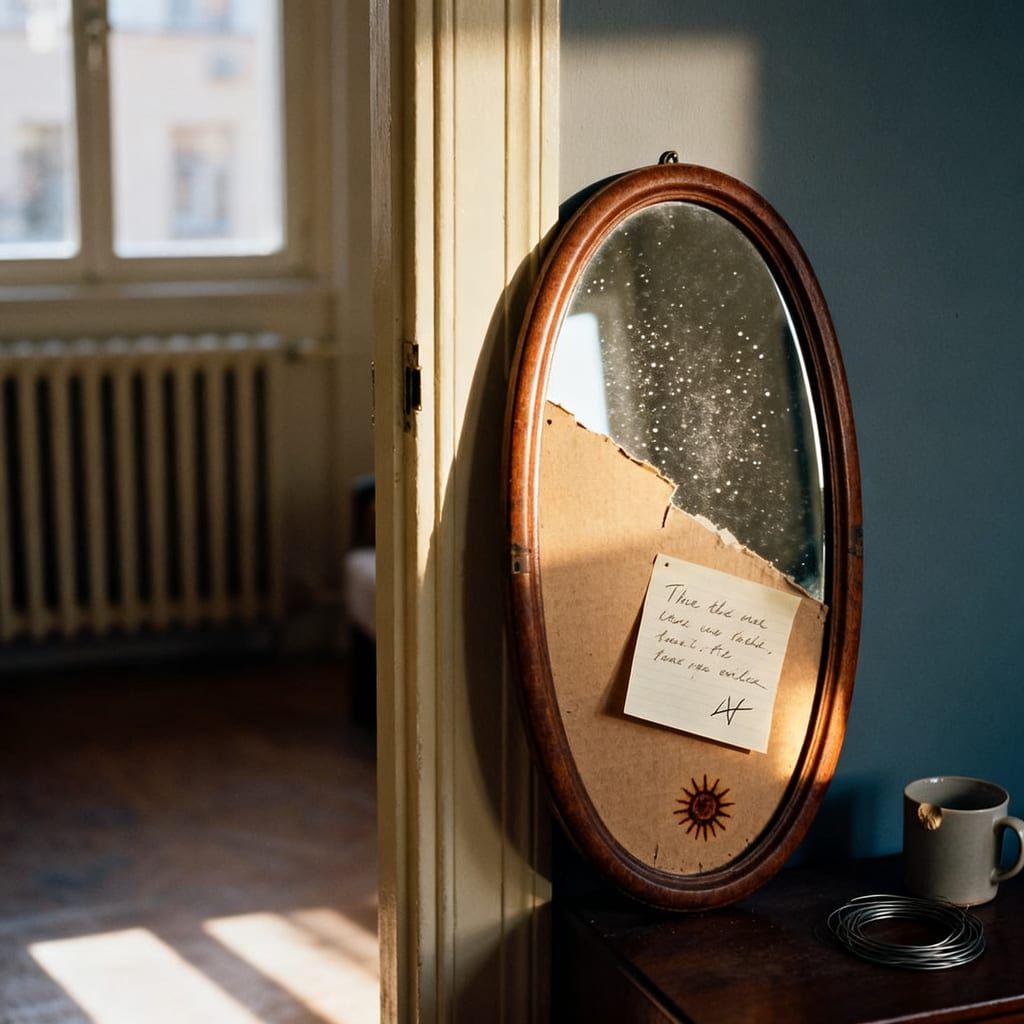
Back in his small apartment, he leaned the mirror on the counter like a guest he wasn't sure he wanted to invite in. Afternoon light skimmed the glass, vapor-soft. His hands knew what to do-his hands always did-finding the tiny nails, levering them free, slipping the cardboard backing loose with a retoucher's care.
The inside smelled like attic dust and dry wood. On the cardboard, in a looping hand not quite neat, someone had written:
To the one who thinks fixing is all you're good for: hang this, then step back. You make things too. -R.A., '99.
The apartment went quiet, as if it had been pretending to hum.
R.A. Unremarkable initials until his stomach flipped and heat climbed his neck. Not Rafael. He hadn't said that name aloud in years. He had trained his mouth around "my father" as if it were a thing in a museum you nod at but don't touch.
Theo slid his thumb along the inner edge of the frame and found it: a tiny sunburst no bigger than a pencil eraser burned into the wood, its rays flaring in a pattern he had drawn from memory in the corners of middle school worksheets, in the margins of movie tickets. A mark he had convinced himself he had made up, the way a kid invents constellations to give shape to empty sky.
He sat on the floor. He could hear the radiator clink as if metal were clearing its throat.
Rafael Alvarez, frame-maker. The shop had been three blocks off the main drag, the kind of place you passed a hundred times before daring to go in. The last time Theo had been there, he was twelve and angry, everything a hinge ready to swing the wrong way. His father had an apron that made him look rectangular, the sawdust in his hair giving him a faded halo. Then he was gone, a going that felt like a verdict. The story calcified there because it was easier that way. Easier to retouch memory until the edges were clean.
He googled on a blue light evening, fingers jittering. The old shop address pulled up now as a ceramics studio with a cheerful website and a calendar of hand-building classes. A photo showed terracotta mugs with thumb-dents where someone's need had pressed.
The studio was open late on Thursdays.
He stood outside the door longer than made sense. Inside, clay cooled the air, earthy and damp. Shelves bowed under bowls that looked like small moons. A woman in a bandana lifted her head from a wheel and squinted through splattered glasses.
"Looking for a class?" she asked, foot easing off the pedal, the wheel's spin slowing to a pulse.
"I-" His throat felt like a room he needed to straighten before someone saw it. "Did this used to be a frame shop?"
Her face did a quick something like weather changing. "You're the third person this year to ask me that," she said, grinning. "Yes. We inherited a rainstorm of tiny nails. And a shoebox we didn't have the heart to throw out."
She introduced herself as Marisol, gestured him to a stool by the window, and went digging in the back. He listened to the wheel water whisper, his own breath gonging in his ears. When she returned, she held a shoebox like it held a secret you had to cup.
Inside-paper curls like the insides of pine cones. Strips of cardboard cut from the backs of frames. A slip of masking tape with pencil words: blessings.
"I didn't know who wrote them until a woman brought a map to the sunburst mark," Marisol said, tapping the edge of the box. "Said it meant Alvarez. The shop ghost." She studied Theo's face. "You know him." It wasn't a question.
"My father," he said, and the air thinned around the word, and he didn't fall. "Rafael."
Marisol's gaze softened and sharpened at once. She placed the box between them. "Take your time."
The notes were small voices waiting their turn. May this hold your favorite face. Hang love where you can't miss it. If you cry in this, it can take it. A few were funny; one just said, Steady as a hand on your back.
He found the same looping hand on all of them, the weight of the pencil shifting when the words curved. He ran a finger along the grooves of letters the way you trace names on old tombstones.
"People think framing is about corners," Marisol said, clearing clay from her nails with a wooden stick. "It's about choosing what matters."
Theo wanted to say he knew that, that every day he made decisions about skin smoothing and shadow lifting and how much reality could take before it tipped into a lie. Instead he kept reading.
Near the bottom, folded twice into a sharp square, was a stiffer piece-mirrored on one side, the other a blank plane of gray. He turned it. Words crowded the surface, crowding each other as if afraid they'd run out of room.
Theo, it began. Not son. Not mi hijo. Just the name he had worn to school and in waiting rooms and when people asked who he belonged to.
If you find this, it means you looked. It means you know I left and haven't let the story go hard. I wanted to be a man you could point to without your mouth going dry. I wanted to be good at more than measuring twice. I was good at drinking. I got good at leaving before I broke what I loved. I went to get sober. I meant to come back better. I kept thinking I needed to be better before I could come back at all. I didn't make it. I am sorry. I left little things like pennies-blessings where my hands went. If you follow them like a child follows a line drawn in chalk, maybe you'll find someone softer at the end. Not me. The part of you I didn't ruin.
You make things too, your teacher said once. Don't let the fixing eat it. Step back. Please. -Rafael, who loved you the whole way too far.
Theo pressed his thumb into the glass part so hard a half moon bloomed on his skin. He remembered a teacher with paint under her fingernails pushing a rolling cart of poster board; remembered a boy bringing home a collage that smelled like glue, holding it up, his father smiling, actually smiling, in the square of light from the shop door.
"When?" he said, voice small.
"He died in 2000," Marisol said softly. "A man who used to own the bakery two doors down told me. Said Rafael had white-knuckled it for almost a year, then pneumonia. No family listed. We didn't know who to call." She took a breath like she was deciding. "I kept these for the person who would come."
He didn't realize he was crying until the paper darkened where a tear fell, a single drop making the words bow a little. He inhaled the studio-the iron tang of wet clay, the silt smell of making. It felt like a place where hands did what mouths couldn't.
"I want to build a frame," he said, surprising himself. The sentence walked into the room and looked comfortable there.
Marisol lifted a brow. "We're short on wood, long on mud." Then she smiled, bright. "But I know a guy with offcuts. And I have a saw that only screams a little."
They found enough strips of maple to make a simple rectangle. The blade's whine hit a place in his chest like a tuning fork. He measured, marked, angled the miter box just so, the way you hold breath over a delicate edit. The cuts were not perfect. The corners didn't kiss; they met like people learning how.
Marisol mixed glue that smelled like school and patience. They clamped the joints, left a tiny star of negative space at each bevel where a more experienced hand would have hidden the gap. He sanded until the edges felt like skin.
"What are you putting in it?" she asked.
"A mirror," he said, surprised again. "For my apartment. For-" He stopped. For what? For the mornings his face looked like it belonged to someone a little braver. For the nights he forgot to turn off the living room lamp and woke at 3 a.m. to his own outline on the ceiling.
When the glue held, he flipped the frame and cut a new piece of backing from cardboard Marisol pulled from the recycling. The pencil in his hand felt heavier than any stylus. He thought of all the hours he had spent erasing pores, coaxing bruised under-eyes back toward daylight, tightening laugh lines like he was apologizing for them. He thought of the oval mirror leaning on his counter at home with its quiet dare.
He wrote, in a hand that did not try to pretend it wasn't his: If you think all you do is fix, hang this, then take three steps back. Count the things only you could have made. If you can't name them yet, start small: coffee, a kind word, the dent your thumb left here. He drew a tiny sunburst in the corner, then, next to it, a smaller star of his own devising, an asterisk that meant: more to say.
Marisol watched him cap the pencil. "Payment is a mug," she said. "Something ugly to love."
He laughed, which came out like coughing at first and then found its shape. "Deal."
He hung the first mirror-the estate sale oval-in his entryway that evening. He stood back the three steps, hands in pockets like a kid trying to pretend he hadn't been practicing this for hours. His face shifted in the light from the street. He could see the crooked seam of the frame and, beneath it, the way the whole wall seemed more held.
A week later, on the landing outside his door, his neighbor, Mina, sat cross-legged with a noise complaint folded in half on her knee. She worked maintenance for their building and a second one across the river; she carried a ring of keys heavy enough to anchor a small boat.
"I fix other people's messes for a living," she said without preamble, rubbing at a gray smear on her forearm. "Which I don't mind. But my sister sent me photos of the quilt she finished and I wanted to set the boiler on fire." She gave a short, embarrassed laugh. "Stupid."
"It's not," Theo said, feeling the words catch on something newly built inside him. "Come in for a second."
He showed her the frame he'd made at Marisol's. It wasn't grand. It held the glass like a palm. In it, Mina's eyes were shiny with tired. The apartment smelled like oranges and the faint metallic aftertaste of the saw.
"It's a good mirror," she said, hands hovering like you do with babies and other breakable things.
He turned it and showed her the back. "Read it," he said.
She did. She traced the asterisk with a fingernail. "You wrote this?"
"I had help," he said. He didn't try to untangle the pronouns. "Do you want it?"
She blinked. "You're...giving me your mirror?"
"I have another," he said. He did. He had the oval with his father's message and a room where the air felt different now that the unseen words lived there. He had a frame with his own handwriting pressed flat like a leaf.
Mina lifted the mirror like it knew her. "I'll bring you cookies."
"The ugly mug accepts all offerings," he said, and she laughed again, real this time.
After she left, he stood in front of the oval and tried to see past himself. Think of a man with sawdust in his hair, leaving penny-sized kindnesses where his hands had gone. Think of a boy who had told himself one story because it kept him warm, and an older version of that boy adding a chapter even if the book had closed in places.
The mirror couldn't hold all of that. No glass could. It held enough: a face, a room, a mark burned into wood. He stepped back, three steps, and the apartment widened as if it had been waiting for him to notice what was already there.
In the shop-turned-studio, a shoebox stayed ready for the next arrival. At home, by the door, the oval caught the evening like honey. Somewhere down the hall, a small laugh cracked open, and a clatter of keys sounded like the start of a song.
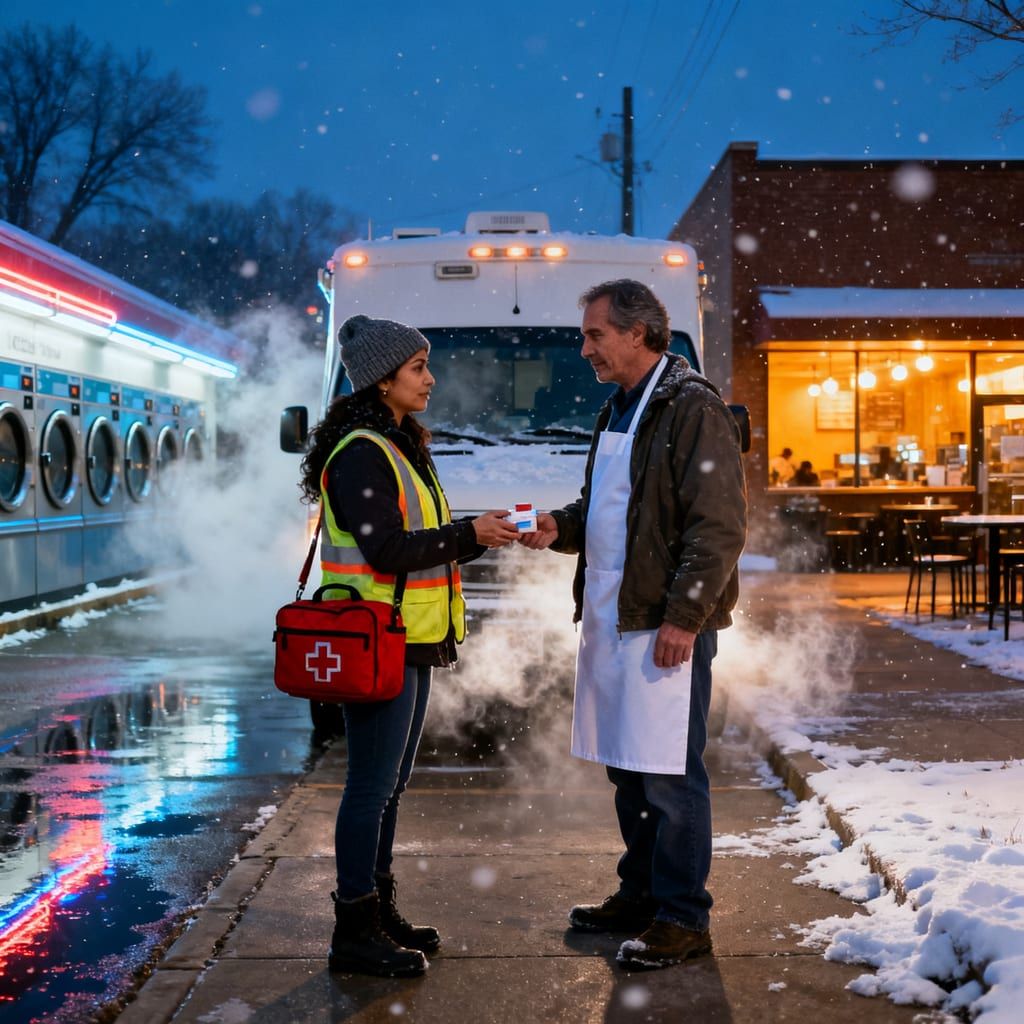
Between a laundromat's hum and a café's light, a van keeps score another way
Read more →
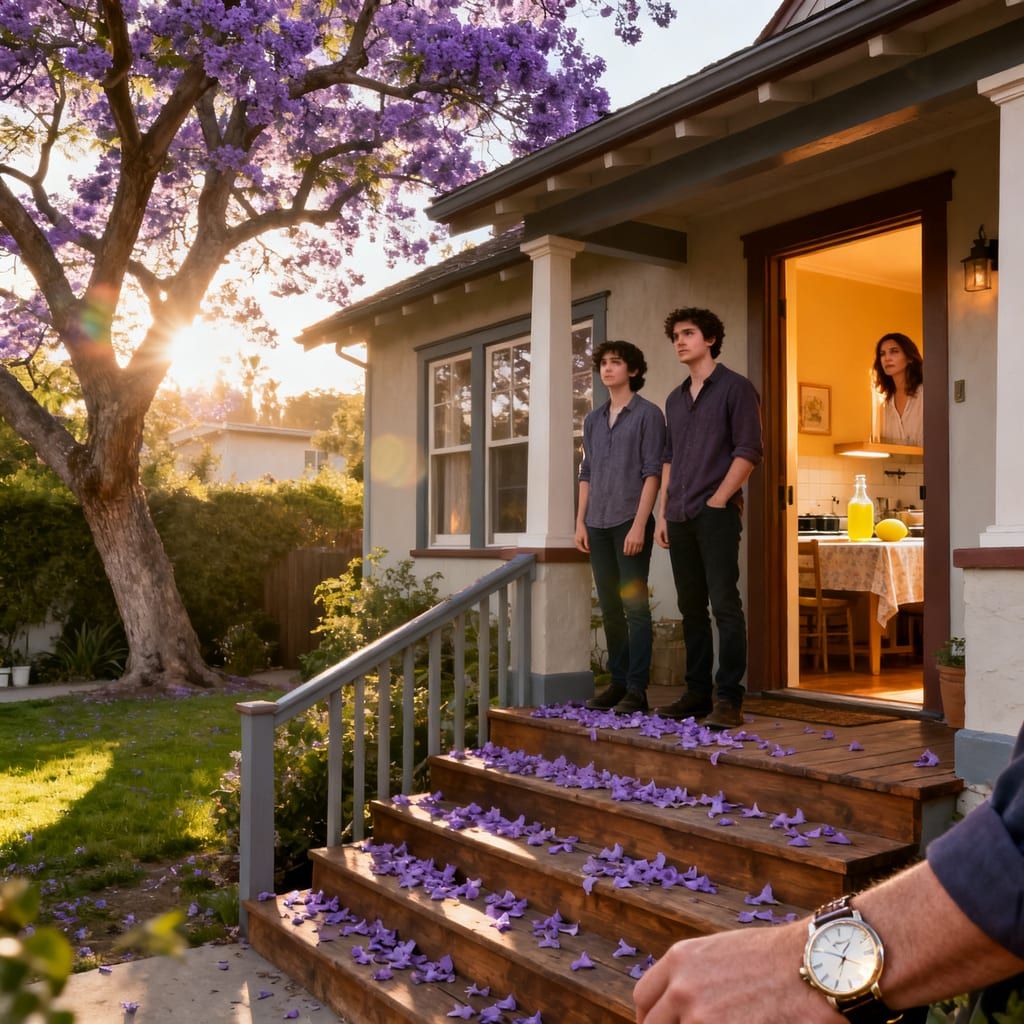
A daughter learns to read between the lines of a life split in two
Read more →Story audiobooks for children of all ages — a new one every day on Smarter Way Stories.