Castling Behind Barbed Wire
A quiet move beneath fluorescent lights
Read more →
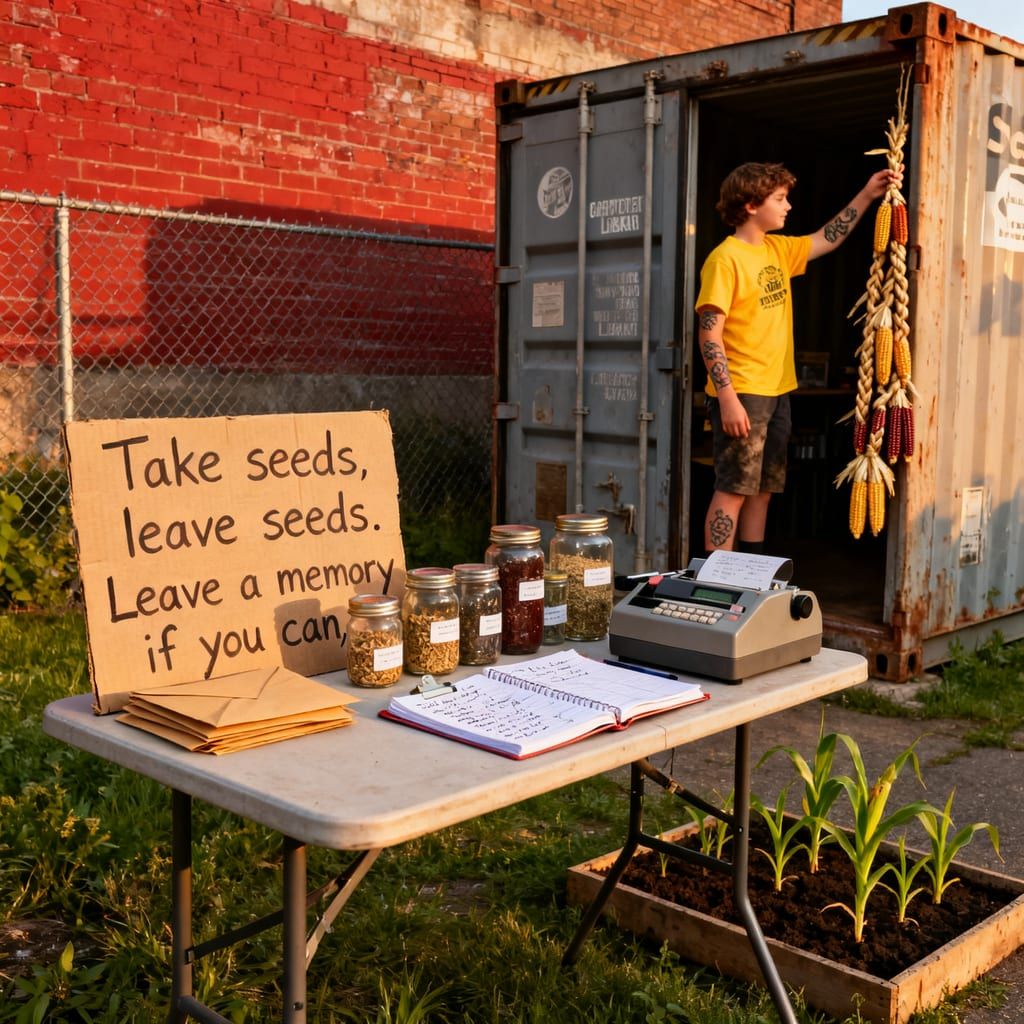
The first Saturday back home, Eli scrawled a sign on the inside of a cereal box: Take seeds, leave seeds. Leave a memory if you can.
He propped it on a shaky folding table between the kettle corn stall and a man with crates of bootleg DVDs. The market lot was a patchwork of oil stains and chalked hopscotch, the air sugared with cinnamon from fried dough. Eli set out old jars-thrifted, their labels half scrubbed-lined up manila envelopes like blank postcards. His mother's grocery cart held everything else: a ledger book with marbled paper, a bundle of pencils, an old label maker he'd found in a junk drawer back at the house.
He felt foolish and, at the same time, unaccountably steady. He rubbed the heel of his hand over the tabletop until the splintered edge didn't catch.
A woman with a nose ring paused. "You selling?"
"Trading," Eli said. "Or giving. Depends on what you've got-seeds or stories." He lifted an envelope, shook it like a rattle. "Payment accepted in pencil."
She huffed a laugh and reached into her tote. "I've got basil from my windowsill and a whole lot of tips from a nonna who swore the moon had opinions."
"Perfect." He slid the ledger across, open to the first line.
By noon, the table grew from curiosity to waypoint. A barista from the coffee shop at the corner, wrists inked with birds, pressed a packet into his palm. "Armenian cucumbers. My pop-pop smuggled them in his sock during a trip back from Yerevan-family legend, anyway. I've been growing them on my fire escape." She wrote carefully in the ledger, tongue stuck between her teeth. Her name, the origin, a doodle of a laddered vine.
A mechanic with hands like wrenches cupped marigold heads as if they were candles. "From my Lily's funeral," he said, voice catching on the name. "She hated the word mourn. She said, 'Plant me somewhere I can eavesdrop.'" He crumbled the dried petals over an envelope, orange confetti trembling in the breeze. Eli labeled the packet MARIGOLDS, LILY-HEARD LAUGHTER IN JUNE.
A teacher shepherded a string of second-graders in neon field-trip tees. "We've got sunflowers," she announced, grinning. "Named after their bus driver because he always slows down for crows." The kids argued over how many seeds to leave versus take, solemn and serious in the way of small custodians.
Eli catalogued it all-ink smudged on his fingertips, graphite moons on the sides of his hand. Each entry felt like a blessing he got to pass along: beans from a great-uncle's backyard, tomatoes that outlasted a divorce, zinnias that weathered last summer's drought. He peeled black-and-white labels, the handheld gun chattering out names and notes he stuck to jars like prayers.
The quiet he'd carried home from his layoff-an echoing room of spreadsheets and closed tabs-filled up with mismatched voices. His mother called him between naps to ask what had walked across his table that day. He told her about the boy who pocketed three radish seeds like the start of a heist and the elderly woman who pressed her number into his palm "in case your tomatoes get lonely."
By the second Saturday, a college kid with a film camera took pictures and tagged him. The neighborhood newsletter ran a photo of the ledger under the headline Borrowed Pockets, Kept Promises. Strangers showed up with jars-peanut butter, jelly, tahini-washed and ridged with labels peeled off, ghosts of adhesive still tacky.
"Who taught you to save?" he'd ask, sliding the ledger forward.
"My aunt," said a nurse, tucking hair behind her ear. "She said seeds don't mind if you forget their names as long as you remember their thirst."
"My neighbor," said a man balancing a toddler on one hip. "He traded me squash for snow shoveling when my wife was on bedrest."
Eli kept a map on a scrap of cardboard: dots for stoops, yards, even a fire escape three streets over. The dots multiplied, a constellation that made sense of the four-block radius he'd roamed on a skateboard as a kid.
He moved the exchange, when it rained, into the public library's meeting room-fluorescent-lit, smelling of old paper and the faint ghost of high school homework. The librarian taped a sign to the door: Seed Swap & Stories, 11-2, Free. Kids traced leaves with crayons while elders debated compost with the fervor of sports radio callers.
On a Tuesday evening, Eli arrived at the lot with a new box of envelopes and found Miles, the landlord, measuring the blacktop with a click-wheel. Miles wore a polo and a look that said he had other places to be.
"Afternoon," Miles said, not looking up.
Eli nodded at the wheel. "How many miles to the gallon?"
Miles didn't smile. "I'm paving. Storage company wants a satellite lot. It's good money." He gestured around, encompassing kettle corn, toddlers in wagons, the DVD guy's folding chair. "I gave you all a few months' grace after the grocer closed. Time's about up."
"It's..." Eli started, then stopped. He wanted to say it's more than a flea market, more than a table. He wanted to say he had nothing else that felt like forward motion. "It's working," he said instead.
"Not my call," Miles said, though his hand tightened on the wheel. "Notice goes out Friday."
Eli nodded, as if the news were weather. He boxed up the envelopes that night with a care that looked like prayer and felt like bracing for a fall.
Two days later, a small package arrived at Eli's mother's house, addressed in a hand that shook. Inside, nested in newspaper, lay a coffee tin with no label. He eased off the lid and stared at speckled kernels the color of old teeth, some freckled brown, some moon-pale. A Polaroid slid out and landed face up on the table: two kids in a sunburned backyard, grinning with the reckless joy of a hose on a July day. One boy, all elbows and cowlick, had a face Eli recognized: thin-lipped smile, dent in the chin. Miles. The girl next to him held a braid of corn as thick as her wrist.
Eli's throat tightened. He had seen a black-and-white version of that braid in a frame at his mother's, labeled in delicate script: Sofía's Wedding Braid, 1967.
The note was on ruled paper, the lines wobbling. Sofía's wedding corn-kept safe in coffee tins and closets since 1967-don't let it end with me.
On the envelope, a return address: an assisted living facility fifteen minutes away.
The facility smelled faintly of lemon cleaner and roses stubborn in a courtyard. A volunteer led Eli to a small lounge where an older woman sat looking out the window at a crepe myrtle. Her hair was white in a way that suggested an agreement with time.
"You're Sofía's grandson," she said when he stepped in. "I see it in the eyebrows."
Eli laughed, then swallowed, the way a laugh becomes a yes when you don't trust your voice.
"I'm Alma," she said, offering her hand. "Miles's mother. We were kids together on Grove Street. Your grandmother braided that corn for her wedding. When my dad got laid off at the mill, winter gnawed at us. Your abuela came by with sacks of corn and put them on our table like it was nothing." Alma stared at her hands, then out at the tree. "She said, 'Eat two, save one. And one more for the future.' She braided me a small one. Said, 'For when the boy who will ask for stories shows up.' I kept saving it, bad year and good. I don't know why except maybe because she asked me to."
"She asked all of us to," Eli said softly.
Alma smiled, thin and bright. "Miles don't remember," she said. "He was always looking forward. I thought, someone has to keep an eye on back then. Until you came along with that ledger." She patted his arm. "You'll know what to do with it."
Eli called Miles and asked to meet at the lot. Saturday morning, the market breathing around them, he set the tin between them on the table. He placed the Polaroid next to it, let the sun fall on the faces until Miles squinted.
"I don't-" Miles started, then did the math on his own features in the photo. His mouth opened, shut. He touched the edge of the image like it might skip.
"Your mother kept it going," Eli said. He angled the tin so Miles could see the kernels. "My grandmother saved your family with this corn one winter. She asked for one braid for the future." He waited a beat. "You're part of that braid."
Miles looked around-at the barista who waved every time she passed, the mechanic logging marigolds into the ledger with the earnestness of bookkeepers, the teacher tying nametags to sunflower packets with raffia. He looked at the chalked hopscotch, at the stain where someone had dropped a whole jar of beets and the purple had been scrubbed into a faint aurora.
"I was going to pave," he said, more to himself than to Eli.
"Maybe you still can," Eli said. "But not all of it." He slid an envelope toward Miles and a pencil. "Plant it with me. At least once. Let it get its feet into this dirt again."
Miles wiped his palm on his jeans, then took the pencil. "I don't garden."
"I didn't either," Eli said, and something in his voice made it not a boast but a bridge.
They planted in a rectangle of weedy soil at the lot's edge, palms grit with the same dirt. Kids clustered, pointing at the kernels like jewels. The mechanic brought a trowel and then a second one when he saw how Miles was mangling the first. An elderly couple argued over planting depth. The barista crouched to photograph a small hand pressed to the soil.
Eli tucked each kernel into its pocket, thumb firm at the end as if giving a blessing. He thought of his grandmother's wedding braid, heavy and rustling. He thought, quietly, of his layoff and the way a life can seize up, then open if you lay it down in rows and trust it will take.
The week the stalks reached his knee, a teenager spray-painted a green heart on the plywood that fenced their rectangle. Someone else added SEEDS underneath. The newsletter ran an update. Instagram filled with hands and dirt and the occasional corn selfie that, inexplicably, made sense.
Miles began stopping by. Once he brought iced tea with the lids taped to keep the bees out. Once he brought his mother, who sat in a lawn chair and hummed, and when a child gave her a fallen tassel, she tucked it behind her ear.
The paving got postponed, once, then again. When pressure from the storage company ratcheted back up, Miles came to the table and stood there long enough to count the freckles on his hands. "I can offer a seasonal lease," he said finally. "And a corner-permanent-for a seed library. In that old shipping container I was going to scrap."
Eli waited. He exhaled so slowly it felt like rain after a dry spell. "We can make a home in a corner," he said. "We've all been doing it our whole lives."
In September, the corn ripened. Ears fat and studded, silk gone from ballerina to broom. Eli and Miles walked the rows with baskets while children darted like sparrows. Elders called out advice that began as nagging and ended as laughter.
Eli pulled back the husks and there it was: the old colors returning like a song you only remember when you hear it-pearled whites and tooth-brown speckles, a faint blush on some like sunset on under-snow. He braided three full ropes the way his grandmother had taught him, fingers remembering a dance his brain hadn't yet named. He tied them with twine and hung them in the shipping container-cool, dim, smelling of dust and something sweet.
People came for jars and left with recipes, with stories traced in pencil. The ledger fattened, spines creaking, margins full of small drawings-bees, fences, a bus with sunflowers in the windows.
That afternoon, a man hovered at the table, cap in his hands. "I don't have anything to trade," he said, eyes on his shoes. "I just-my mother used to plant a row of something pretty to trick herself into liking yard work. She'd sing to them. I can still hear it when the radio's down and the windows are open." He swallowed. "I thought maybe I'd take a packet, if that's okay."
Eli lifted one of the small braids he'd made from the last picking. Not a full rope, just a strand, humble and neat. He pressed it into the man's hands. "Take this," he said. "Hang it where you'll see it. Come back in spring."
The man's eyes went glassy. "I don't-this is-"
"Someone saved it for you," Eli said. He didn't say his grandmother's name or Alma's, didn't pull out the Polaroid that had built a bridge where there hadn't been one. He didn't need to.
Evening laid gold over the lot. The kettle corn guy swept sugar from the blacktop; the mechanic wiped his hands on a rag and kissed his fingers to the marigolds. Miles stood by the shipping container, palms on the doorframe as if testing its weight. Eli labeled the last jar of the day, the gun spitting out a strip of white: SOFÍA'S WEDDING CORN-SAVED FOR THE FUTURE.
He stuck the label on and felt it all settle into place: jars lined like a spine, the ledger thick with other people's care, the braids whispering when the door swung shut. Seeds wanting what they had always wanted-to live again, to travel in borrowed pockets, to be remembered not for their names but for the hands that passed them on.
He lifted his gaze and caught, in the window of the shipping container, a reflection of himself hunched over the table-one person, ordinary and necessary. He thought of the promise he could not name when he began, the one that had tugged him to a folding table with a cardboard sign.
Keep what keeps us, a voice in him said. Give it away before it's lost.
He wrote it down in the ledger's margin, small and quick, and closed the book, the pencil tucked inside like a seed.

Story audiobooks for children of all ages — a new one every day on Smarter Way Stories.