The Sparrow Street Postcard Cipher
A blue bench, a bell, and a stranger who cared enough to finish a sentence
Read more →
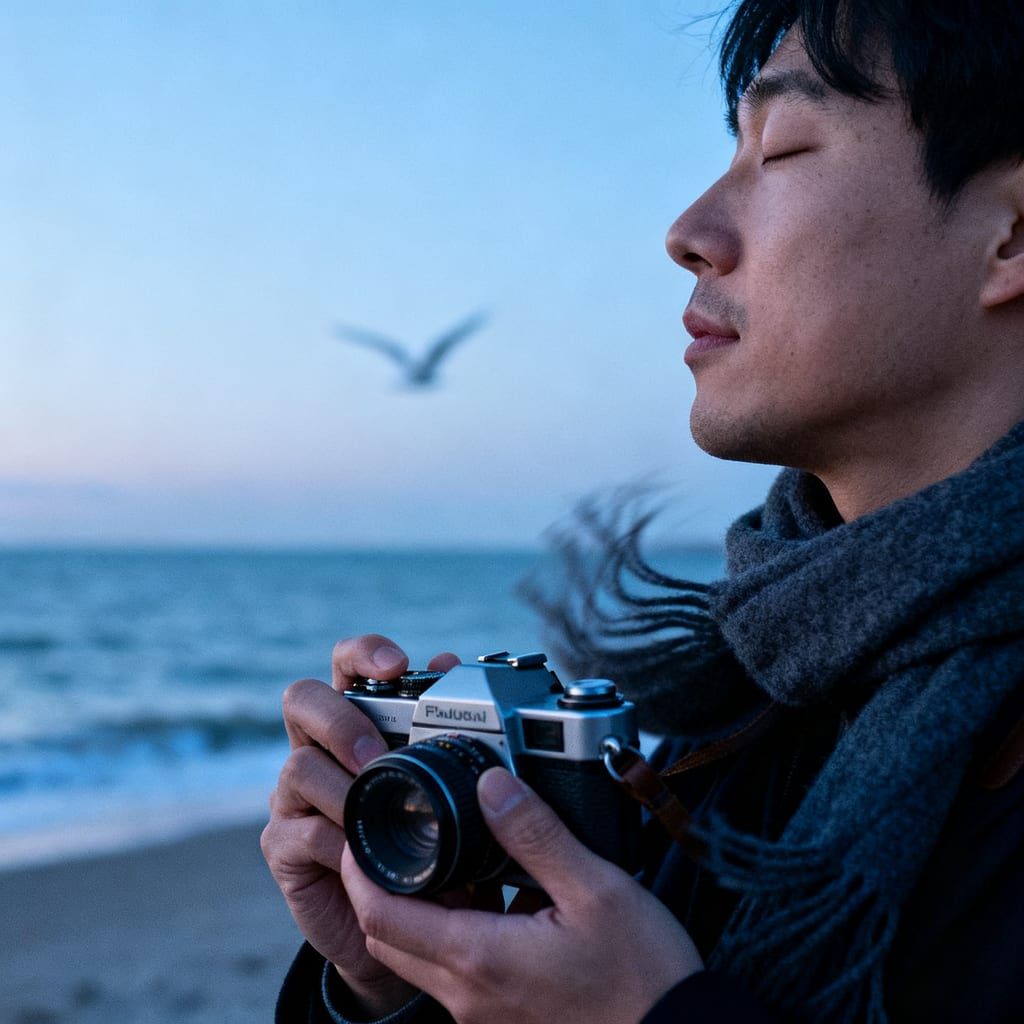
On his first day at the community arts center, Elias stood in a room that smelled like tempera paint and old coffee and waited for his hands to stop shaking. Outside, the el train chattered and sighed, moving past like a curtain of rain. He set a metronome on the folding table, wound it, and let its tiny pendulum count the seconds he couldn't quite feel.
He had a bag of tricks-metronomes for rhythm, phone haptics to count steps, tactile grids glued to foam core for framing. He had a private ache he didn't unpack: a decade of glossy campaigns where fruit gleamed and watches sparkled and none of it, not one saturated pixel, meant anything anymore. Images had once been oxygen. Now they were a paycheck with backlighting.
"Elias?" The voice belonged to a woman with a cane folded like a slender question mark. Her hair was braided close to the scalp, and she smiled as if she were already in on the joke.
"Mira," she said. "Blind since forever. But I aim like a dart. You'll see. Or, you know-" She laughed, and it was bells, high and bright, trimming the room into a friendlier shape.
DeShawn arrived with the careful heft of someone who used to be large in the world and had learned to make himself light. A construction vest was folded over his forearm like the old life he kept meaning to put back on.
"Used to spot weld at thirty feet," he said, tapping the table edge with his knuckles. "Now I spot edges with my toes."
Noor slipped in quiet, a knitted cap pulled low, a satin ribbon tied around her wrist like a psalm. She found a chair with the stillness of water settling.
"Is this the right room?" she asked, even though she had arrived without spilling a second.
"Yes," Elias said. "I'm Elias. We'll-" He stopped. The old scripts-Rule of Thirds, golden hour, perfect light-rose to his tongue like an allergy. He swallowed them back. "We'll learn to take photographs that are honest."
"How do you know," Noor said, head tilted slightly, "when a photograph is honest?"
The metronome ticked. Outside, a bus sighed to its curb. Elias looked at the black cameras waiting like polite dogs on the table. "We'll start with listening," he said at last.
They learned a language that perfumed the air with textures instead of nouns. Where sight would have named shapes, they named temperatures-radiator warmth blooming on ankles, a draft worrying the left cheek. Shadow became the hush beneath fluorescent light. Form arrived in sound: chair legs rasping, a door groaning its burden, the quick skitter of a mouse in the wall.
He set their phones to vibrate in gentle pulses-three beats to walk between spots on a tactile grid, one to lift the camera, two to breathe.
"Picture a square," Elias said, moving their hands over the raised lines he had glued with patient late-night glue fumes. "Not with your eyes. With your fingers. With the way your shoulders sit when you turn toward the window."
Mira held the camera as if it were the beginning of a joke she'd tell later. "Describe my shot like I'm soup," she said, grinning.
"You're-" Elias listened, then smiled despite himself. "You're a simmer on the back burner. The radiator is your horizon."
"Perfect," she said, and clicked.
DeShawn learned to anchor himself by counting heartbeats until the bus brake exhaled at the curb and the world lined itself up, obedient to his chest. Noor did something harder. She stood perfectly still at doorways as if the doorway were a tuning fork, her head at a subtle angle he came to recognize. The room arranged itself around her-the low hum of the refrigerator, the thin glassy clink of someone setting down a mug, the thread-notes of conversation tugging at a far corner.
"Teach us the triangle," DeShawn said one afternoon, impatient but soft with it.
"ISO, shutter, aperture," Elias said, chalk squeaking across the board he never used for ad clients. "Light's a bargain. You spend it here or here or here."
"And if we have no light?" Noor asked.
"Then you spend time," he said, surprising himself. "Or trust."
They went to the lake on a bruised afternoon, the kind of Chicago sky that made you wrap your scarf even if the air was kind. Lake Michigan curled and uncurled at the concrete shore, an enormous cat. Wind skated the surface and slid between their ribs.
"Anchor," Elias said. "Find something steady."
"The wind," Noor said, facing south, then slightly east. "Left cheek. Sixty percent."
Mira laughed, bells threaded with cold. "Tell me when the gull screams," she said. "I'm going to make it shut up."
They stood like small lighthouses. A gull wheeled close enough that the air changed; you could feel the feathered engine of it. DeShawn listened hard, his hands loose at the camera. The gull's cry tore loose, a bright cloth in the gray. DeShawn clicked.
Weeks later, in the lab that always smelled faintly like pennies, the print bloomed in the tray. A pale shape against a ruined sky-except it wasn't a shape at all. It was where the gull had not been. The gull had flared and turned and left an absence-a gull-shaped negative stitched into the clouds.
The three of them bent close. Even without sight, there was a way to bend that said you were looking.
"It's not there," Mira said, delighted. "It's there because it isn't."
Noor's fingers hovered over the image, careful not to touch wet paper. "Honest," she said. "The air remembers what moved through it."
Something in Elias gave way the way a window unlatches in spring. He had spent years catching light like a trophy. Here was something refusing to be held-gorgeous not for what it showed but for what it let go.
For their final show, Elias pictured clean frames, a soft wash of spotlights, tiny placards declaring Artist Statement in a font that took itself seriously. Noor waited until his speech ran down and then said, "What if we had no lights at all?"
"Gimmicky," Elias said, too fast. The word snapped out like a twig.
"Or accurate," Noor said. "Raised-line prints. Braille captions. Audio we record ourselves. Sighted guests blindfolded at the door. If honesty is what we're after, let them arrive the way we do."
DeShawn rubbed his knuckles, a habit now, a rhythm. "Let them count heartbeats," he said.
Mira, always the bell, chimed in. "Plus it saves on electricity."
Elias looked at them and saw not students but artists who had built a craft from breath and trust. He felt the old impulse-a need to control, to polish-loosen like a tie at the end of a long wedding. He nodded. "We'll need ushers," he said. "And very clear exits."
They spent evenings recording descriptions, each word a fingertip. In the small studio, they leaned toward the mic and began not with what a sighted person would see but with what the scene had done to them.
"Say it like I can drink it," Mira told herself, and Elias sat in the dark booth and pressed Record.
On opening night, guests shuffled in with the embarrassed laughter of people about to surrender something they didn't know weighed so much. Blindfolds fluttered like tame moths. The lights cut out with a click. The room inhaled.
A hand brushed Elias's sleeve-Noor's ribbon whisper-soft. "Ready?" she breathed.
"I think so," he said, and wasn't lying.
Mira went first. Her voice poured through the speakers low and warm. "I am holding a cup," she said, and you could hear the grin at the edge of it. "Steam climbs my face like dawn. The lip is chipped where my mouth is not. The cup is white, but that doesn't matter. It is heavier on the right. In my palm, it tells me not to rush."
Someone in the dark laughed, then sniffled, a small wet honesty.
DeShawn's piece thumped into the room and made the chairs feel like scaffolding. "Listen," he said. "Hear the rebar sing when you walk across it? Boom-boom-boom. I stand where the wind is a bass drum. The sky is a ceiling no one finished painting. My brother's laugh is a nail gun. It scares me and then it doesn't."
There were murmurs, a hush collecting like velvet on a stage.
Then Noor. Silence for a full metronome measure. When she spoke, her words fell like pins.
"This is the Blue Line at four seventeen," she said. "A stroller wheel ticks like a playing card in a bicycle spoke. Two strangers share an exhale by accident and forgive each other for nothing. A pigeon hesitates on the platform edge and decides to be brave. The train arrives, pulls the air with it, and our coats lean toward the future without our permission."
The room made a sound Elias had not heard in months. Not applause. Not praise. The sound of people being briefly, unanimously human.
He felt himself breathing. He listened to his own breath as if it were a small weather he might predict. He forgot to perform. He stood with them in the dark and let the world press a quiet hand to the back of his neck.
After, with the blindfolds off and the exit lights still dim, the guests spoke in voices newly rearranged. "I didn't know," someone said, which was either apology or prayer. A woman touched the raised lines of DeShawn's scaffolding with reverence, as if reading someone's spine.
In the hall, Noor found Elias, ribbon loose around her wrist. "I've never been trying to capture objects," she said, a confession or a thesis, he couldn't tell. "Only what they do to the air."
Elias nodded, throat tight. "I think that's all I ever wanted," he said, and believed it in a new way, like stepping into a room and realizing you've been mispronouncing its name for years.
He walked home without lifting his camera once. It hung from his neck, light as an idea you didn't need to defend. On the sidewalk, a boy dribbled a ball, its hollow echo measuring the block. A woman laughed into her scarf. A cab slid by, tires hissing, city breath exhaling. Everything kept not posing for him, and he let it.
At blue hour the next morning, he took the train to the lake. Wind at his left cheek, sixty percent. The water muscled the shore, indifferent and holy. He set the metronome in his pocket and didn't wind it. He closed his eyes.
Behind his eyelids, old campaigns glowed and went out like bad streetlights. He stood in the seam where night leaked into morning and waited for the world to tell him its shape. A gull winged past-he felt its wake as a tug on the air. Somewhere to his right, a jogger's shoes noted time. Farther off, the city cleared its throat.
He lifted the camera. He let his breath settle. He pressed the shutter when the wind found him and leaned, just slightly, into the day.
The picture would be imperfect. He would print it on cheap paper first, then good. He would trace the raised lines for his class, listening to their hands understand it. He would not name what was in the frame because the naming would be beside the point.
He opened his eyes. The lake lay out in its ridiculous bigness, refusing to be owned. He laughed once, a short sound the wind carried away and brought back. For the first time in years, the morning arranged itself, and he did not try to improve it. He only stood there-listening, present-while the world did what it always had, which was everything.
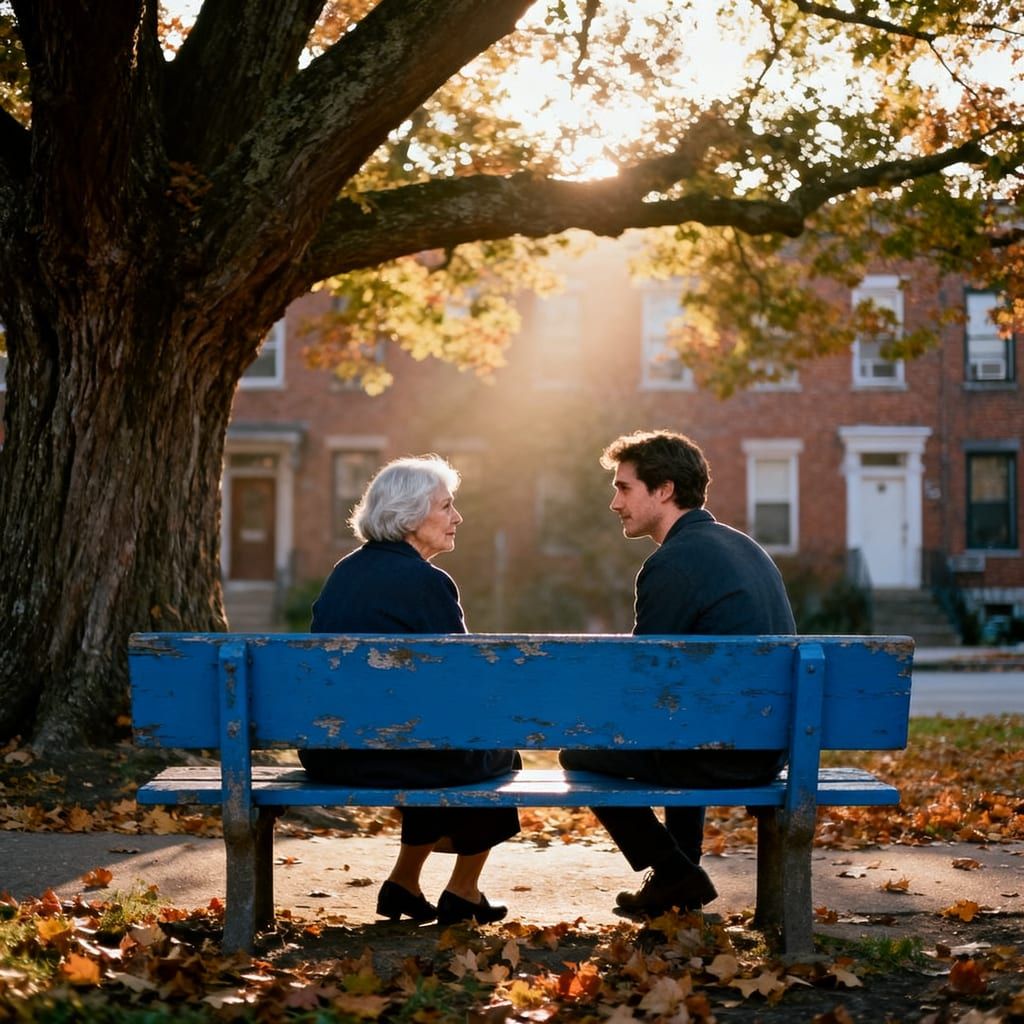
A blue bench, a bell, and a stranger who cared enough to finish a sentence
Read more →
Story audiobooks for children of all ages — a new one every day on Smarter Way Stories.