A Different Name, The Same Heart
In Los Angeles, a daughter learns how to carry two lives forward
Read more →
The flyers curl at the corners before she even leaves the copy shop-cheap paper, cheaper ink, a slant of letters as if the words were leaning into wind. Iris tapes one to the laundromat door while the dryers breathe out warm lint and somebody's change clatters in a pocket. At the bus stop, her reflection wavers on the glass, a ghost with a roll of blue painter's tape.
On the neighborhood app, she posts the same message, then closes her phone and turns it face down as if it might bite. Sad Walks, the paper says in bold that isn't bold enough. Saturdays, 7 a.m. River path. Three rules: no fixing, no comparing, no one walks behind alone.
She doesn't sleep much that Friday. The cat paces the hallway and returns to her chest like a tide. She counts not sheep but questions. What if no one comes. What if they do.
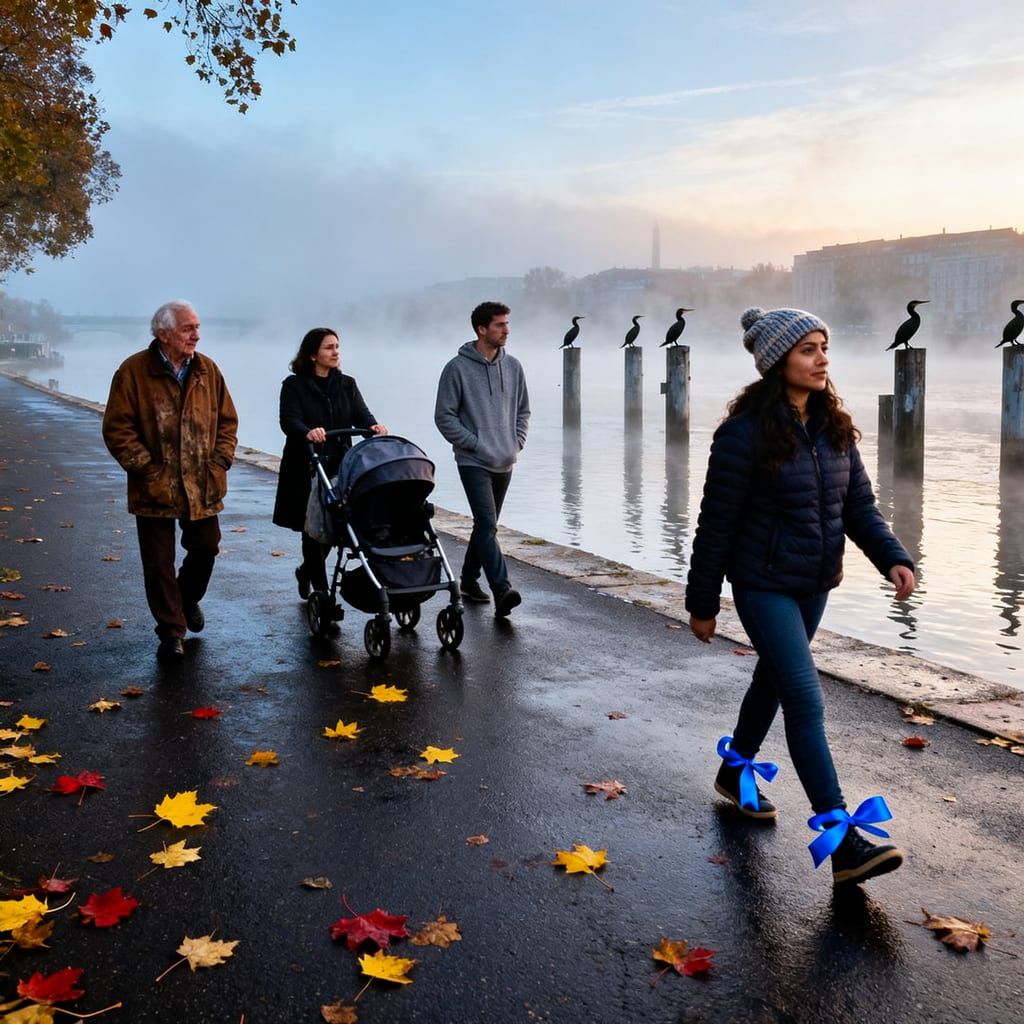
At dawn, fog sits low over the river like a thought you can't quite think through. Iris stands by the path in a knit hat that makes her look gentler than she feels, thermos uncapped, breath part steam, part prayer. The knot in her stomach is tight enough to tune an instrument.
He appears first: an older man in a brown coat that has known rain. "Thomas," he says, sticking out a hand that's warm despite the cold. Then a single mom steering a stroller with one knee, hair in a fast, forgiving bun. "Dani. He's Leo. He bites sleeves, not people." The baby blinks once, skeptically. A quiet guy in a gray tech hoodie lifts a palm from a safe distance. "Jay."
"Okay," Iris says, voice thinner than she wants. "The rules?" She reads from the flyer as if it were law. "No fixing. No comparing. No one walks behind alone."
Thomas nods like a man signing a treaty. "Sensible," he says.
They don't quite become a line so much as an elastic, unsure shape. Sneakers scuff leaves. A cormorant shakes river water from its throat and watches them pass.
"Name the colors you spot," Iris offers, throat steadying to a rhythm. "Just for the first stretch."
"Brown," Thomas says, then laughs at himself and amends, "Rust. Ochre. That's better."
"Blue that's pretending to be white," Dani says, gesturing at the fog.
"Exit sign green," Jay murmurs, pointing at a jogger's shoes. He doesn't say why it's the first color that comes to him.
They count how many windows are lit. They list three lies the morning told and one truth they'll keep. The lies change: Today will be easy. You are alone. You'll feel better if you stay in bed. The truth is slipperier, but they try it on like a thrifted sweater until something fits. There were four swans under the bridge. The bakery opens at eight. The blue heron was there even when I didn't look.
Over weeks, an accrual of ordinary miracles. On the second mile, Leo sleeps, an arm flung over his face like a tiny celebrity evading paparazzi. Thomas, who used to be a mail carrier, admits he misses porches-the creak of a screen door, the permission to look at people's wind chimes.
"Porches tell the truth about a house," he says. "Yard lies, but the porch? The porch confesses."
Jay times their loops with an accuracy that does not quite tip into obsession. "Forty-one minutes, twelve seconds," he reports the third week, as if time had behaved itself and deserved praise. He never says why he's there, which is its own kind of telling.
Iris, who used to count pills, starts counting cormorants on the pylons and benches that need repair. She sleeps on Fridays, soft and surprising, like a door that finally swings on its hinges without groaning.
Their Sad Walks grow to a dozen, then shrink again. A man comes once with a camera and never returns. A teenager on a scooter does a loop around them and declares, "Midwives of doom!" before shooting away, delighted by himself. They don't go viral. They go steady.
When the air turns apple-clean and the trees decide to speak in gold, Iris buys a roll of blue ribbon from the craft store. The cashier snaps off a length to tie around the register as a joke. "Sky in a spool," she says, and Iris nods like she has been given weather to carry.
They adopt a quiet ritual: tie the ribbon to a shoelace if you'll keep pace, if you won't disappear behind the last lamppost. It's not a promise, exactly. More like a nudge, a visible beat.
They add small things that companion rather than cure. A WhatsApp thread that only allows check marks, not words-one tap meaning: alive. A laminated "if you miss us, here's the next turn" map so a latecomer can step into the day at the third bench past the mural. A silent minute on the bridge, faces open to wind, for names none of them say out loud.
On a raw morning when sleet does its petty, relentless work, Thomas arrives in a poncho that could shelter an entire scout troop. "Mall walk," he declares, ridiculous and right. They count potted palms and unflattering mannequins. Dani finds a community piano tucked between a jewelry kiosk and a shoe store and plays something slow while the stroller squeaks approval down the polished floor.
On the equinox, leaves skitter like coins dropped by an invisible hand. The path is a patchwork of yellow and red, slippery as a memory. Iris's phone, in the pocket of her jacket, holds a note not meant for other eyes-an unspooled calendar alarm, a date set in a room that had no windows. She carries it like a pebble in a shoe.
By the underpass, there's a bench where the river sound thickens. She has sat there before with a plan that felt like relief. This morning, the old pull leans on her shoulder, casual as a friend. She slows. The line that isn't a line starts to stretch.
Jay matches her step without looking at her. He reaches into his hoodie pocket and pulls out a small laminated card, edges rounded, the kind you'd make if you trusted lamination more than weather. On it: distances and tiny drawings-four lampposts, a mural of a blue dog, the bakery's awning, a crooked arrow to the river bend.
"I keep these in case my brain forgets that places exist beyond my apartment," he says, gaze on the card, not on her. "Also for if-if I can't remember what comes after the turn."
"What comes after this turn?" Iris asks, throat a wire stretched between two nails.
"The bakery opens at eight," he says. "The pigeons by the fourth bench are, statistically, too brave." A half-smile. "And you'll hate this, but...I set a date once. For an ending. Then you people kept showing up. It was like trying to make tea in a sink that someone kept filling with new mugs. Interference. Dumb, stubborn interference."
Wind lifts the ribbon on his shoe. The blue flashes, a sky on a string. Iris doesn't say the whole thing out loud. She doesn't have to. She takes the ribbon from her pocket-she always keeps an extra now-and ties it fresh onto her laces, double-knot careful, a ritual like signing her name. Her hands shake, but not enough to stop her.
Later, in the bakery bathroom that smells like cinnamon and bleach, she opens the note, meets the date she once gave the future, and deletes it. The screen goes briefly blank, then ordinary again. Her breath stutters once and then finds the beat outside the door-mugs clinking, a child laughing because a napkin has stuck to his hand.
Weeks lean into winter. They don't fix each other. They share gloves when someone forgets. They learn that Thomas's wife hated the word "moist" and collected tiny ceramic birds, that Dani cannot keep plants alive but waters everyone, that Jay runs his laundry on Wednesdays because the laundromat is loud enough to mute him and not ask questions.
"Tell me three lies the morning told you," Thomas says one day, borrowing Iris's old prompt like a scarf.
"It said I'm a bad mother," Dani answers, instantly, then softer: "It said Leo will remember every time I sigh." She taps her blue ribbon with one finger. "It said toast doesn't count as breakfast. The truth is...he loved the toast." Leo gurgles agreement, jam on his chin.
Iris starts noticing broken things the city has given up fixing. She brings a little notebook and writes: bench bolt missing; lamppost flickers like a bad thought; mural chipped at the dog's ear. She emails the city twice a week. Sometimes someone answers. Sometimes she buys a pack of washers and learns how to turn a wrench.
On a particular morning when the sky can't decide if it's bruise or pearl, she hears her name from across the crosswalk. A neighbor in a raincoat she knows only by dog says, "Sad Walks?" as if naming a constellation she can finally see. Iris laughs, unexpected and clean. How right the name is.
By winter, photos appear in the thread from three neighborhoods over-five shoes, five knots of blue, captioned only with a check mark. Someone ties ribbon to a wheelchair spoke. Someone to a cane.
After a walk that feels like wading through wet wool, they crowd into a diner with fogged windows and a waitress who calls everyone honey in the same key. The table is sticky with a thousand breakfasts. Iris orders coffee for the table before they sit, like she trusts they're staying.
Steam writes its silent script on the glass. Leo bangs a spoon and is briefly a percussionist. Thomas tells a story about a porch with a ceramic frog that held a spare key under its rubber mouth. Jay, after a long look at the menu like it's an exam, orders pancakes and eats them in precise triangles. Dani's phone lights with a check mark from someone who couldn't come; she lifts it like grace before pocketing it.
"I'll top you off," Iris says, hand on the coffee pot like a pitcher of some simpler mercy. She leans, refills Thomas's cup, the steam fogging her glasses for a second so everything becomes haloed and close.
No one announces salvation. No one declares victory over anything. The blue ribbons are damp and a little ridiculous in the puddled entrance. Their coats steam on the backs of chairs. Saturday sits in the middle of the table with the syrup, ordinary and shared.
Iris feels the table's wobble under her palm and adjusts the napkin stack to steady it. The world holds, not because it must, but because four people and a baby have agreed to stand here, to sit here, to lift forks and cups and names without demanding reasons. The cat will be waiting at home. The craft store ribbon will make more knots. The river will keep its counsel.
Next Saturday at seven, they'll go nowhere in particular. They'll list colors and count lit windows and keep a minute on the bridge. They'll measure progress by breath, not miles. And when someone slows near the underpass, the others will slow, too, a metronome made of footsteps, keeping time for the part of the song that almost forgets how to go.
In Los Angeles, a daughter learns how to carry two lives forward
Read more →
In the soft hours before dawn, staying becomes its own kind of rescue
Read more →
Story audiobooks for children of all ages — a new one every day on Smarter Way Stories.