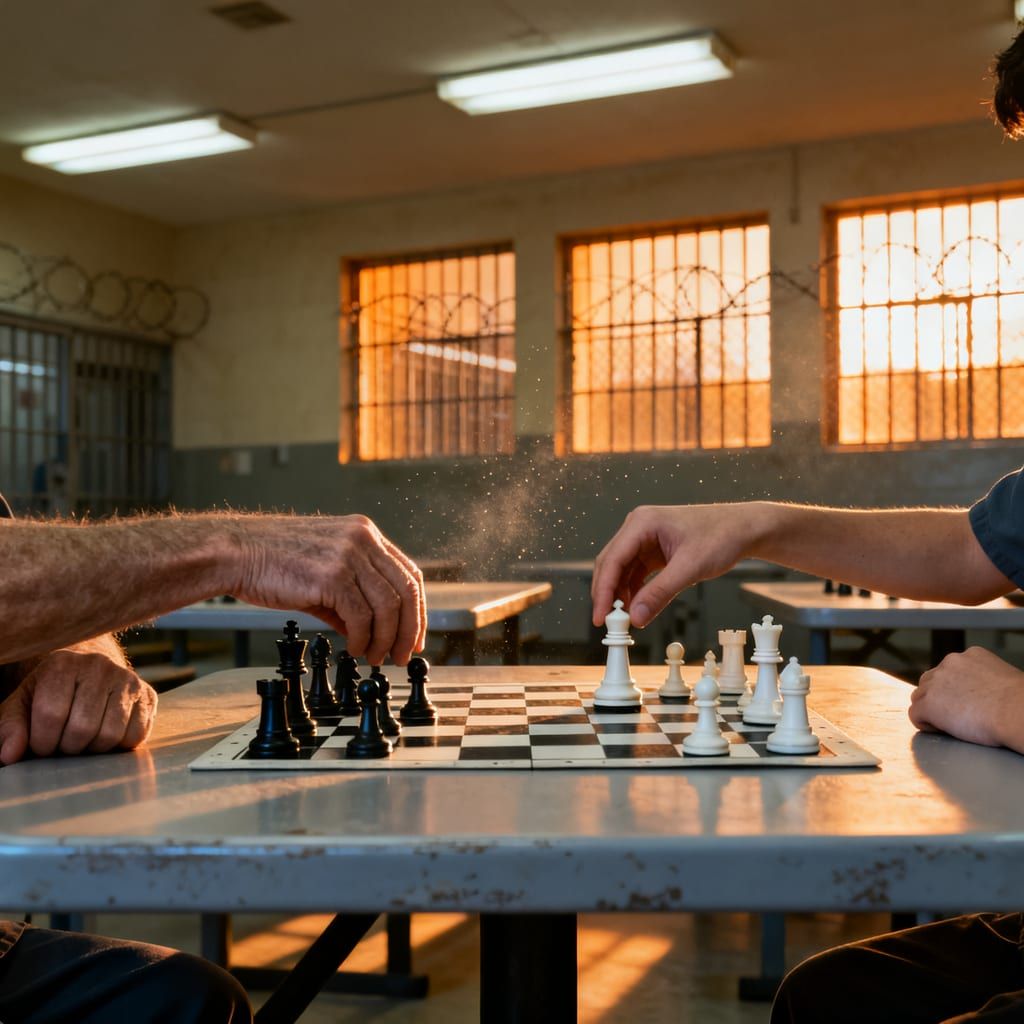
Castling Behind Barbed Wire
A quiet move beneath fluorescent lights
Read more →

The municipal office smelled like old coffee and wet wool. Salt gathered in pale commas along the baseboards where boots had dragged winter inside. The phone on Lena Ortiz's desk blinked like a small, unblinking eye.
"Ortiz, you got a walk-in," Ro from intake called, voice lifting over the copier's rasp.
Lena capped her pen, slid her stack of already-late forms into a crooked pile, and stood. Her knees cracked-a private metronome.
In the waiting row sat a woman in a navy headscarf and a winter coat zipped to the throat despite the overheated room. Beside her, a boy, long-limbed the way boys are right before they become men. He balanced a line of plastic bottle caps on his thigh, the colors bright against black jeans: lemon-soda yellow, water-blue, two reds from a brand Lena could picture but not name.
"You're Ms. Ortiz?" The woman offered a careful smile. "I am Amina."
Lena nodded, felt the prickle of a dozen other red-lit voicemails behind her, and let them fade. She drew two chairs up to her desk.
As they spoke in halting English and folded hands, Lena learned the basics: the building on Lake Street with the brick that wept in rain, the landlord who liked to tell stories about what the neighborhood "used to be," the neighbors who knocked with their complaints cupped like fragile gifts-the noise, the noise, the noise-until a notice slid under the door in a white envelope.
"He does this," Amina said, managing the English with both palms. She nodded toward the boy. "Hassan. He likes the sound. Pop. Quiet. Not too loud."
Hassan, eyes on the caps, pressed his thumb just so and made a soft click-like a raindrop finding a pan in the night. He didn't look up.
"He hasn't spoken since..." Amina's voice thinned. She touched her chest, above the zipper. "Since the boat."
Lena felt the familiar pressure under her ribs-the weight of something unnamed and always present. She had a drawer full of pamphlets, a brain full of policies, and a heart that still, against all evidence, assumed there was a lever to pull that would make a corridor open.
"We'll try everything," she said. She tapped a sticky note against her knee to keep from promising more.
Ordinary channels first. That was the drill and the discipline.
She called emergency relief; the line sighed and placed her on hold to a looped piano that sounded like the memory of rain. The legal aid number rang to an inbox with a cheerful voice that had only ever belonged to an intern. The tenant liaison-"We're here for our residents" printed in enthusiastic sans serif across the email footer-spoke fluently in subsections and unfortunatelys.
By afternoon, Lena's monitor reflected her own face in pale blue: winter dry around the mouth, hair in a bun that had given up its principles. She drank what had once been hot coffee and pictured the boy aligning his caps. Pop.
Outside, a bus exhaled in the street. A man in a lime parka trudged by, the hood fur rimmed in salt. Lena pressed her palms into the desk's fake wood and felt the flimsiness of it, the way it shivered at the slightest knock.
She picked up the phone again.
The building's lobby had marble that had seen better shoes. Someone had taped up a sign about packages, another about the heat-PLEASE TURN RADIATORS TO THE RIGHT, THANK YOU-each with corners lifting like tired flags.
Lena set a folding table near the mailboxes. Amina arranged paper cups as if they might make a good impression. A translator-Nisreen, warm-eyed, paid in a gift card Lena had put on her own credit card last night-stood near, scarf wreathed and patient.
They made tea. They made room.
Neighbors trickled in, drawn by curiosity or the homemade cookies Lena had set out. A man in a union hoodie. A mother with a stroller, the wheel squeaking with every push. An older woman with a QVC pendant, face powdered pink. Lena offered names like bridges: "This is Amina. She's on five."
"Hi," the woman with the pendant said. "I saw the notice in the elevator."
Nisreen interpreted. Amina nodded, hands folded, a nervous tattoo of thumbs against fingers.
"We just wanted to listen," Lena said. She told a quick story about Mr. Custodio from the third floor who'd once played saxophone at 2 a.m. and now played at noon by the dumpsters for whoever wanted a song. "Sometimes we need a minute to find our new normal."
Hassan stood near the wall, caps in his hoodie pocket. He slipped one out, pressed, made the soft click Lena had begun to hear even when he didn't. Pop. Pop. A heartbeat-or a lookout's gentle warning.
A few neighbors signed support letters. Most nodded and drifted back to their lives. The union hoodie man took a second cookie, said, "Good luck with the landlord," which Lena chose to receive as a blessing.
As she folded the table back down, her phone buzzed on the mailboxes. A notification lit the dull glass.
"You're trending," Ro texted, followed by a skull and two dancing lobsters. A link below: a short clip of Lena at the table, hands moving as she spoke, face softer than she felt.
The caption read: "our building's social worker hosting a kumbaya hour instead of dealing with a nuisance tenant 🙄 #softcity" The handle: @SpeakUp312. The account small, the tone sharp. Comments bred under it like mold.
Lena stood there with the folded table biting her shin and felt the tiredness like fog. She was a person who could cry at dog food commercials and she refused to do it under the eyes of a security camera.
She put the phone in her pocket. She stacked cups. She told herself outreach gets mocked; that is the penalty and the proof. Still, the clip hollowed a curve inside her she would have to fill with something else.
She sat on her couch with her boots still on, apartment warm in the way of buildings where heat is an all-or-nothing proposition. The radiators ticked. The upstairs neighbor practiced scales on a trumpet like an argument that kept starting over.
Her phone buzzed again. A direct message from the same account.
can you help someone who doesnt use words
No punctuation, no capitalization. The words arrived like a door opening exactly halfway.
Lena stared. She typed, erased, typed again.
Who is this?
im in the lobby sometimes i was there today the noises are mine
Her heartbeat found a new rhythm. Pop-pop-pop.
Hassan?
pause. then:
maybe thats the name or you use that name i like the noise because it holds a shape i know when the room is sharp i can make a round sound and then the room is less sharp
She read it twice, three times. The sentences unspooled with a startling precision. No case, no periods. Just breath.
I can help, she typed. If you want.
he wrote:
sounds are like animals here some bite some lick your hand i keep the ones that dont hurt if we have to move we will lose the ones that know us
Lena felt the old lever in her chest shift. The case file had been ink and checkboxes. Suddenly there was a person speaking in a room she could enter.
Can I share your words? With your mom? With others? Carefully.
there is a woman who reads to her mailbox every day like a prayer she will understand better if the sound is in the room not on paper
He added, after a moment: you can take my sounds if you put them back
She asked permission the way you ask to touch a stranger's wrist. Amina listened as Nisreen translated. Hassan watched his thumbs.
"His words," Lena said. "We can let the building hear them. A neighbor reading. Music under. His sound too, if he wants."
Amina's eyes shone, the kind that made Lena want to reach, and not reach. "He writes?" she whispered, voice like a match.
"He writes," Lena said. "He is loud, on a phone."
They recorded in Lena's office after hours, the white-noise machine baffling the hallway's arguments. The neighbor with the pendant-her name was Joyce-came because she recognized herself in the mailbox prayer. She read Hassan's lines slowly, as if lifting a sleeping child.
A street musician Lena knew from under the L, a man with mittens with the fingertips cut off, laid a single, steady note on a battered melodica. The kind of tone that makes winter listen to itself.
Hassan, at the corner of the room, clicked a cap in time. Pop. A metronome. A lighthouse. When the melodica breathed, he breathed.
Lena edited late, the track lines on her screen like a cardiogram. She made room for quiet. She let the caps come through like stitches.
She uploaded the episode to the community podcast Ro liked to mock and secretly devour. She called it: The Sounds That Don't Hurt. She texted the link to the tenants' group chat. To the landlord's email. To the liaison who'd said unfortunately.
By midnight, her phone did a small, contained dance on the table. Reposts. A heart from a teenage neighbor. A voice note from Joyce: "I listened twice. I heard winter. Thank you."
The courthouse was the color of bruised ice. Lena's breath made ghosts on the steps. She made a note to buy better gloves off the next paycheck-then laughed at herself, soft, because she always made that note and never did.
In the hallway outside 4B, Amina sat in her best coat, hands laced; Hassan stared at the scuffed tile as if a map would appear if he waited long enough. The landlord arrived tight-jawed, a thick folder under his arm like a verdict. Next to him, a woman in a wool hat and a coat with a fur collar threaded through the arm in that way older mothers make their coats last forever. She placed a palm on her son's sleeve.
"Are you-" Lena began.
"His mother," the woman said. Her eyes were wet the way winter makes eyes. "We listened last night. To the..." She fumbled, made a tiny, involuntary pop with her lips. "To that."
Hassan looked up. He reached in his pocket without thinking.
The judge was late. The room had that institutional stillness that hears only itself. The landlord's mother held her son's folder and said, softly, "When he was little, he used to hum into the radiator when it scared him. It made a...tunnel. A way through."
The landlord stared at the grey carpet as if something in it might save him. He looked young then, suddenly. Not the building, not the rules. A son.
When their case was called, everything that was supposed to happen happened: names, addresses, the throat-clearing melody of the law. Then there was a pause where argument should have gone.
The landlord leaned into the microphone. "We'd like-" He glanced at his mother. She nodded once. "We'd like to propose accommodations instead."
The judge raised neat eyebrows. "Go on."
"We'll put felt on the chairs. We can set a delivery hour early in the morning where it's...quieter. There's a storage room on two-we can turn it into a quiet space. For anyone."
Lena waited for the gavel. It didn't come. The judge simply made a note, mouth softening. Amina whispered something into Nisreen's ear that made her choke-laugh: a relief that sounded like a cough.
Hassan's thumbs moved. Pop. Pop. The softest fireworks.
Outside, the wind was brave. The sky was the color of unlit nickel. Lena walked with Amina and Hassan as far as the bus stop, close as people who had been in a kind room together are allowed to be in public.
"Thank you," Amina said. The words were ceremonial and also not-new coin placed in a palm.
Hassan looked at Lena's face and then to the street and then back. He held out his closed hand, waited. She held out her own. He placed a blue cap, warm from his pocket, in the center of her skin.
Back at the office, her desk had been visited. A precise line of plastic bottle caps ran from her keyboard to the edge-a river of small colors crossing a brown desert. Lemon-yellow, water-blue, two reds, a green with its brand name worn off. Between the second red and the green, a gap the width of her thumb.
Ro, passing, made the universal expression for What the hell and then, catching the tenderness in Lena's face, let it slide.
Lena sat. She thumbed the blue cap in her pocket until the plastic warmed. The phone blinked its eye again. She lifted it, dialed the next number on her list.
When the line picked up-an elderly man somewhere alone with a kettle and a draft, if she had to guess; a voicemail her voice had never reached before-Lena did not clear her throat to make herself sound like authority. She said hello the way you say hello to a person in the same room. Then she waited.
The office hummed. The radiator knocked. Down the hall, someone laughed at something the copier had done. Lena held the cap, let its roundness press a circle into her palm. She listened.
And in the quiet at her ear, a pause opened into a story.

Story audiobooks for children of all ages — a new one every day on Smarter Way Stories.